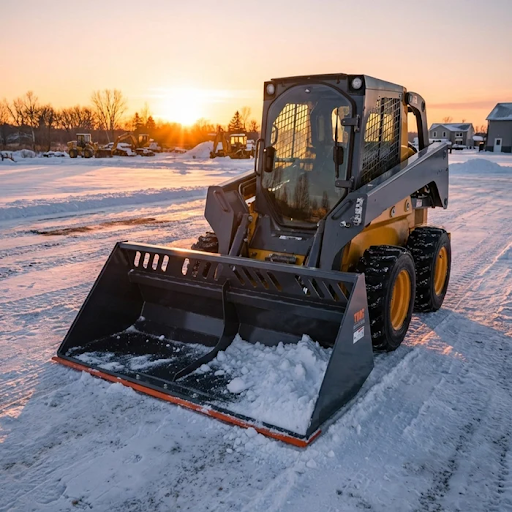
Snow removal contractors and landscape crews across the snow belt run the same attachment for two completely different materials, and the autumn changeover is when the mismatch shows up. A bucket sized for mulch and compost handles snow comfortably, while one sized by weight for aggregate will be half empty on both.
Density Is the Whole Specification
Why a Dirt Bucket Comes Up Short
A standard dirt bucket is sized so that a full load roughly matches what the loader can lift. Mulch weighs a fraction of what wet sand does, so filling that same bucket with mulch produces a load well under the machine’s capacity and a cycle that moves far less material than it could have.
Bigger Is the Answer
A skid steer mulch bucket solves it simply by being physically larger. More cubic yards per scoop at the same lift rating means fewer cycles for the same pile, and over a day of loading compost or blowing snow into a heap that arithmetic is the entire productivity story.
The Limit Is the Wrong Material
A light material bucket loaded with wet aggregate will exceed the loader’s rating before it is full, and the machine reports that as a lifted rear end rather than as a refusal to lift. Knowing which bucket is currently fitted matters more than it sounds on a shared yard.
Width Adds a Second Constraint
A bucket wider than the machine’s tracks protects the tires from the pile, and it also makes the attachment the widest point on the machine. That changes how the operator has to judge clearances in a yard full of parked vehicles and loading docks.
The Cutting Edge and How It Works
Bolt-On Rather Than Teeth
These buckets scrape a surface clean rather than digging into it, which is why a bolt-on cutting edge rather than welded teeth is normal here. A straight edge gets under a pile of mulch or a layer of snow and leaves the pavement behind it clear.
Edge Material Follows the Surface
Steel scrapes hardpack and ice effectively, and it will also mark concrete and catch at paver joints. A rubber or polyurethane edge protects finished surfaces and wears faster, and a snow bucket working a sealed parking lot usually ends up with the softer option fitted.
Back-Dragging Earns Its Place
Pulling the bucket backward with the edge down clears the strip against a building that no forward pass can reach. On a tight commercial site this is the single most used technique of the night, and a flat-bottomed bucket is what makes it work.
Where Eighty-Four Inches Helps and Hurts
On open pavement the wide bucket is straightforwardly better: fewer passes, less overlap, and a cleaner surface on the first run. That is exactly what a contractor billing by the lot wants on a route with a dozen stops.
The width turns against you in three places:
- Loading docks and between parked vehicles
- Greenhouse and barn aisles
- Gateways on residential properties
- Anywhere a spotter is not available
Operators running mixed sites generally keep a narrower skid steer bucket alongside and accept the changeover. Visibility over a tall light material bucket is the trade nobody mentions, because a high back plate holds more material and blocks more of the view forward.
Loading Without Tipping the Carrier
Load Center, Not Just Weight
A full bucket extended forward puts its mass further from the machine than the same load carried tucked in, and a light material bucket has a long load center by design. That is where stability goes rather than at the lift cylinder.
The Habit That Fixes It
Carry the bucket low and tucked while traveling, and raise it only once you are at the pile. That habit costs nothing and removes the condition in which a loaded machine tips forward on a slope or over the soft edge of a lot.
Overhead Needs a Spotter
Raising a wide bucket near a building, a power service or a greenhouse frame puts the widest part of the machine where the operator cannot see it. A spotter is the accepted answer on any site where that happens repeatedly.
Where Bucket Design Is Going
The direction is toward bolt-on edge systems that let one bucket serve several surfaces, and toward high-visibility back plates that recover some of the sightline lost to capacity. Quick-attach standardization has already made swapping between a dirt bucket and a light material bucket a one-minute job.
For a contractor the useful framing is cubic yards per hour rather than bucket size. TMG Industrial lists struck capacity, width and edge type together, which allows a bucket to be matched to the material and the machine instead of to a nominal dimension.