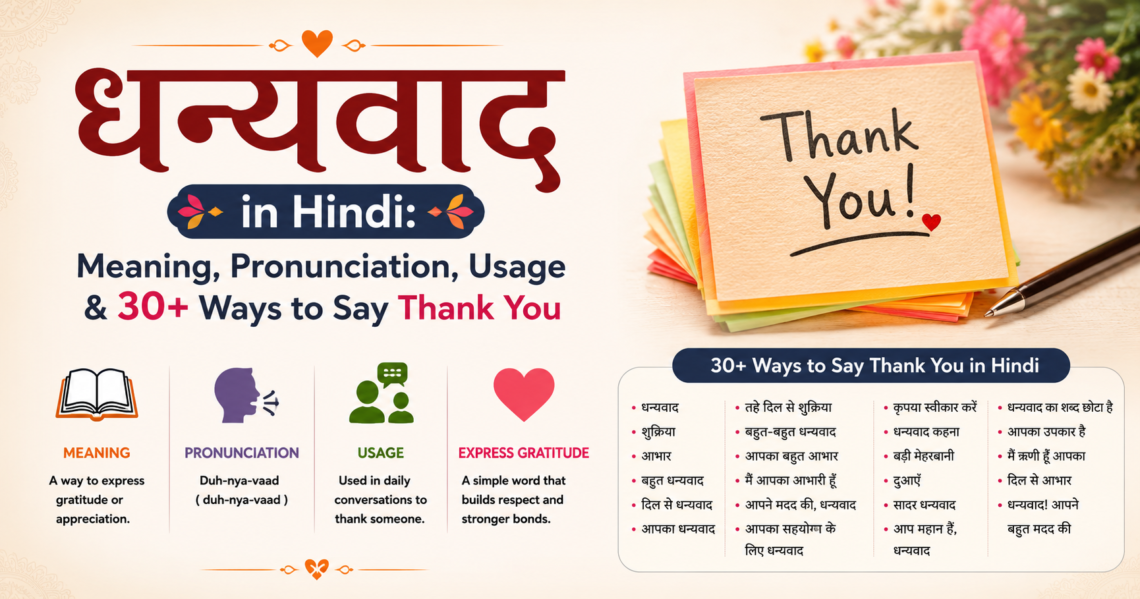
Dhanyawad (धन्यवाद) is the formal Hindi word for “thank you.” It’s pronounced dhun-yuh-vaad (IPA: /d̪ʰənjaːʋaːd̪/) and is used to express gratitude in respectful, professional, or elder-facing situations — similar to how “thank you very much” sounds more formal than a casual “thanks” in English.
It’s spelled several ways in English script — dhanyavad, dhanyawad, dhanyavaad, dhanyabad — all referring to the same Devanagari word: धन्यवाद. There’s no single “correct” romanization; Hindi doesn’t have official English spelling rules, so all four are widely accepted.
Quick Answer Box
| Question | Answer |
| How do you say thank you in Hindi? | Dhanyawad (धन्यवाद) — formal, or Shukriya (शुक्रिया) — informal |
| How is dhanyawad pronounced? | dhun-yuh-vaad (stress on the second syllable) |
| Is dhanyawad formal or casual? | Formal / respectful |
| What’s the informal version? | Shukriya (शुक्रिया) |
| How do you reply to dhanyawad? | “Koi baat nahi” (कोई बात नहीं) or “Aapka swagat hai” (आपका स्वागत है) |
| What language does dhanyawad come from? | Sanskrit — dhanya (धन्य, “blessed/fortunate”) + vāda (वाद, “expression/utterance”) |
The Meaning and Origin of Dhanyawad
Dhanyawad is a Sanskrit tatsama word (a word borrowed directly from Sanskrit into Hindi without change) built from two roots:
- धन्य (dhanya) — meaning “blessed,” “fortunate,” or “worthy”
- वाद (vāda) — meaning “speech,” “expression,” or “declaration”
Put together, dhanyawad literally translates to something closer to “an expression of feeling blessed” — which is a beautiful, more poetic origin than the English “thank you” (which comes from “think,” as in “I will think of you kindly”). Because it’s a Sanskrit-derived word, dhanyawad carries a slightly more formal, literary weight in Hindi than everyday spoken words — the same way “gratitude” feels heavier than “thanks” in English.
The word is shared, with the same spelling and meaning, across Hindi and Nepali, and closely related forms exist in Marathi (dhanyavaad) and several other Sanskrit-influenced Indian languages.
Dhanyawad vs. Shukriya: What’s the Difference?
This is one of the most searched follow-up questions, so here’s the direct answer.
| Dhanyawad (धन्यवाद) | Shukriya (शुक्रिया) | |
| Origin | Sanskrit | Arabic/Persian (via Urdu) |
| Register | Formal, respectful | Casual, everyday |
| Best used with | Elders, teachers, bosses, strangers, formal writing, speeches | Friends, family, peers, casual conversation |
| Common in | Hindi-medium formal contexts, written Hindi, news, official speech | Everyday spoken Hindi/Urdu, Bollywood dialogue, texting |
| Example | “Aapke sujhaav ke liye dhanyawad” (Thank you for your suggestion) | “Shukriya yaar, tune meri madad ki” (Thanks buddy, you helped me) |
Neither word is “more correct” — they’re register choices, much like “thank you” versus “thanks a bunch” in English. Since Hindi and Urdu share a huge amount of everyday vocabulary (Hindustani), shukriya is understood and used comfortably by Hindi speakers even though it isn’t Sanskrit-origin.
How to Pronounce Dhanyawad Correctly
Breaking it into syllables: dhun-yuh-vaad
- dhun — like “done” but with a soft “dh” (tongue touches upper teeth, breathy)
- yuh — quick, like the “yu” in “yucca”
- vaad — rhymes with “cod,” with the “v” pronounced closer to a soft “w”
Native speakers often compress it slightly in fast speech to sound like “dhun-yavaad,” and in very casual contexts it’s sometimes shortened to just “dhanyawad!” with rising intonation, similar to how English speakers say “thanks!” quickly.
30+ Ways to Say Thank You in Hindi
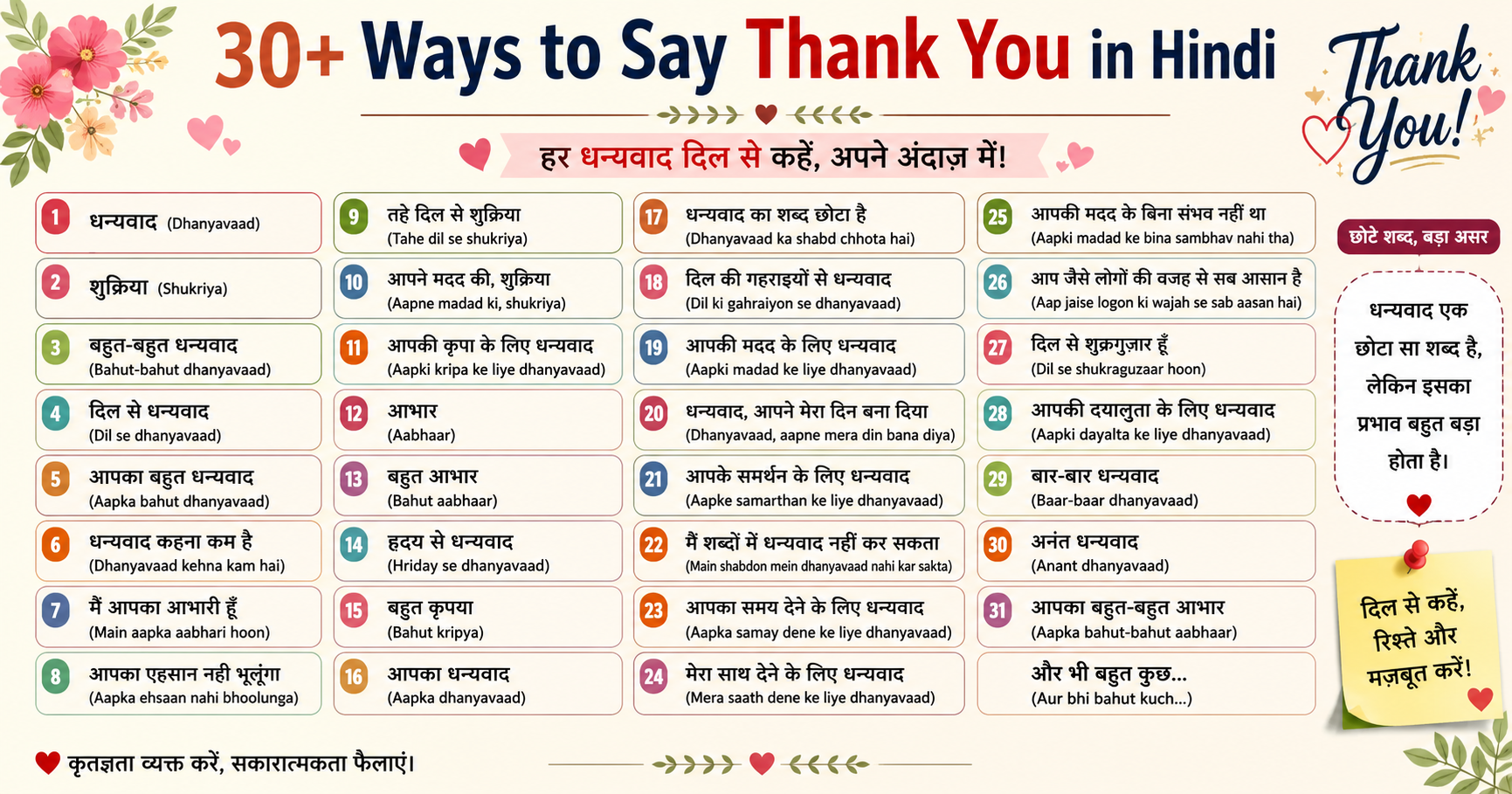
Here’s a categorized list — far more comprehensive than a basic dictionary entry — covering different intensities and social contexts.
Basic and Formal
- धन्यवाद (Dhanyawad) — Thank you
- बहुत धन्यवाद (Bahut dhanyawad) — Thank you very much
- आपका बहुत-बहुत धन्यवाद (Aapka bahut-bahut dhanyawad) — Thank you so, so much (very formal)
- आपका आभार (Aapka aabhaar) — I’m grateful to you (formal/literary)
- आपके प्रति आभारी हूँ (Aapke prati aabhaari hoon) — I am grateful toward you
- मैं आपका आभारी/आभारी हूं (Main aapka abhari hoon) — I am indebted/thankful to you
- सादर धन्यवाद (Saadar dhanyawad) — Respectful thanks (used in formal letters/emails)
Casual and Everyday
- शुक्रिया (Shukriya) — Thanks
- बहुत शुक्रिया (Bahut shukriya) — Thanks a lot
- थैंक यू (Thank you) — Borrowed English, used casually all the time
- थैंक्स (Thanks) — Borrowed, very casual, common among younger speakers
Heartfelt / Emotional
- दिल से धन्यवाद (Dil se dhanyawad) — Thank you from the heart
- तहे दिल से शुक्रिया (Tahe dil se shukriya) — Thanks from the bottom of my heart
- आपका एहसान कभी नहीं भूलूंगा/भूलूंगी (Aapka ehsaan kabhi nahi bhoolunga/bhoolungi) — I’ll never forget your kindness
For Specific Situations
- आपकी मदद के लिए धन्यवाद (Aapki madad ke liye dhanyawad) — Thank you for your help
- समय देने के लिए धन्यवाद (Samay dene ke liye dhanyawad) — Thank you for giving your time
- उपहार के लिए धन्यवाद (Uphaar ke liye dhanyawad) — Thank you for the gift
- शुभकामनाओं के लिए धन्यवाद (Shubhkamnaye ke liye dhanyawad) — Thank you for your wishes
- आमंत्रण के लिए धन्यवाद (Aamantran ke liye dhanyawad) — Thank you for the invitation
- सहयोग के लिए धन्यवाद (Sahyog ke liye dhanyawad) — Thank you for your cooperation/support
Religious / Devotional Register
- ईश्वर का धन्यवाद (Ishwar ka dhanyawad) — Thanks to God
- भगवान का लाख-लाख शुक्र है (Bhagwan ka laakh-laakh shukra hai) — Thank God (a hundred thousand times)
In Writing (Letters, Emails, Cards)
- सधन्यवाद (Sadhanyawad) — “With thanks” (used as a formal sign-off)
- कृपया मेरा धन्यवाद स्वीकार करें (Kripya mera dhanyawad sweekar karein) — Please accept my thanks
- धन्यवाद सहित (Dhanyawad sahit) — With thanks (formal letter closing)
How to Respond When Someone Says Dhanyawad
Hindi doesn’t have one single fixed equivalent of “you’re welcome” — several natural options exist depending on formality:
- कोई बात नहीं (Koi baat nahi) — “It’s nothing” / “No worries” (most common, casual-to-neutral)
- आपका स्वागत है (Aapka swagat hai) — “You’re welcome” (formal, slightly literal translation of the English phrase, common in customer service)
- इसमें धन्यवाद की कोई बात नहीं (Isme dhanyawad ki koi baat nahi) — “There’s no need to thank me for this”
- यह तो मेरा फर्ज़ था (Yeh to mera farz tha) — “It was my duty/obligation” (used when someone thanks you for help)
- अरे, कोई बात नहीं! (Are, koi baat nahi!) — casual, warm, with a filler word for friendliness
Dhanyawad Shayari and Quotes (Popular Short Examples)
Thank-you shayari (short rhyming verses) is a very popular Hindi cultural format for expressing gratitude on birthdays, social media captions, and WhatsApp status updates. A few original example styles:
- Aapke saath ka har pal khaas hai, / itni mohabbat dene ke liye dhanyawad. — “Every moment with you is special; thank you for giving so much love.”
- Shabdon mein bayan nahi kar sakta yeh ehsaan, / dil se nikla hai yeh dhanyawad. — “I can’t put this kindness into words; this thanks comes straight from the heart.”
- Zindagi ke har mod par saath dene ke liye, / tahe dil se shukriya aur dhanyawad. — “For standing by me at every turn in life, heartfelt thanks and gratitude.”
(If you want, I can write a larger original shayari/quotes collection as a separate section or standalone article — that’s a strong secondary content cluster for internal linking.)
Cultural Context: When to Use Dhanyawad vs. Other Expressions
- Indians and Hindi speakers say thank you less reflexively than in Western cultures — among close family, gratitude is often shown through actions rather than words, and constant “thank yous” between family members can even feel oddly formal or distant.
- Dhanyawad is expected in professional emails, public speeches, on-air broadcasting, teacher-student interactions, and customer service.
- Shukriya dominates in Bollywood films, everyday conversation, and youth culture.
- Namaste is a greeting, not a thank-you — a common confusion for learners. Namaste means “I bow to you” and is used for hello/goodbye, not gratitude.
Frequently Asked Questions
What does dhanyawad mean in English?
Dhanyawad means “thank you” in English. It’s the formal way to express gratitude in Hindi.
Is dhanyawad the same as dhanyavad?
Yes. Dhanyawad, dhanyavad, dhanyavaad, and dhanyabad are all different English spellings of the same Hindi word: धन्यवाद.
What is the difference between dhanyawad and shukriya?
Dhanyawad is formal and Sanskrit-derived; shukriya is casual and Arabic/Persian-derived. Both mean “thank you,” but dhanyawad suits elders, professionals, and formal writing, while shukriya suits friends and everyday speech.
How do you say “thank you very much” in Hindi?
“Bahut dhanyawad” (बहुत धन्यवाद) for formal contexts, or “bahut shukriya” (बहुत शुक्रिया) for casual ones. “Bahut-bahut dhanyawad” adds even more emphasis.
What is the reply to dhanyawad in Hindi?
The most common replies are “koi baat nahi” (कोई बात नहीं, “no worries”) and “aapka swagat hai” (आपका स्वागत है, “you’re welcome”).
Is namaste and dhanyawad the same?
No. Namaste is a greeting used for hello and goodbye, meaning “I bow to you.” Dhanyawad is specifically used to say thank you.
How do you write dhanyawad in Hindi script?
धन्यवाद
Can I say “thank you” in Hindi using English words?
Yes — many Hindi speakers casually say “thank you” or “thanks” (borrowed directly from English), especially in urban areas and among younger speakers. It’s understood everywhere but is more casual than dhanyawad.
Read more: 400+ Best Mother’s Day Captions for Instagram (2026) – Short, Funny, Heartfelt & Unique