If you’ve lived in a Raleigh home for more than a few years, you’ve probably wondered at some point whether your air ducts need cleaning. Maybe it’s the dust that resettles on the shelves a day after you wipe them down, or a musty smell that kicks on with the HVAC system, or just the fact that nobody can remember the last time anyone looked inside those ducts. Air duct cleaning in Raleigh, NC comes up a lot in home maintenance conversations here, partly because of how mixed the local housing stock is: century-old bungalows Inside the Beltline, mid-century ranches in established neighborhoods, and new construction with two-system HVAC setups all accumulate debris differently.
This guide walks through when duct cleaning actually makes sense, what a professional visit typically involves, and how to avoid the upsell tactics that give the industry a bad reputation.
Do You Actually Need Air Duct Cleaning?
This is the question worth answering honestly before spending any money. The EPA has been fairly direct on this point: duct cleaning hasn’t been shown to prevent health problems in most homes, and routine cleaning on a fixed schedule isn’t necessary for everyone. That’s a more conservative stance than a lot of companies in this space are willing to admit, but it’s the accurate one.
There are, however, a handful of situations where cleaning genuinely helps:
- Visible mold growth inside the ducts or on other HVAC components
- Ducts infested by rodents or insects, with nesting debris inside the system
- Excessive dust or debris actually blowing out of the supply registers when the system runs
- A home renovation that filled the ductwork with drywall dust or sawdust
- Moving into an older home where the duct history is unknown
If none of those apply, a good technician should tell you that outright rather than pushing a service you don’t need. That kind of straight answer is a decent litmus test for whether a company is worth trusting with the rest of your HVAC system.
Why Raleigh’s Housing Mix Changes the Duct Cleaning Job
One thing that’s easy to overlook: Raleigh doesn’t have one typical duct system. Homes closer to the urban core, especially those built between the 1920s and 1950s, often have retrofitted ductwork that wasn’t part of the original construction. That kind of system needs a gentler, slower approach so aging metal or flex duct isn’t damaged during cleaning.
Mid-century ranches and condos further out tend to have more standard installations, so cleaning them tends to be the fastest, most straightforward job in the lineup, since the ductwork was installed as a single system rather than pieced together over decades. Newer construction is its own category entirely: these homes frequently run two separate air handlers for upstairs and downstairs zones, which means two systems to inspect and, often, two separate quotes. Builders also leave a surprising amount of construction dust inside new ductwork, so a home doesn’t have to be old to need a first cleaning.
Two-story homes with upstairs laundry rooms bring their own wrinkle, too: dryer vent runs in these layouts sometimes get disconnected in the attic during other work, which is a fire risk worth catching early rather than discovering later.
Because the right approach genuinely depends on which of these categories a home falls into, it’s worth working with local duct cleaning specialists who service enough Raleigh neighborhoods to know the difference on sight, rather than a company applying the same process to every job regardless of housing type.
What a Professional Duct Cleaning Visit Looks Like
A legitimate service call generally follows a similar sequence regardless of who you hire:
- Inspection first. A technician should look at the actual condition of the ducts, explain what they’re seeing, and quote the job before touching anything, not after.
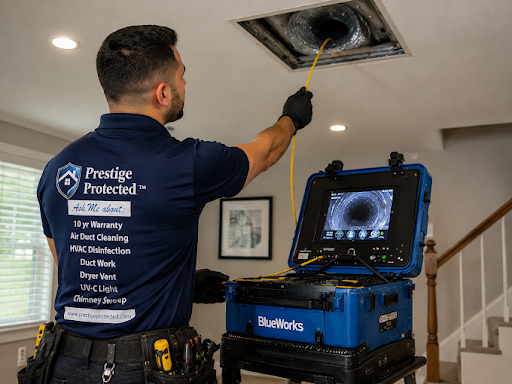
- Source-removal cleaning. This means physically dislodging debris with rotating brushes and pulling it out with a high-powered, HEPA-filtered vacuum running under negative pressure, so loosened dust travels toward the vacuum instead of into the living space.
- Coverage of the full system. That includes supply and return ducts, registers, trunk lines, and the blower compartment, not just the parts that are easy to reach.
- Documentation. Photos before and after the work give homeowners a way to actually see what was removed, rather than taking someone’s word for it.
If a company skips the inspection and goes straight to a flat-rate cleaning, or can’t show you what came out of your ducts, that’s worth a second look.
Don’t Forget the Dryer Vent
Air duct cleaning and dryer vent cleaning get lumped together, but they’re separate systems that serve different purposes, and dryer vents carry a real fire risk that regular ductwork doesn’t. The U.S. Fire Administration attributes roughly 2,900 home dryer fires a year to lint buildup, with failure to clean the vent as the leading contributing factor, and those fires cluster in fall and winter when dryers are working hardest.
A vent that needs attention usually announces itself in one of a few ways: laundry that’s still damp after a full cycle, the outside of the dryer feeling hotter than normal to the touch, or lint visibly collecting around the exterior vent hood rather than staying inside the trap. A proper cleaning covers the transition hose behind the machine, the full duct run to the exterior wall, and the hood and flap outside, usually finishing with an airflow check to confirm it actually worked. Most standard vent runs take 30 to 90 minutes; longer or more winding runs can take up to two hours. Once a year is a reasonable baseline for most households, more often if there’s a large family, pets, or a long vent run.
Questions Worth Asking Before You Book Air Duct Cleaning
A few questions tend to separate companies that do the job right from ones that don’t:
- Will you inspect first and give me an itemized quote before starting?
- What equipment do you use, and is the vacuum HEPA-filtered?
- Will I get before-and-after photos?
- Is my home a two-system setup, and does that change the quote?
- What’s your experience with older, retrofitted ductwork specifically?
Local companies familiar with Raleigh’s mix of older Inside-the-Beltline homes, standard mid-century installations, and newer multi-system construction (Prestige Protected is one example) tend to give more accurate answers to these questions than a national chain quoting sight unseen, since the right approach genuinely differs by housing type. For homes with a laundry room upstairs, it’s also worth asking specifically about a dryer vent inspection rather than assuming it’s automatically included in a duct cleaning visit. The two jobs are related but not identical, and the vent run is where the fire risk actually lives.
Common Duct Cleaning Sales Tactics Worth Recognizing
Because duct cleaning is hard for most homeowners to evaluate firsthand (you can’t easily see inside your own ductwork), it’s also an industry with a reputation for pressure tactics. A few patterns are worth knowing before anyone shows up at the door:
- The “your ducts are filthy” phone pitch. No legitimate technician can assess duct condition over the phone or from a coupon mailer. Any pricing or urgency claim before an actual inspection is a sales tactic, not an assessment.
- The unbelievably low advertised price. A $99-whole-house special is almost always a lead-generation offer, with the real price appearing once a technician is already in the attic and finds “additional” work needed.
- Health guarantees. Claims that cleaning will cure allergies, asthma, or chronic illness go well beyond what the EPA’s own guidance supports. A company willing to make that promise is a company willing to skip the parts of the job that don’t show up in a sales pitch.
- No photos, no proof. If a company can’t or won’t show before-and-after images of what came out of the ductwork, there’s no way to confirm the work was actually done thoroughly.
- Refusal to itemize. A flat “whole house” price with no breakdown by system makes it hard to know whether both air handlers in a two-system home were actually serviced.
None of this means duct cleaning itself is a scam category. It means the job is worth booking with the same scrutiny as any other home service where the work happens somewhere the homeowner can’t easily verify it.
Frequently Asked Questions
How much does air duct cleaning cost in Raleigh, NC?
Industry cost guides put a typical single-system cleaning at $450 to $1,000, and that number should roughly double for any home running two air handlers, since it’s two separate jobs rather than one.
How often should air ducts be cleaned?
There’s no universal schedule. Cleaning makes sense when there’s visible mold, pest infestation, or excessive dust, not on a fixed yearly calendar the way HVAC filter changes work.
Is duct cleaning worth it for allergies?
It can help in specific cases, like homes with pet dander buildup or after a renovation, but the EPA is clear that it hasn’t been shown to prevent health problems as a general rule. Anyone dealing with ongoing allergy symptoms should treat duct cleaning as one possible factor, not a guaranteed fix.
How long does a duct cleaning appointment take?
Most single-system homes take a few hours from inspection through cleanup. Two-system homes or older retrofitted ductwork can take longer.
Is dryer vent cleaning included in air duct cleaning?
Not usually. They’re typically quoted and performed as separate services, since a dryer vent run is a different type of ductwork with different fire-safety stakes.
Homeowners doing this kind of research generally do better hiring someone who can explain why a job is or isn’t needed, rather than someone who wants to schedule immediately. That one conversation upfront tends to say more about a company than anything on its website.
Prestige Protected is an air duct and dryer vent cleaning company serving Cary, Raleigh, and the greater Triangle area of North Carolina. The company specializes in HEPA-filtered, source-removal duct cleaning with photo-documented results, and its technicians are EPA certified and HVAC Excellence certified.