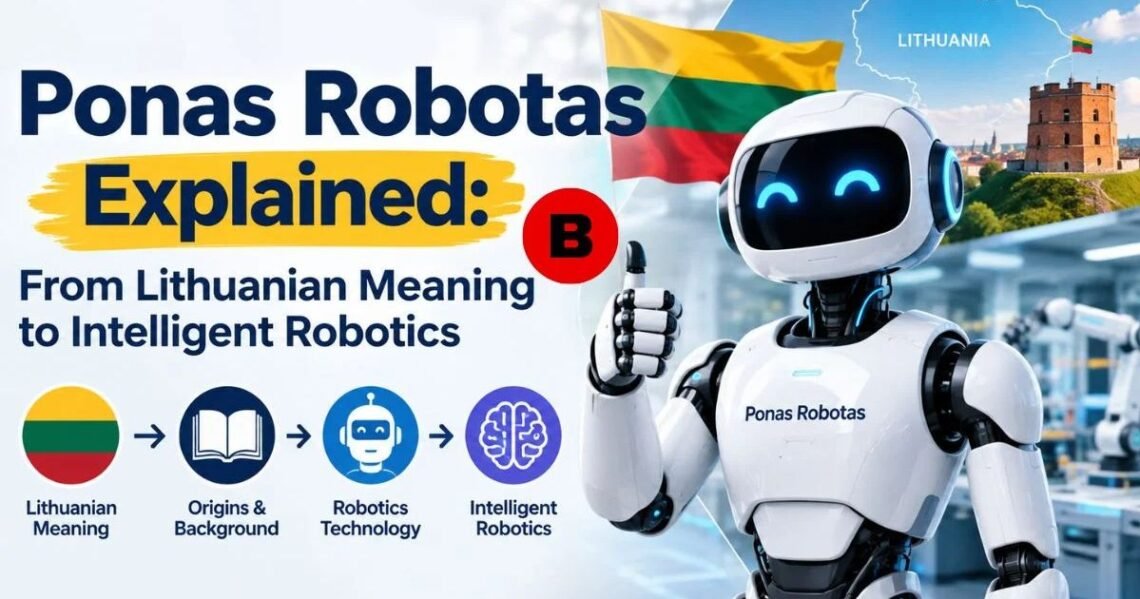
Ponas Robotas is a Lithuanian phrase that translates into English as “Mr. Robot.” Although the words may sound like the name of a modern robot, artificial intelligence tool, or advanced technology platform, the phrase has a more specific linguistic and cultural meaning. It is closely associated with the Lithuanian title of the American television series Mr. Robot, a psychological thriller known for its exploration of hacking, cybersecurity, digital privacy, corporate power, and human identity.
Interest in Ponas Robotas brings together several topics. Some people want to understand the Lithuanian translation, while others are searching for information about the television series, its characters, its storyline, or the technology featured in it. The word robot also encourages broader questions about artificial intelligence, automation, and the role of intelligent machines in everyday life.
Understanding these connections makes it easier to separate the phrase’s established meaning from assumptions about modern technology. Ponas Robotas is not, by itself, the recognized name of a particular AI model, robot manufacturer, or technical robotics category.
This guide explains the meaning of Ponas Robotas, its linguistic origins, its connection with the television series, the show’s major themes, and the real-world technology concepts that make the subject relevant today.
What Does Ponas Robotas Mean?
Ponas Robotas is a Lithuanian expression that translates directly to “Mr. Robot” in English. It combines two words that each have a straightforward meaning.
- Ponas: A respectful form of address similar to “Mr.” or “Sir.”
- Robotas: The Lithuanian word for “robot.”
When these words appear together, they form a phrase that gives a robot a human-style title. The translation is simple, but its meaning can change slightly depending on the context in which it appears.
For example, someone discussing Lithuanian vocabulary may use Ponas Robotas simply to explain the translation of the two words. A television viewer may use the phrase when searching for the series known in English as Mr. Robot. Someone interested in robotics might interpret it as a descriptive name for a machine or a fictional robotic character.
These interpretations are not automatically interchangeable. The original phrase has a clear linguistic meaning, while a particular product, fictional character, or technology project would require additional context to identify.
The most recognizable cultural association is the television series Mr. Robot. Its Lithuanian-language title helps explain why the phrase appears in searches connected with entertainment, cybersecurity, and technology.
Why Is the Phrase Written as Two Words?
Ponas Robotas consists of a title followed by a noun. The first word provides a respectful form of address, while the second identifies the subject as a robot.
This construction is easy to understand once the Lithuanian vocabulary is clear. English speakers are familiar with expressions such as Mr. Smith or Mr. President, in which a title comes before a name or role. Ponas Robotas follows a similarly understandable pattern, although the grammar belongs to Lithuanian.
The capitalization may vary depending on whether the phrase appears at the beginning of a sentence, in a title, or in ordinary text. When used as a title or named subject, writers commonly capitalize both words.
What Is the Simplest English Translation?
The most direct translation is “Mr. Robot.” “Sir Robot” may also help communicate the general idea of the words, but “Mr. Robot” is the more familiar English rendering.
It is important not to assign additional technical meanings to the translation. The phrase does not automatically mean an intelligent robot, a self-learning machine, a virtual assistant, or an autonomous system. Those descriptions would depend on the particular machine or fictional concept being discussed.
What Is the Origin of Ponas Robotas?
The phrase can be understood by separating its linguistic background from its connection with popular culture.
Linguistically, Ponas Robotas is built from Lithuanian vocabulary. Ponas provides the respectful title, and robotas identify the machine. The expression does not need a complicated historical explanation to make sense.
Its cultural significance is more closely connected with the television series Mr. Robot. The show became widely recognized for combining a suspenseful fictional story with subjects drawn from computing, cybersecurity, online anonymity, and the influence of large corporations.
As viewers encountered the series in different countries and languages, localized titles helped make it accessible to local audiences. Ponas Robotas is associated with the Lithuanian-language presentation of the series.
This connection explains why a search for the phrase may lead to questions about a television drama rather than information about a physical robot.
There is an important distinction here: the phrase itself is not evidence of a separate technology invention. A translated title, a fictional name, and the official name of a commercial product are different things. Confusing them can create unnecessary uncertainty about what Ponas Robotas actually refers to.
Ponas Robotas and the Mr. Robot Television Series
The American television series Mr. Robot is the strongest cultural connection associated with the phrase Ponas Robotas. Created by Sam Esmail, the series follows Elliot Alderson, a cybersecurity engineer who becomes involved in hacking activities and a larger conflict involving corporate power and digital systems.
The show premiered in 2015 and concluded in 2019. It ran for four seasons and became known for its distinctive visual style, psychological storytelling, complicated characters, and serious treatment of technology-related subjects.
Rather than presenting hacking as a simple contest between a hero and a villain, the series explores the motivations, personal struggles, and ethical questions behind digital actions. It combines technical problems with a story about trust, social inequality, privacy, control, and identity.
The title Ponas Robotas connects Lithuanian-speaking audiences with the same central story. It does not describe a separate television production or necessarily identify an actual robotic machine.
What Is the Story of Mr. Robot?
The story centers on Elliot Alderson, a skilled cybersecurity professional who works for a company that helps protect computer systems. Outside his professional role, he uses his technical knowledge to investigate people and systems, exposing weaknesses that others might overlook.
Elliot’s life changes when he encounters a mysterious figure known as Mr. Robot. This character draws him into a group of hackers called fsociety, whose members want to challenge the power of major corporations.
Their plans involve digital attacks, financial records, and the consequences of disrupting systems on which individuals and businesses depend. As the story develops, the series explores the difference between wanting to change an unfair system and understanding the harm that radical actions can cause.
The plot also focuses on Elliot’s personal experiences. His relationships, emotional struggles, and changing understanding of events are central to the narrative. Technology is important, but the show is not simply a technical demonstration of hacking methods.
Its combination of suspense, psychology, and social commentary gives the series a broader appeal than a conventional crime drama.
Who Is Elliot Alderson?
Elliot Alderson is the central character in Mr. Robot, portrayed by actor Rami Malek. He works in cybersecurity and possesses advanced computer skills, but his professional abilities exist alongside serious personal difficulties.
Elliot is observant, intelligent, and deeply suspicious of the institutions around him. He questions the motives of corporations, struggles to connect with other people, and frequently examines the relationship between his own perceptions and reality.
These characteristics make him an unusual television protagonist. His technical expertise gives him access to digital systems, while his personal experiences influence how he interprets the world.
The series uses Elliot’s perspective to explore how isolation, mistrust, and the desire for control can affect a person’s decisions. His character also demonstrates that technical intelligence does not automatically provide emotional certainty or ethical clarity.
Read more: Unity Leather Card Wallet: Features, Design, Benefits, and Buying Guide
Who Is Mr. Robot?
Mr. Robot is a major character portrayed by Christian Slater. He is closely associated with the hacker group fsociety and plays an important role in Elliot’s journey.
The character’s significance extends beyond his involvement in hacking. His relationship with Elliot is central to the show’s psychological structure, and the series gradually reveals additional information that changes how viewers understand their interactions.
The name itself makes sense in the context of the Lithuanian phrase. Mr. Robot becomes Ponas Robotas when the title is expressed in Lithuanian, connecting the character with the phrase’s direct English meaning.
However, Mr. Robot should not be confused with a real-world AI assistant or a commercially available robot. He is a fictional character within the television series.
Main Themes Explored in Ponas Robotas
Although Ponas Robotas is a translation and cultural reference, its association with Mr. Robot introduces several subjects that remain relevant to modern technology discussions.
Cybersecurity and Hacking
Cybersecurity is one of the series’ central themes. The story explores weaknesses in computer systems, unauthorized access, digital investigations, and the potential consequences of attacks against organizations.
Hacking is not presented as a purely technical activity. The show also examines motivation, responsibility, secrecy, and the effect of digital actions on ordinary people.
In real life, cybersecurity professionals work to protect networks, software, devices, and sensitive information. Their work may involve identifying vulnerabilities, investigating suspicious activity, testing security controls with authorization, and helping organizations recover from incidents.
The distinction between authorized security testing and illegal access is essential. A person may use similar technical knowledge in different ways, but permission, purpose, and the methods used determine whether an activity is legitimate.
Privacy and Digital Identity
The series asks how much personal information people reveal through their digital activities. Online accounts, financial services, communications, and connected devices can create records that reveal details about a person’s life.
This theme is relevant because many everyday activities now depend on digital services. People use phones for banking, shopping, communication, navigation, work, and entertainment. Each activity can involve different forms of data collection and storage.
Digital privacy involves understanding what information is collected, who can access it, how long it is retained, and whether it is shared with other parties.
Ponas Robotas, through its association with Mr. Robot, can therefore lead readers toward a broader discussion of privacy and the responsibilities of people and organizations that manage digital information.
Corporate Power and Financial Systems
Another important theme is the influence that large corporations can have on individuals and society. The fictional organizations in the series control important services and resources, making their decisions consequential for many people.
The story uses this setting to question what happens when economic power becomes concentrated and when ordinary people have limited control over the systems they depend on.
These themes are dramatized for entertainment. The fictional events should not be treated as a literal description of how every real financial institution or corporation operates.
Nevertheless, the underlying questions are relevant. Businesses must consider data protection, accountability, service reliability, consumer rights, and the social consequences of their decisions.
Identity and Psychological Complexity
Mr. Robot is also a psychological drama. Elliot’s understanding of himself and other people changes throughout the story, and viewers are encouraged to question how much they can trust his perspective.
The series explores isolation, memory, perception, trauma, and the ways personal experiences can influence behavior. These subjects help explain why the show attracts viewers who are interested in psychological storytelling as well as technology.
The title Ponas Robotas may sound like a story about a machine, but the series is fundamentally concerned with people and the systems they create. Its central conflicts involve human choices, relationships, beliefs, and consequences.
Is Ponas Robotas a Real Robot or Artificial Intelligence System?
No evidence establishes Ponas Robotas, by itself, as the official name of a specific commercial robot, recognized AI model, or established robotics technology category.
The phrase translates to “Mr. Robot,” and its clearest cultural association is the television series. Someone may use the words as a nickname for a machine, a fictional character, a classroom project, or a creative technology brand, but such use would not make the phrase the recognized name of a particular product.
This distinction matters because words associated with robots and artificial intelligence are often used broadly in online discussions. A title that sounds technological is not proof that a corresponding product exists.
To verify a claim about a specific robot or AI tool, look for concrete information such as the manufacturer’s identity, the product’s official name, its documented capabilities, and reliable technical specifications.
Without those details, it is more accurate to explain Ponas Robotas as a Lithuanian expression and a cultural reference than to describe it as a newly developed machine.
How Is a Robot Different From Artificial Intelligence?
A robot is generally a physical machine designed to perform tasks. It may move through an environment, manipulate objects, carry equipment, or carry out repetitive operations.
Artificial intelligence, commonly called AI, refers to computational methods that perform tasks such as recognizing patterns, processing language, making predictions, or generating responses.
The two concepts can work together, but they are not identical.
For example, a robotic arm on a factory production line may repeat a carefully programmed sequence without using advanced AI. A chatbot can use AI to answer questions without having a physical body. An autonomous mobile robot may combine sensors, control software, and AI-based perception to navigate an environment.
Consequently, the word robotas in Ponas Robotas does not establish whether a machine uses artificial intelligence. That question can only be answered by examining a particular system.
Can Ponas Robotas Be Used as a Robot’s Name?
Yes. Anyone creating a fictional character, educational project, or personal robot could choose Ponas Robotas as a name. The expression is understandable as “Mr. Robot,” making it suitable for a character that is intended to sound formal, friendly, or memorable.
A teacher might use the name for a classroom robotics activity. A writer might create a robot character with this title. A developer might use it informally for a prototype.
These are possible uses of the phrase, not proof that a particular commercial product exists under that name.
Anyone considering it for a business or product should also check applicable trademark, domain, and naming requirements before adopting it commercially.





One comment on “Ponas Robotas: Meaning, Origins, Mr. Robot TV Series, and Technology Explained”