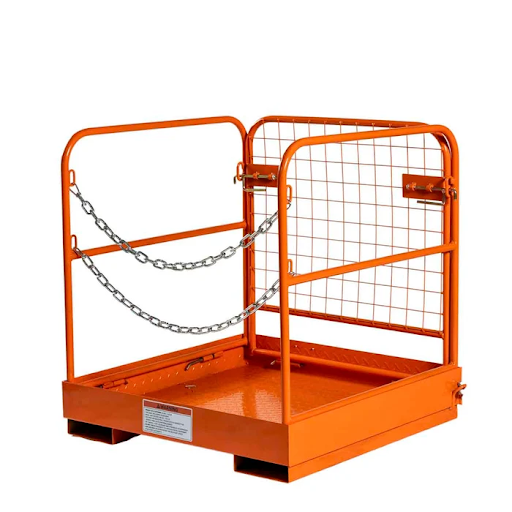
Lifting a person with a forklift looks like a solved problem the moment somebody welds a railing onto a steel box. The equipment that makes it defensible is specific, and almost none of it is about the railing. A forklift work platform carries requirements that a fabricated cage does not meet, and the difference shows up in exactly the situations the platform exists for.
The load center moves when the person does
A forklift carrying a work platform is rated at a stated load center, usually twenty four inches from the fork face. That rating assumes the weight sits in a predictable place, which is true of a pallet and false of a person.
Someone stepping to the outer edge of a platform shifts the center of gravity forward, and the truck loses capacity in proportion. The arithmetic matters most on an older machine already working near its limit at height, where a small forward shift is the difference between stable and tipping.
Retention is the item that gets left off
Fork pockets stop a forklift work platform sliding sideways. Nothing about them stops it sliding forward off the fork tips, which is what a retaining chain or a bolted collar is for. That single component is the most common omission on a shop built forklift safety cage. A platform tipped slightly nose down, which happens whenever the mast is tilted forward to reach something, needs a positive mechanical stop rather than friction and weight.
Floors, rails and the gaps between them
A non slip floor on a forklift work platform is doing more than preventing a stumble. It is the surface a person braces against while reaching outward, and a smooth plate with oil on it removes the one bit of grip that makes reaching safe.
Rail height is specified rather than chosen. A toe board matters just as much, because the hazard on an elevated work platform is rarely the occupant falling and often a tool leaving the floor onto somebody below.
Driving with a person raised is the line
Most jurisdictions draw the same distinction: raising a person is permitted under conditions, driving while they are raised is not. The reason is that a forklift steers from the rear and pivots around its front axle, so a direction change at height translates into a large swing at the top.
Four rules cover almost every requirement:
- Park, brake and neutral before raising
- Operator stays at the controls throughout
- No travel while the platform is elevated
- Inspect the platform before each use
The second one is the one that gets argued about. An operator leaving the seat removes the only person who can lower the platform in an emergency, and a person stranded at height is a worse problem than the job they went up to do.
Folding changes storage, not duty
A folding man cage earns its place in a small shop because it goes flat against a wall between uses. Folding hardware introduces hinges and pins that carry load, so the inspection before use has to include whether those pins are seated and secured.
Capacity on a folding unit describes the occupant plus tools plus materials. Eight hundred pounds sounds generous until two people with a toolbox and a length of conduit are standing in it, which is the realistic way these get loaded.
Where a platform beats the alternative
A scissor lift or a boom is the right tool for sustained work at height. A platform on a forklift suits short tasks in a building that already has a truck, where bringing in other equipment costs more than the job.
The honest limit is time. If a job takes a full day at height, the forklift is tied up and the operator is sitting still, and at that point renting the right machine is cheaper than it looks.
The pre use inspection that actually finds things
Most platform failures are visible before the lift. Welds at the rail junctions, the condition of the retaining hardware, and whether the fork pockets have spread from repeated loading are the three places wear concentrates.
Spread pockets are the quiet one. A pocket that has opened up by a few millimeters lets the platform rock on the forks, and that movement is read as normal flex until the day somebody notices how far the top rail travels.
Specification details worth reading
Platform dimensions, capacity and fork pocket size decide whether it fits the truck. Retention method, gate arrangement and whether the data plate carries a capacity rating decide whether it survives an inspection. TMG Industrial builds this one at thirty six by thirty six inches with an eight hundred pound capacity, hand rails and a non slip floor. Checking the truck capacity at the height the job needs, before the platform is bought, is what keeps the combination inside its rating.