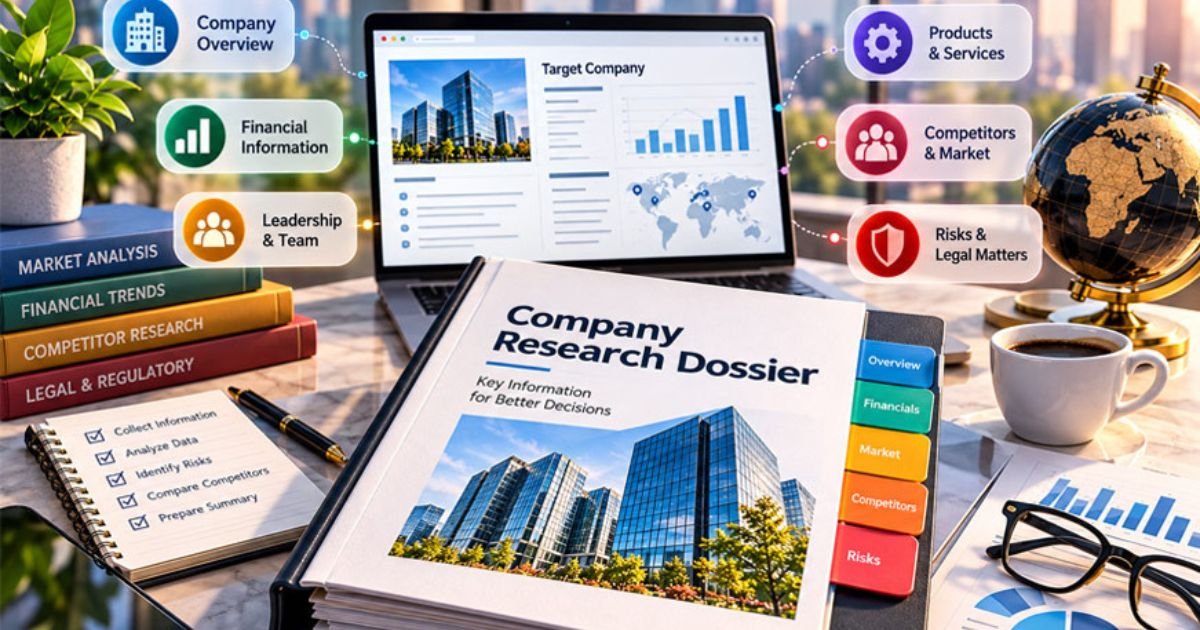
A research dossier for a target company is a structured collection of verified facts, analysis, and sources about one company, assembled to support a specific decision. Whether you are preparing for a job interview, checking out a vendor, evaluating an investment, or sizing up a competitor, the dossier turns scattered online information into one organized document you can actually use. This guide walks you through the full process: what a dossier contains, how to build one step by step, a field-by-field template you can copy and fill in, the best research strategies and sources, and the mistakes that ruin most company research.
Key Takeaways
- A research dossier is a decision-support document, not a data dump. Every section should serve the decision you are trying to make.
- Define your research objective before you open a single tab. Interview prep, vendor vetting, and investment analysis need different depths of the same dossier.
- Structure beats volume. A tight 16-section dossier with sources and confidence ratings is more useful than a 30-page pile of unfiltered facts.
- Verify with two independent sources before you put a fact in the dossier. Company websites describe how a company wants to be seen, not how it is.
- Update on a schedule, not when something breaks. A dossier older than six months should be re-verified before any important decision.
- The template below is genuinely fillable. Each section tells you exactly what to write and where to find it.
| Quick Fact | Detail |
|---|---|
| What it is | A structured, source-backed profile of a company built for one specific decision |
| Who uses it | Job seekers, investors, sales teams, procurement managers, analysts, founders, students |
| Typical length | 8 to 20 pages, depending on the decision and the company |
| Core sections | Executive summary, identity, history, offerings, business model, leadership, finances, market, competitors, operations, reputation, legal risks, opportunities, risks and gaps |
| Time to build | 3 to 6 hours for a standard job-seeker dossier; 15 to 40 hours for due-diligence depth |
| Most important rule | State your objective first, cite every fact, and rate your confidence in each claim |
| Update cadence | Refresh quarterly for companies you track; re-verify before every major decision |
What Is a Research Dossier for a Target Company?
A research dossier for a target company is a single organized document that answers one question: what do I need to know about this company to make a good decision? The word target matters here. You are not writing a general encyclopedia entry. You are researching one specific company because something is on the line: a job, a contract, money, a partnership, or a strategy call.
The dossier collects identity facts (legal name, ownership, size, locations), business facts (what they sell, how they make money, who their customers are), financial facts (revenue, funding, growth, debt), market facts (industry position, competitors, trends), people facts (leadership, board, key hires), and risk facts (lawsuits, complaints, controversies, red flags). It adds analysis on top: what the facts mean, what is strong, what is weak, what is missing, and what you recommend doing next.
Think of it as the difference between a pile of ingredients and a finished meal. Google gives you ingredients. A dossier gives you the meal, with the recipe written down so someone else can check your work.
Why a Research Dossier Matters
Most people research companies the lazy way: they read the About page, skim a few headlines, maybe glance at reviews, and call it done. That approach fails in predictable ways. It fails because company websites are marketing documents. It fails because headlines capture moments, not patterns. And it fails because memory is unreliable: by the time the decision arrives, you have forgotten half of what you read and cannot say where the rest came from.
A structured dossier fixes all three problems. First, it forces you to use multiple source types, which catches the gap between how a company describes itself and how everyone else describes it. Second, it creates a written record with dates and sources, so you can tell a fact from last week from a fact from three years ago. Third, it separates facts from opinions: the evidence log holds what you found, and the analysis section holds what you think it means.
There is also a confidence angle that most guides skip. When you walk into an interview, a pitch meeting, or a negotiation with a well-built dossier in your head, you sound different. You ask sharper questions. You notice when someone contradicts the record. You make fewer guesses. That confidence is not a soft benefit; it directly changes outcomes.
Research Dossier vs. Company Profile vs. Due Diligence Report
These three documents get mixed up constantly, and the confusion matters because each one has a different job.
A company profile is a description. It says what the company is: name, size, products, markets, leadership. It is neutral and general purpose. Company directories and databases are full of profiles. They are a starting point, not a decision tool.
A research dossier is an investigation. It starts with your objective, selects the facts that serve it, verifies them, analyzes them, and ends with a recommendation or a set of open questions. A dossier is opinionated by design: it tells you what the evidence suggests you should do.
A due diligence report is a formal risk assessment, usually tied to a transaction. It goes deeper on legal, financial, and compliance checks, often with professional verification (background checks, audited statements, legal opinions). A research dossier is lighter and more flexible; a due diligence report is heavier and more formal. In practice, a good dossier often becomes the first phase of due diligence, and the due diligence report verifies and extends it.
Use a profile when you need a quick description. Use a dossier when a decision depends on understanding. Use a full due diligence report when money, legal liability, or regulatory exposure is on the line.
Define Your Research Objective Before Starting
This is the step almost everyone skips, and it is the step that determines whether the other twenty steps are worth anything. Before you open a single tab, write down one or two sentences answering three questions.
One: what decision is this research supporting? Examples: “Decide whether to accept a second-round interview with Company X.” “Choose between three vendors for a two-year software contract.” “Evaluate whether this startup is worth a seed investment.”
Two: what would change your decision? If nothing could change it, stop researching. If layoffs last quarter would kill the investment, then recent layoffs go at the top of the priority list. This question tells you where to spend your limited time.
Three: what do you need to be true, and what evidence would prove it? “I need this employer to be financially stable” is a belief looking for evidence. Writing it down forces you to specify the evidence: three years of growing revenue, no mass layoffs in the last 18 months, a healthy funding runway. Now you know exactly what to look for instead of reading aimlessly.
Write these sentences at the top of your dossier document. When the research threatens to sprawl, reread them. Anything that does not serve the objective gets cut or demoted to an appendix.
Step-by-Step Process for Building a Company Research Dossier
Here is the full build process, in order. Follow it once and you will never go back to aimless googling.
Step 1: Set Up Your Workspace
Create one document and one evidence log. The document is the dossier itself. The evidence log is a simple table: claim, source, date, source type, confidence level, notes. Every fact in the dossier must trace back to a row in the log. This sounds fussy, but it takes five extra seconds per fact and it is what separates a dossier from a pile of notes.
Step 2: Capture the Identity Baseline
Start with the boring facts: legal name, trade names, website, headquarters, founding year, ownership type (public, private, subsidiary, nonprofit), industry, and employee count. For US companies, the Secretary of State business search in the company’s home state confirms the legal name, formation date, and active status. This step takes fifteen minutes and prevents the classic error of researching the wrong similarly named company.
Step 3: Map the Business in Plain Language
Before you touch financials, write two or three sentences explaining what the company does, for whom, and how it makes money. If you cannot write this clearly after an hour of research, that is itself a finding: either the company is genuinely complex, or its positioning is muddy, or you are looking at the wrong sources. The pricing page is often more revealing than the About page, because it shows who pays, for what, and how much.
Step 4: Research Each Dossier Section in Order
Work through the template sections below one at a time. Do not jump around. Identity first, then business, then financials, then market and competitors, then people, then risks. Each section builds on the last. Trying to analyze competitors before you understand the business model produces generic nonsense.
Step 5: Score Your Sources
As you go, label each source: primary (company filings, official statements, government records), secondary (reputable journalism, analyst reports, databases), or tertiary (blogs, forums, anonymous reviews, social media). Primary sources establish facts. Secondary sources provide context and cross-checks. Tertiary sources generate questions, never conclusions. A claim supported only by tertiary sources gets a low confidence rating and a note that it needs verification.
Step 6: Write the Analysis Last
Only after the facts are collected do you write the opportunities, risks, and recommendation sections. Read your whole evidence log, look for patterns, and ask: what would a skeptic say? What is the strongest argument against my current conclusion? This step is what makes the dossier yours instead of a summary of other people’s writing.
Step 7: Date It and Set a Review Trigger
Every dossier gets a preparation date and a version number. Add a line saying when it should be refreshed or what event should trigger a refresh (an earnings report, a funding announcement, the interview date). A dossier without a date is a liability, because nobody reading it later can tell whether it is current.
The Full Research Dossier Template, Section by Section
This is the usable template. Sixteen sections. For each one: what to write, what good looks like, and where to find it. Copy these headings into your own document and fill them in.
Section 1: Executive Summary
Write this last, place it first. Half a page maximum. Cover: what the company does in one sentence, the three most important findings, the top two or three risks, and your recommendation or bottom line. Busy readers often stop here, so every sentence must carry weight. If the recommendation has conditions (proceed if X is verified, walk away if Y is true), state them plainly.
Section 2: Company Identity and Background
The identity block, written once and reused everywhere. Legal name, trade names and brand names, official website, headquarters address, founding year and founder, ownership type, parent company or subsidiaries if any, industry classification (NAICS or SIC code), employee count with a date, and office locations. What good looks like: no ambiguity. If the company trades under a different name than its legal entity, both are listed, with a note on which one appears in official records. Where to find it: the company website’s About and legal pages, the Secretary of State business search, SEC filings for public companies, and reputable business databases.
Section 3: Company History and Major Milestones
A dated timeline, not a story. Founding, first product, major funding rounds or acquisitions, expansions, leadership changes, pivots, crises, and the current state. Add a one-line “why it matters” to events that shaped the company’s trajectory. What good looks like: dates attached to everything, and the pattern is visible at a glance (steady growth, boom and bust, recent acceleration). Where to find it: company history pages, press release archives, funding databases like Crunchbase, and news archives.
Section 4: Products, Services, and Customer Segments
A list of what the company actually sells, who buys it, and roughly how each offering contributes to revenue. Include pricing model per product (subscription, one-time, freemium, enterprise contract) if it can be found. Add a short paragraph on the target customer: industry, company size, role of the buyer. What good looks like: you can explain the product line to a stranger in two minutes. Where to find it: product pages, pricing pages, customer case studies, app stores, and review sites. If you can try the product yourself, do it; firsthand experience is the highest-signal research you can do.
Section 5: Business Model and Revenue Sources
How the company makes money, in plain language. Who pays, for what, and on what terms. Note whether revenue is recurring or one-time, concentrated in a few customers or spread across many, and whether the company depends on advertising, transactions, subscriptions, services, or hardware. Flag concentration risk: if one customer or partner provides most of the revenue, that is a structural weakness no matter how healthy the top line looks. Where to find it: annual reports and investor presentations for public companies, pricing pages and terms of service, customer case studies, and industry analyst coverage.
Section 6: Leadership, Ownership, and Governance
Names, roles, and backgrounds of the CEO, founders, key executives, and board members. Note recent leadership changes and the reasons given. For public companies, add insider ownership and executive compensation highlights. For private companies, note known investors and funding history. Include one line of judgment per key person: what is their track record, and what are they known for? Where to find it: the company leadership page, LinkedIn, proxy statements and DEF 14A filings for public companies, funding databases, and reputable interviews or profiles.
Section 7: Financial Performance and Stability
Revenue, profit, margins, growth trend over three to five years, cash position, debt, and burn rate for startups. Label every number with its period and source. Distinguish audited figures from estimates; if you are using an estimate, say so and say whose estimate it is. For private companies, funding history often substitutes for financial statements: total raised, last round, valuation if disclosed, lead investors, and implied runway. What good looks like: a reader can tell whether the company is growing, profitable, and financially stable, or whether it is burning cash on a short runway. Where to find it: SEC EDGAR for public companies, investor relations pages, Crunchbase and PitchBook for funding, and audited statements where available.
Section 8: Market Research and Industry Position
Industry size, growth rate, major trends, and the company’s position within it. Name the market segment precisely; “tech” is not a market. Note regulatory factors, technology shifts, and economic cycles that affect the industry. What good looks like: you can say whether the company is riding a growing wave, fighting in a flat market, or swimming against the tide. Where to find it: industry analyst reports, trade publications, government statistics, and the market discussion in annual reports.
Section 9: Competitor Analysis and Market Positioning
The three to five most relevant competitors, with a comparison table. For each competitor: what they sell, who they serve, how they differ, and where they are stronger or weaker. Include indirect competitors and substitutes, because the real threat often comes from a different category. Finish with a simple SWOT: strengths, weaknesses, opportunities, threats. What good looks like: a clear statement of the company’s competitive edge, stated in terms of customers and products rather than buzzwords. Where to find it: competitor websites and pricing pages, customer review comparisons, analyst reports, and industry news.
Competitor Comparison Table Template
Build a table with the company and each competitor as columns, and these rows: target customer, core product, pricing model, key strength, key weakness, and recent move. Fill one cell at a time from evidence. This table often reveals that the “competitors” are serving different customers entirely, which is itself a finding.
Section 10: Operations, Technology, and Supply Chain
How the company delivers what it sells: office and facility locations, manufacturing or delivery infrastructure, key suppliers or partners, technology stack if relevant, and intellectual property (patents, trademarks, proprietary technology). Note single points of failure: one factory, one cloud provider, one key supplier. Where to find it: company operations pages, job postings (which reveal the tech stack), patent databases, supplier disclosures in filings, and logistics or facility news.
Section 11: Reputation and Customer Feedback
What customers and employees actually say, separated from what the company says about itself. Summarize ratings on review sites, recurring praise, and recurring complaints. Look for patterns across at least two review sources before treating a complaint as a pattern. Include notable press coverage, awards, and any public controversies with dates. What good looks like: a balanced picture with specifics, not vibes. “Glassdoor rating 3.8 with 400 reviews; recurring praise for flexibility, recurring complaints about promotion speed” beats “mixed reviews.” Where to find it: Glassdoor, Indeed, Trustpilot, G2, app stores, the Better Business Bureau, consumer complaint databases, and reputable news archives.
Section 12: Legal, Regulatory, and Compliance Risks
Lawsuits, regulatory actions, fines, recalls, data breaches, labor disputes, and environmental issues, each with dates and current status. Note the difference between an allegation and a finding: a filed lawsuit is not a conviction, and a settled case is not an admission of guilt. Record the facts and let the reader judge. For US companies, federal court records are searchable through PACER, state business records show liens and judgments, and agencies like the EPA and OSHA publish enforcement data. Where to find it: court databases, regulatory agency sites, news archives, and company disclosures in filings.
Section 13: Growth Opportunities and Strategic Priorities
Where the company could go next: new markets, new products, partnerships, acquisitions, geographic expansion. Tie each opportunity to evidence: a job posting for a new region, a patent filing, a stated strategy in an investor presentation. This section separates wishful thinking from real signals. What good looks like: three to five opportunities, each with a reason it is plausible and a reason it might fail. Where to find it: investor presentations, earnings calls, job postings, patent filings, partnership announcements, and analyst commentary.
Section 14: Key Risks, Weaknesses, and Red Flags
The honest mirror of Section 13. Financial risks (declining revenue, high burn, debt), legal risks, competitive risks, operational risks (key-person dependence, supplier concentration), and market risks. Include a red-flag list: things that would make you walk away or demand more verification. Examples: frequent leadership turnover, a pattern of regulatory fines, declining headcount alongside claims of growth, or financials that do not reconcile. Where to find it: your own evidence log, read critically. The best red flags come from contradictions between sources.
Section 15: Evidence Log and Source Register
The backbone of the dossier. A table with these columns: claim, source, date accessed, source type (primary, secondary, tertiary), confidence (high, medium, low), and notes. Every factual claim in the dossier maps to one row. High confidence means a primary source or two independent secondary sources agree. Medium means one solid secondary source. Low means tertiary only or a single unconfirmed source. Low-confidence items stay in the log but should not drive decisions until verified.
Section 16: Information Gaps and Next Steps
What you could not find, what is uncertain, and what to do next. List the specific unknowns (“2024 revenue not disclosed; last funding round was 2022”), the questions you would ask the company directly, and the checks you would run before deciding (a background check, a reference call, a product trial, a site visit). A dossier that admits its gaps is more trustworthy than one that pretends to be complete. This section also sets the update trigger: what event or date should prompt a refresh.
Research Strategies and Sources That Actually Work
Knowing the template is half the job. The other half is knowing how to find reliable information without drowning in it.
Use a Source Ladder, Not a Source Pile
Rank every source before you read it. Tier one: the company’s own official materials (filings, audited statements, press releases, official pages). Tier two: government records and reputable journalism. Tier three: analyst reports and databases. Tier four: review sites, forums, and social media. Read tier one first for facts, tier two for verification, tier three for context, tier four for questions. Most bad research is tier four material treated as tier one.
Search Like an Investigator
Basic name searches give you the company’s own marketing. Add operators to go deeper. Searching the company name with site:linkedin.com surfaces employee profiles, team updates, and hiring patterns. Searching with filetype:pdf finds annual reports, investor presentations, whitepapers, and executive decks that never appear on the marketing site. Searching the company name with words like lawsuit, layoff, funding, or acquisition, filtered to the last year, gives you the recent history the homepage will not mention. Searching the CEO’s name separately from the company often turns up interviews and profiles with useful detail.
Read the Pricing Page Before the About Page
The About page is written for everyone, which makes it useful for no one. The pricing page tells you who the customer is, how the company makes money, what it competes on, and how confident it is in its product, usually in under two minutes. If there is no public pricing, the “request a demo” flow, the case studies page, and the careers page do the same job from different angles.
Cross-Check Everything That Matters
Any fact that could change your decision needs two independent sources. Independence matters: two articles quoting the same press release are one source, not two. The company’s own statement plus a regulatory filing is genuine cross-checking. A database plus a news report is genuine cross-checking. Ten blogs repeating the same rumor is not.
Mine Job Postings
Careers pages are an underused intelligence source. Open roles reveal the tech stack, the growth priorities, the new markets, the team structure, and sometimes the problems (a sudden cluster of senior hires in compliance suggests a regulatory push; a hiring freeze page with old listings suggests a slowdown). Check the posting dates. A careers page full of listings from two years ago tells its own story.
Separate Stated Values from Observed Behavior
Every company claims great values. The dossier should record the claims, then test them against observable behavior: how leaders communicate publicly, how the company responds to criticism, what employees say unprompted, how decisions get made in visible cases. When stated values and observed behavior match, that is a genuine strength. When they diverge, that is a finding worth flagging, especially for job seekers.
Date Every Fact
Information rots. A revenue figure from 2021 presented as current is worse than useless; it is misleading. Every row in your evidence log carries an access date and, where possible, the date the fact describes. When you revisit the dossier, the dates tell you what needs re-verification.
Use Case 1: Researching a Company Before a Job Interview
This is the most common reason ordinary people build a company dossier, and it deserves its own playbook because the goal is different. You are not evaluating the whole company. You are building two things: a clear answer to “why this company?” and a set of smart questions that prove you did the work.
Start with the high-signal items, ranked by how much they actually move an interviewer’s opinion. First, the product, used firsthand if possible. Sign up, try it, bring one specific observation. Interviewers can tell instantly whether you touched the product or just read the homepage. Second, how the company makes money: who pays, for what, roughly how. Most candidates skip this, and it signals commercial awareness. Third, one recent specific piece of news: a launch, a funding round, a leadership change. One thing you can discuss beats five you can only name. Fourth, your interviewers: a quick look at public professional profiles tells you their scope and recent work, so you do not explain their own job back to them. Fifth, the mission and values, held lightly. Reciting the mission impresses nobody; tying it to something concrete you would contribute is what counts.
Then run a 48-hour plan. Day one: build the identity baseline, map the business model in two sentences, read the last six to twelve months of news, and pull the job description apart into responsibilities versus qualifications. Day two: research the team, read a handful of employee reviews looking for patterns rather than single complaints, identify two direct competitors and one alternative, and convert everything into three artifacts: your tailored “why this company” answer, three to four questions for the interviewer, and your negotiation parameters.
On questions, aim for evidence, not flattery. “I saw you launched X in March and hired a new head of Y. How is the team thinking about Z?” beats “What is the culture like?” every time. For negotiation, use your research on the company’s financial health, hiring patterns, and regional norms to ground your ask. “Based on the responsibilities we discussed and the market for this level in this city, I would expect this range” is a stronger position than a number pulled from a salary site, because it shows you understand the business you are joining.
Use Case 2: Vetting a Vendor or Business Partner
Vendor dossiers have a different center of gravity: risk and reliability. You care less about the product vision and more about whether this company will still exist in three years and whether it will honor a contract.
Weight the financial section heavily. Check revenue trend, funding runway if private, and any history of missed obligations. Check the legal section for lawsuits with customers or partners, which predict how disputes get handled. Read customer reviews with a vendor’s eye: complaints about support responsiveness and billing are operational signals. Verify the basics that people skip: the legal entity name on the contract matches the registered entity, the business is in good standing, and the person signing has authority.
Add a reference step the template already anticipates: ask the vendor for two customer references, then actually call them, and log the calls in your evidence register. Ask references what went wrong, not what went well. And build in an exit check: if this vendor failed in year two of a three-year contract, how painful would switching be? That question belongs in your risks section.
Use Case 3: Evaluating an Investment or Acquisition Target
Investment dossiers go deeper on financials, ownership, and downside protection. The template sections stay the same; the depth and the skepticism change.
For public companies, read the actual filings, not summaries of them. The risk factors section of a 10-K is the company telling you, in legally careful language, what could go wrong. Read it. For private companies, triangulate: funding history, headcount growth, customer announcements, and hiring patterns together form a rough picture of trajectory when financials are not disclosed. Be explicit about what you could not verify; an investment dossier with labeled estimates is professional, while one that presents estimates as facts is dangerous.
Run a dedicated red-flag pass before you finalize: unexplained leadership departures, auditor changes, restated financials, related-party transactions, regulatory investigations, customer concentration, and a business model that only works with continuous fundraising. Any single flag does not kill a deal, but each one needs an explanation before money moves. End with a clear recommendation tied to conditions: invest, pass, or proceed to formal due diligence, with the specific questions the next phase must answer.
Common Mistakes That Weaken a Research Dossier
Starting without an objective. Research without a decision is just reading. The objective disciplines every other choice.
Treating the company website as the truth. It is the company’s self-portrait. Use it for facts like founding year and product names, and verify everything else.
Collecting without analyzing. A dossier of fifty copied facts and zero conclusions helps nobody. The analysis sections are where the value lives.
Confusing recency with relevance. A headline from this week is not automatically more important than a trend from three years. Date your facts and weigh them by decision impact.
Ignoring what you cannot find. Missing information is information. If a ten-year-old company has no disclosed revenue, no named customers, and no press beyond its own blog, that pattern belongs in the dossier.
Single-source claims. One review, one blog, one anonymous comment is a lead, not a finding. Log it, label the confidence low, and keep digging.
Copying statistics without checking them. Industry numbers get recycled across articles until nobody knows the original source. Trace a statistic back to its origin or leave it out. Never invent a number to fill a gap; write “not disclosed” and move on.
Letting the dossier go stale. A dossier is a snapshot with an expiry date. Decisions made on year-old research are decisions made on hope.
Skipping the evidence log. Without sources and dates, the dossier is an opinion piece. With them, it is a working document someone else can audit and update.
The Best Tools for Company Research
You do not need expensive subscriptions to build a strong dossier. These categories cover nearly every section of the template, mostly free.
Official company sources. The company website, investor relations page, press release archive, careers page, and official social accounts. First stop for identity, offerings, leadership, and stated strategy.
Government and regulatory records. The SEC EDGAR database for public company filings in the US, Secretary of State business searches for entity status, federal and state court record systems for litigation, and agency enforcement databases for regulatory actions. These are the backbone of verification.
Funding and private-company databases. Crunchbase and PitchBook for funding rounds, investors, and acquisitions. LinkedIn for headcount estimates, hiring patterns, and team structure. Useful, but treat their figures as directional rather than exact.
News and archives. Google News with date filters for recent developments, and news archives for history. Set up alerts on the company name during an active research project so new developments reach you.
Review and employee sites. Glassdoor and Indeed for employee sentiment, G2 and Trustpilot for customer feedback, app stores for product feedback. Read for patterns across many reviews, not individual complaints.
Patent and IP databases. Patent office search tools for technology direction and R&D activity. A surge of filings in a new area often precedes a product launch.
Your own toolkit. A document for the dossier, a spreadsheet for the evidence log, and a simple folder for saved PDFs and screenshots of key sources. Save the important pages; links rot and pages change.
AI assistants, used carefully. AI tools can summarize long filings, organize notes, and spot patterns in your evidence log. They cannot verify facts. Treat every AI-generated claim as unconfirmed until you check it against a real source, and never let an AI tool invent statistics, quotes, or citations. The verification rule applies double to machine output.
When Should You Update a Research Dossier?
A dossier is a snapshot, and snapshots expire. Set the refresh schedule when you finish the first version.
Refresh quarterly for companies you track actively: competitors, key vendors, potential employers you are courting. Re-verify fully before any major decision: signing an offer, signing a contract, investing money. Trigger an immediate update on material events: a funding round, an acquisition, a leadership change, a major lawsuit, a product recall, or a wave of layoffs.
Each update gets a new version number and date. Keep the old versions; the history of how your understanding changed is valuable, and it protects you if someone later asks what you knew and when.
Frequently Asked Questions
How long should a research dossier be?
Long enough to support the decision, short enough that someone will read it. For job interview prep, five to ten pages is plenty. For vendor evaluation, ten to fifteen. For investment analysis, fifteen to thirty, with appendices for raw data. If the executive summary cannot carry the decision in half a page, the dossier is not finished.
What is the difference between a research dossier and a company profile?
A profile describes the company neutrally. A dossier investigates it for a purpose: it selects, verifies, analyzes, and recommends. A profile answers “what is this company?” A dossier answers “what should I do about this company?”
How do I research a private company with no public financials?
Triangulate. Funding history gives you capital raised and implied runway. Headcount trends on LinkedIn suggest growth or contraction. Customer announcements, partnership news, and hiring patterns fill in the trajectory. Label everything you cannot verify as an estimate or unknown. A private-company dossier is honest about its gaps by design.
Can I use AI to write my research dossier?
You can use AI to organize, summarize, and draft, but not to verify. Every fact in the final dossier needs a real source you checked yourself. AI tools are notorious for inventing plausible statistics and citations; any number or quote an AI produces should be treated as unconfirmed until you trace it to a primary or reputable secondary source.
How do I verify a statistic I found in an article?
Trace it to the origin. Find the study, report, or filing the article cites. Check the date, the methodology, and whether the article quoted it accurately. If you cannot find the original, do not use the number, or use it with an explicit “reported by” attribution and a low confidence rating.
What are the biggest red flags in company research?
Frequent unexplained leadership turnover, financials that do not reconcile across sources, a pattern of regulatory fines or customer lawsuits, declining headcount paired with growth claims, heavy dependence on one customer or supplier, and an information vacuum where basic facts should exist. One flag is a question; several are an answer.
How far back should my research go?
For history and trajectory, five to ten years gives you the pattern. For news and developments, focus on the last twelve to eighteen months. For financials, three to five years of trend data. Adjust to the decision: a job interview needs recent context most; an acquisition needs the full arc.
Should I include negative information I cannot fully verify?
Include it in the evidence log with a low confidence rating and a note that it is unverified, but keep it out of your conclusions until it is confirmed. Suppressing a credible lead is as bad as presenting a rumor as fact. The dossier’s job is to hold uncertainty honestly, not to resolve it prematurely.
How is a dossier different for a job interview versus an investment?
The sections are the same but the depth moves. Interview dossiers go deep on products, culture, recent news, and the team you would join, and stay light on financial forensics. Investment dossiers go deep on financials, ownership, legal exposure, and downside scenarios. The research objective you set at the start decides where the hours go.
Where do I start if I have only two hours?
Identity baseline and business model in the first thirty minutes, the last year of news in the next thirty, leadership and reputation in the next thirty, and the final thirty writing the executive summary and the top three risks. You will not have a full dossier, but you will have a working one, which beats a day of aimless reading.
Final Thoughts
A research dossier for a target company is one of those rare documents that gets more valuable the more you use it. The first one takes real effort. The fifth one takes an afternoon, because the template is familiar, the sources are bookmarked, and you know which sections matter for which decision. Build the habit now: define the objective, collect with discipline, verify with skepticism, analyze with honesty, and date everything.
The companies you research will keep changing, and your dossier will keep you honest about what changed and what you actually know. That is the whole game. Start with one company, one decision, and the template above. Fill it in field by field. By the time you reach the recommendation, you will understand the company better than ninety percent of the people who only read the homepage.



One thought on “Research Dossier for Target Company: Complete Guide, Template, and Research Strategies”