If you have recently seen content://cz.mobilesoft.appblock.fileprovider/cache/blank.html on an Android phone, you may wonder whether it is an error, a broken website, a virus, or something that should be deleted.
The unusual-looking address can be especially confusing because it does not look like a normal website URL. Instead of beginning with https://, it starts with content://, followed by a package name associated with AppBlock and a path ending in cache/blank.html.
The good news is that this address is generally not a website at all. It is an Android content URI that points to a local file exposed through an application’s FileProvider. In this particular case, the cz.mobilesoft.appblock.fileprovider authority is associated with AppBlock, an application designed to block distracting apps, websites, and other digital content.
The blank.html portion is important because it indicates that the referenced resource is an HTML file named blank.html. When AppBlock blocks content, a local blank page or placeholder can be involved in the blocking process. Depending on the device, Android version, browser, app configuration, or AppBlock behavior, users may notice this URI in a browser screen, history, WebView, logs, or during a failed navigation.
So, if you are searching for the meaning of content://cz.mobilesoft.appblock.fileprovider/cache/blank.html, the short answer is:
It is an Android content URI associated with AppBlock that points to a cached HTML file, commonly used as part of the app’s internal content-blocking or redirection process. Seeing it by itself does not mean that your phone has a virus or that your device has been hacked.
This guide explains exactly what every part of the URI means, why it appears, whether it is safe, what causes a blank screen, how to troubleshoot it, and when you should investigate the issue further.
What Is content://cz.mobilesoft.appblock.fileprovider/cache/blank.html?
content://cz.mobilesoft.appblock.fileprovider/cache/blank.html is an Android content URI.
It should not be confused with a conventional internet address. A normal website address usually uses a scheme such as https:// and points to a resource hosted on a web server. A content:// URI works differently. Android uses content URIs to identify and access data managed by a content provider.
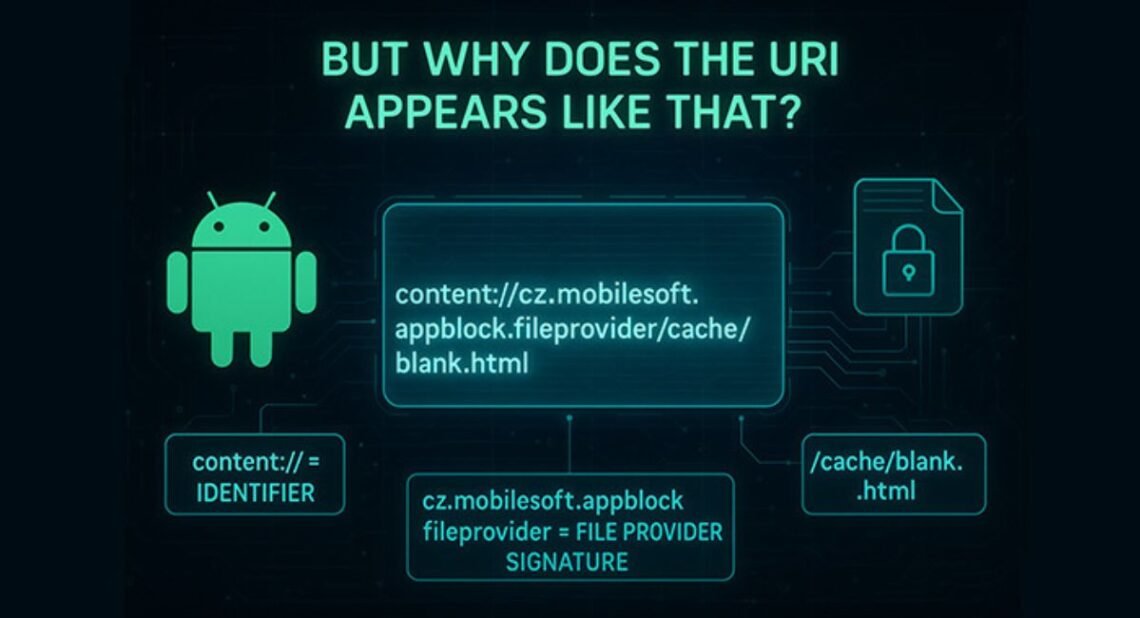
In this case, the URI can be divided into several parts:
- content:// is the URI scheme used by Android for content providers.
- cz.mobilesoft.appblock.fileprovider identifies the provider authority associated with AppBlock.
- /cache/ identifies the cache-related path exposed through that provider.
- blank.html identifies the HTML file being referenced.
Put together, the address essentially represents a locally accessible HTML resource exposed through Android’s content-provider system.
The important point is that the address does not automatically mean that your browser is connecting to a mysterious external server. A content URI can refer to information stored or managed locally on the Android device.
That is why copying this address into an ordinary browser may not produce the same result as opening a normal website URL.
What Does Each Part of the URI Mean?
Understanding the individual components makes this strange-looking address much easier to recognize.
content://
The first part is the content:// scheme.
Android uses content URIs as a standardized way for applications and system components to identify data supplied by a ContentProvider.
A content URI can represent different types of information, including files and other application-managed data.
Unlike a typical web address, the content:// scheme is not designed to identify a public website.
For example, these are conceptually different:
https://example.com/page.html
and
content://some.provider/cache/page.html
The first normally refers to a resource obtained through the web. The second identifies content managed through Android’s content-provider framework.
cz.mobilesoft.appblock
This portion identifies the application namespace associated with AppBlock.
AppBlock is a productivity and screen-time management application that allows users to restrict distracting applications and websites.
The package-style naming convention is common throughout Android. Applications use unique identifiers so that Android can distinguish one application from another.
fileprovider
The fileprovider portion refers to a FileProvider-style component.
Android’s FileProvider mechanism allows an application to provide controlled access to files without exposing the application’s raw filesystem paths.
Instead of handing another component a traditional filesystem location, an application can provide a content:// URI.
This approach is useful because access can be controlled through Android’s permission system.
/cache/
The /cache/ portion indicates that the referenced resource is associated with cached application content.
Cache storage is generally intended for temporary information. Applications commonly use caches to store data that can be recreated when necessary.
Because cache data is temporary, users should not assume that a file appearing under a cache path is an important permanent document.
blank.html
The final component is the filename.
blank.html indicates an HTML document named blank.html.
The name itself is descriptive. A blank HTML document can be used as a lightweight placeholder when an application needs to display an empty page or replace content that should not be displayed.
This is particularly relevant to a blocking application because a blocked page does not always need to be replaced with a full webpage. A lightweight local HTML resource can be sufficient.
Why Does AppBlock Use a Blank HTML Page?
The purpose of a blocking application is to prevent selected content from being displayed or accessed during a configured blocking period.
AppBlock can block applications, websites, URLs, and keywords according to the user’s settings. When a blocked destination is intercepted, the user may not be shown the original webpage.
Instead, the application can use an internal response or placeholder.
A blank HTML resource makes sense for this type of workflow because it is simple and lightweight.
Consider the following simplified sequence:
- You try to open a website.
- AppBlock determines that the website matches an active blocking rule.
- The requested content is prevented from loading normally.
- AppBlock or an associated Android component handles the navigation.
- A local resource such as blank.html may be used as a replacement.
- The browser or WebView displays a blank result instead of the blocked content.
The exact internal implementation can vary between app versions, Android versions, device manufacturers, and configurations. Therefore, it is better to describe the URI as an internal AppBlock-related content reference rather than assume that every device handles it in exactly the same way.
Why Am I Seeing content://cz.mobilesoft.appblock.fileprovider/cache/blank.html?
There are several situations in which you might encounter this URI.
A Website Was Blocked
The most common explanation is that AppBlock prevented a website from opening.
If the website or its domain matches an active blocking rule, the normal webpage may not be displayed.
Instead, a blank page or internal placeholder can appear.
If the URI appears at approximately the same time that a blocked website fails to open, that is a strong indication that AppBlock is involved.
A Blocking Schedule Is Active
AppBlock supports schedules that can automatically apply blocking rules during selected periods.
For example, a user may configure blocking during:
- Work hours
- Study sessions
- Sleep hours
- Specific days of the week
- Personal focus periods
If the URI only appears during one of these periods, the active schedule may explain the behavior.
A Website Matches a Keyword Rule
Blocking does not necessarily have to be based on one exact website.
AppBlock can also use keywords to restrict multiple related websites.
This means that a website you did not manually add to a blocklist can still be affected if its domain or URL matches an active keyword rule.
A WebView Is Involved
Android applications frequently use WebView or similar components to display web-based content inside an application.
If a blocked destination is being opened inside an app rather than directly in Chrome or another standalone browser, the content URI may appear as part of the internal navigation process.
This can make the URI seem unrelated to what you were doing because the application handling the request may be different from the application you were actively looking at.
AppBlock Cache Data Is Being Used
Because the URI contains /cache/, temporary cached data may be involved.
Cache behavior can sometimes produce confusing symptoms when an application has outdated, incomplete, or corrupted temporary data.
In that situation, you may see a blank screen even when the underlying blocking configuration is not intentionally supposed to produce a visible error.
Is content://cz.mobilesoft.appblock.fileprovider/cache/blank.html a Virus?
Usually, no.
The URI itself is not evidence that your Android phone has a virus.
The most important distinction is between a suspicious-looking string and suspicious behavior.
content:// is a legitimate Android URI scheme.
FileProvider is a legitimate Android mechanism.
An application-specific provider authority is also normal.
And a file called blank.html inside a cache-related path is not inherently malicious.
If you have AppBlock installed and the URI appears when a website is blocked, the explanation is generally straightforward.
However, no individual URI can prove that an entire device is safe. If you see unrelated security symptoms, such as unknown applications, persistent pop-ups, unusual permissions, unexpected account activity, or other unexplained behavior, investigate those symptoms separately.
The URI by itself should not be treated as proof of malware.
Is the FileProvider Safe?
Android’s FileProvider system is specifically designed to provide controlled file access.
Traditional file URLs can expose filesystem locations that applications should not unnecessarily share. FileProvider provides a safer mechanism by creating content URIs that can be granted to another application when access is required.
The provider can control which files are exposed.
That means seeing the word fileprovider in an Android URI is not automatically a security warning.
In the AppBlock-related URI, the provider authority is what identifies the component responsible for serving the referenced file.
The important security question is therefore not simply whether the URI contains fileprovider. You should also consider which application owns the provider and whether that application is one you intentionally installed.
What Does a Blank Screen Mean?
A blank screen can have several meanings.
If you intentionally enabled AppBlock blocking, the blank page may simply indicate that the requested content was blocked.
If you did not expect the page to be blocked, there may be a configuration issue.
Possible causes include:
- An active AppBlock schedule
- A website blocklist rule
- A keyword blocking rule
- A temporary AppBlock cache problem
- A browser or WebView issue
- An outdated AppBlock installation
- Incorrect permissions
- A blocking configuration that was not refreshed properly
- A blocked URL that is being opened through an embedded browser
- Temporary application state left over from an earlier blocking session
The difference between a normal blocking result and a technical problem is important.
If you expect the website to be blocked and everything else works normally, the blank result may be expected.
If AppBlock is disabled but the blank screen continues appearing, troubleshooting becomes more appropriate.
How to Fix content://cz.mobilesoft.appblock.fileprovider/cache/blank.html
If you are seeing the URI unexpectedly or getting stuck on a blank screen, try the following solutions in order.
1. Check AppBlock Blocking Rules
Start with the simplest explanation.
Open AppBlock and review your active blocking settings.
Look for:
- Active schedules
- Quick Block sessions
- Blocked websites
- Blocked keywords
- Application restrictions
- Strict Mode settings
- Website-specific rules
If the website you are trying to access is intentionally blocked, the URI may be normal.
If the website should not be blocked, adjust the relevant rule.
2. Check Whether a Schedule Is Active
A schedule can automatically activate blocking at specific times.
Review your current schedules and confirm whether one is currently active.
Pay particular attention to schedules that block browsers, social media applications, entertainment services, or specific websites.
If the problem only happens during certain hours, scheduling is one of the first things to investigate.
3. Refresh AppBlock’s Blocking Configuration
If the blocking behavior appears inconsistent, refreshing the blocking configuration can help.
An application may occasionally have temporary state that does not reflect the settings you expect.
After refreshing the settings, test the same website again.
4. Restart the Android Device
A restart is a simple but useful troubleshooting step.
Restarting Android can clear temporary processes and reload application services.
After the phone starts again:
- Open AppBlock.
- Confirm your blocking configuration.
- Open the browser.
- Test the affected website.
- Check whether the blank page still appears.
If the problem disappears after restarting, it was likely related to temporary application or system state.
5. Force Stop AppBlock
If AppBlock appears stuck, you can force stop the application through Android settings.
The exact menu names vary between manufacturers, but the process generally looks like:
Settings → Apps → AppBlock → Force Stop
Then reopen AppBlock and test the affected content.
Force stopping the app is different from clearing its storage. It does not normally erase your application configuration by itself.
6. Clear AppBlock Cache
If you suspect corrupted or outdated temporary data, clearing the application’s cache can help.
On many Android devices:
Settings → Apps → AppBlock → Storage → Clear Cache
The exact wording may differ depending on the phone manufacturer and Android version.
Clearing cache removes temporary data. It is different from clearing application storage or data.
Do not immediately select the option that deletes all application data unless you understand the consequences.
After clearing the cache, reopen AppBlock and test the affected website again.
7. Update AppBlock
An outdated application can sometimes behave differently from the current version.
Check whether an update is available for AppBlock.
Updates can include:
- Bug fixes
- Compatibility improvements
- Blocking improvements
- Performance changes
- Android-version compatibility fixes
- Changes to how websites are handled
After updating, restart the application and test again.
8. Update Android System WebView and Your Browser
If the problem occurs inside a WebView or browser-based interface, the rendering component may also be relevant.
Make sure your browser and Android System WebView are up to date when those updates are available for your device.
This is particularly useful when the problem looks like a white or empty screen rather than an obvious AppBlock blocking message.
9. Check AppBlock Permissions
AppBlock requires certain permissions for advanced blocking functionality.
If permissions have been removed, restricted, or changed after an Android update, some blocking features may not behave as expected.
Open AppBlock and review any permission prompts or warnings.
Do not grant unrelated permissions simply because you are troubleshooting. Only enable permissions required by the features you actually use.
10. Check In-App Browsers
One frequently overlooked cause is an in-app browser.
Some applications open links inside their own built-in browser instead of sending the link to Chrome or another default browser.
This can change how website blocking works.
If a website works normally when opened directly in your default browser but behaves differently when opened inside another application, the in-app browser may be part of the explanation.
Where possible, configure the application to open links in the device’s default browser.
11. Review Keyword Blocking
If one website keeps being blocked unexpectedly, inspect your keyword rules.
A broad keyword can affect more websites than you intended.
For example, a keyword-based rule can sometimes match a domain that you did not specifically add.
Review your AppBlock keyword configuration and temporarily remove or modify suspiciously broad rules for testing.
12. Disable the Relevant Blocking Rule Temporarily
If you need to determine whether AppBlock is responsible, temporarily disable the relevant blocking rule.
Then open the same website again.
If the website immediately works normally after the rule is disabled, AppBlock is likely responsible for the previous behavior.
This is a useful diagnostic test because it separates an AppBlock configuration problem from a browser, network, or website problem.
13. Reinstall AppBlock as a Last Resort
If the issue continues after updating, clearing cache, checking permissions, reviewing schedules, and restarting the device, reinstalling the application may be considered.
However, this should be a later step rather than the first solution.
Removing an application can remove local configuration and blocking settings.
Before doing this, make sure you understand what information may be lost and whether your settings are synchronized or backed up.
Should I Delete blank.html?
In most cases, you should not manually try to locate and delete blank.html.
The file is part of application-managed content.
Because it resides in a cache path, Android or the application may recreate it when necessary.
Manually deleting an individual internal cache file is therefore unlikely to solve the underlying problem if the application simply generates the file again.
If the problem is caused by corrupted cache data, use Android’s built-in Clear Cache function for AppBlock instead.
This is cleaner and safer than attempting to manipulate application files manually.
Can I Delete the AppBlock Cache?
Yes, clearing an application’s cache is a normal Android troubleshooting procedure.
Cache consists of temporary information that an application can generally recreate.
Clearing AppBlock’s cache may help if:
- A blank screen persists
- An internal page fails to load
- AppBlock behaves inconsistently
- A previous configuration appears stuck
- Temporary application data may be corrupted
Remember that clearing cache is not the same as clearing storage.
Clear Cache: Removes temporary cached information.
Clear Storage/Data: Removes application data and may reset settings or other locally stored information.
If your goal is simply to troubleshoot content://cz.mobilesoft.appblock.fileprovider/cache/blank.html, start with cache rather than deleting all application data.
What If I Never Installed AppBlock?
This situation deserves more attention.
If you have never knowingly installed AppBlock, first check the applications installed on your phone.
Look for AppBlock or an application associated with MobileSoft.
Also consider whether:
- Another person configured the device
- You restored applications from an older phone
- A work or school device has managed applications
- The application was installed previously
- The phone was restored from a backup
- A family member configured screen-time controls
- You are seeing the URI in an old browser history entry rather than a current process
If the application is genuinely absent but the URI continues to appear repeatedly, investigate which application is generating it.
Do not assume that the URI alone identifies malware.
Why Does It Appear in Browser History?
Seeing content://cz.mobilesoft.appblock.fileprovider/cache/blank.html in browser history can look strange because users expect history entries to contain ordinary websites.
However, browsers and Android components can record or interact with internal navigation resources.
If AppBlock redirects a blocked navigation to a local content URI, that URI may become visible in places where you normally expect a website address.
This does not necessarily mean you visited a website called cz.mobilesoft.appblock.fileprovider.
It is better understood as an internal resource reference generated during the navigation process.
Can I Open This URI Like a Normal Website?
Usually, no.
A content:// URI is not a conventional public website address.
It is intended to be resolved by Android’s content-provider system.
If you paste it into a browser and receive an error, blank screen, or unsupported-address message, that does not automatically mean the URI is broken.
The URI may only be meaningful within the application and Android context that created it.
This is similar to the difference between a local application resource and a public internet webpage.
Does This URI Use the Internet?
The URI itself does not indicate a normal internet connection.
The content:// scheme identifies Android-managed content rather than an HTTP or HTTPS web resource.
The underlying AppBlock process can of course involve network-related functionality when managing website lists, application data, updates, or other features, but the URI itself should not be interpreted as a remote website address.
That distinction is important when assessing privacy and security.
Is blank.html Dangerous?
A filename such as blank.html is not dangerous by itself.
HTML files can contain anything from simple markup to complex scripts, but the name blank.html alone does not indicate malicious behavior.
In this particular AppBlock-related context, the filename is consistent with a lightweight blank or placeholder resource.
If your security concern is whether the URI itself represents malware, the answer is generally no.
If you have broader security concerns about an unknown application or suspicious device behavior, evaluate the application, permissions, installation source, and other symptoms separately.
Why Does the Page Sometimes Stay Completely White?
A white screen can occur when the blank HTML resource is doing exactly what its name suggests.
However, a persistent white screen can also result from a technical problem.
Potential causes include:
- A corrupted cache
- An outdated application
- WebView compatibility problems
- Incorrect permissions
- A stale blocking configuration
- Browser compatibility issues
- An in-app browser limitation
- A URL matching an unexpected rule
- Temporary Android system problems
The key is to determine whether the blank screen is intentional.
If AppBlock is currently blocking the site, a blank page can be an expected result.
If AppBlock is not supposed to block the site, follow the troubleshooting sequence described above.
How to Prevent Unexpected AppBlock Blank Pages
You can reduce unexpected occurrences by keeping your blocking configuration organized.
Start by reviewing your schedules.
Avoid creating unnecessarily broad keyword rules unless you actually want broad blocking.
Keep your browser configuration consistent.
Make sure AppBlock and relevant Android components are updated.
Periodically review permissions after major Android updates.
If you frequently switch between browsers, check that the browser you actually use is covered by your intended blocking configuration.
You should also understand whether you are using Quick Block, scheduled blocking, Strict Mode, website blocking, keyword blocking, or another AppBlock feature.
A clear configuration makes unexpected blocking much easier to diagnose.
AppBlock and Website Blocking Explained
AppBlock is primarily designed to help users reduce digital distractions.
Its functionality can include blocking applications and websites, setting schedules, limiting access to distracting services, and helping users maintain focused periods.
Website blocking can be based on specific websites or broader keywords.
This explains why a user may encounter an internal blocking resource without having intentionally navigated to it.
For example, suppose you configure AppBlock to prevent access to a social media website during work hours.
During that period, you open the website.
Instead of receiving the website’s normal HTML response, the blocking system intervenes.
The visible result may be a blocked page, a blank page, or another application-controlled response.
The internal content URI can therefore be part of the mechanism that separates the user from the blocked destination.
Difference Between a Content URI and a Website URL
One of the biggest sources of confusion is treating the URI as if it were a regular URL.
Here is the practical difference:
| Feature | Normal Website URL | Android Content URI |
| Common scheme | https:// | content:// |
| Typical location | Internet server | Android application/provider |
| Primary purpose | Access web resources | Access app-managed content |
| Example | https://example.com | content://provider/path/file |
| Requires internet | Usually | Not necessarily |
| Public webpage | Usually | No |
| Controlled by Android provider | No | Yes |
This distinction makes content://cz.mobilesoft.appblock.fileprovider/cache/blank.html much less mysterious.
It is better thought of as an Android resource reference than as a strange website.
When Should You Actually Be Concerned?
Seeing the URI alone is usually not a reason to panic.
You should investigate further if the URI appears alongside other unexplained problems.
Examples include:
- An unknown application appears on the device
- Apps are requesting unusual permissions
- You see persistent pop-ups outside normal applications
- Browser settings repeatedly change without your permission
- Websites redirect unexpectedly even when AppBlock is disabled
- Battery or data usage changes dramatically without explanation
- Unknown applications repeatedly reinstall themselves
- Security warnings appear
- Your device behaves differently after installing an unfamiliar application
These symptoms are different from simply seeing an AppBlock-related content URI.
If AppBlock is installed and you recently attempted to access blocked content, the URI has a straightforward explanation.
Quick Troubleshooting Checklist
If you need a fast solution, work through this checklist:
- Open AppBlock.
- Check whether a schedule is active.
- Review blocked websites and keywords.
- Check whether Quick Block is enabled.
- Confirm that the affected website should not be blocked.
- Refresh the blocking configuration.
- Force stop AppBlock.
- Restart the Android phone.
- Clear AppBlock’s cache.
- Update AppBlock.
- Update your browser and Android WebView.
- Check AppBlock permissions.
- Test the website directly in your default browser.
- Check whether an in-app browser is involved.
- Temporarily disable the relevant blocking rule.
- Reinstall AppBlock only if other solutions fail.
This approach avoids unnecessarily deleting application data and helps identify the actual cause.
Frequently Asked Questions
What is content://cz.mobilesoft.appblock.fileprovider/cache/blank.html?
It is an Android content URI associated with AppBlock that references a cached HTML resource named blank.html. It is generally related to AppBlock’s internal handling of blocked or redirected content.
Is content://cz.mobilesoft.appblock.fileprovider/cache/blank.html a virus?
No, the URI itself is not a virus. Its appearance is generally associated with Android’s content-provider system and AppBlock. Other security symptoms should be investigated separately.
Why is AppBlock showing a blank page?
A blank page can be used as a lightweight replacement for content that AppBlock has blocked. It can also appear when cached data, permissions, browser components, or blocking settings are not functioning correctly.
Can I delete blank.html?
You generally do not need to manually delete the file. It is better to clear AppBlock’s cache through Android settings if you believe temporary data is causing a problem.
Does this URI mean my phone is hacked?
Not by itself. The URI is consistent with a legitimate Android content-provider reference associated with AppBlock.
Why does this appear in Chrome?
The URI can become visible during a blocked navigation or when Android or another application passes the content reference to a browser or WebView. Its appearance does not mean it is a normal Chrome website.
Can I open the URI directly?
Not in the same way that you open an ordinary HTTPS website. It is an Android content URI intended to be resolved through the appropriate content-provider mechanism.
Why does the URI contain fileprovider?
FileProvider is an Android mechanism that allows applications to expose files through controlled content:// URIs rather than directly exposing filesystem paths.
What does /cache/ mean?
It indicates that the referenced resource is associated with cached application content. Cache data is generally temporary and can be recreated by the application.
What does blank.html mean?
It is the name of an HTML file. In this context, it can function as a lightweight blank or placeholder resource when content is blocked or replaced.
How do I stop seeing the URI?
If AppBlock is responsible, review its schedules, Quick Block sessions, website rules, and keyword rules. If the behavior is caused by a temporary cache problem, clearing AppBlock’s cache and restarting the device may help.
Should I uninstall AppBlock?
Not necessarily. If you use AppBlock intentionally, uninstalling it is unnecessary simply because you saw this URI. Consider uninstalling only if you no longer want the application or if troubleshooting has established that it is responsible for an unwanted behavior.
Will clearing cache remove my AppBlock settings?
Clearing cache is designed to remove temporary data, while clearing storage or app data is the more destructive option. Because Android menus can vary by device, read the option carefully before confirming.
Why does the blank page appear only at certain times?
This often points toward an active schedule. AppBlock can apply different blocking rules during specific times or conditions, so time-dependent behavior is useful evidence when diagnosing the problem.
Final Verdict
content://cz.mobilesoft.appblock.fileprovider/cache/blank.html may look like a complicated or suspicious web address, but it is generally much simpler than it appears.
It is an Android content:// URI associated with AppBlock’s FileProvider and a cached HTML file named blank.html. In a typical scenario, the URI becomes relevant when AppBlock handles blocked content and uses a local resource rather than allowing the requested webpage to load normally.
The most important points are:
- It is not a normal website URL.
- It is an Android content URI.
- cz.mobilesoft.appblock.fileprovider identifies the AppBlock-related provider.
- /cache/ refers to temporary application content.
- blank.html is the referenced HTML resource.
- Seeing the URI alone does not mean your phone is infected.
- A blank screen can be an expected result of content blocking.
- Unexpected blank pages can also result from cache, permissions, browser, WebView, or configuration problems.
- Checking AppBlock schedules and blocking rules should be the first troubleshooting step.
- Clearing AppBlock’s cache is a reasonable next step if temporary data is suspected.
- Updating AppBlock, Android WebView, and the browser can help with compatibility problems.
- Manually deleting internal cache files is generally unnecessary.
- If you have never installed AppBlock, investigate which application is generating the URI rather than assuming malware.
In short, there is usually no reason to panic when you encounter content://cz.mobilesoft.appblock.fileprovider/cache/blank.html. In most cases, understanding how Android content URIs and AppBlock’s blocking behavior work is enough to explain why the unusual address appeared and what you should do next.
Read more: Glaadvoice.com: Complete Guide, Features, Content, Safety, and What You Should Know





One comment on “content://cz.mobilesoft.appblock.fileprovider/cache/blank.html: Meaning, Causes, Safety, and How to Fix It”