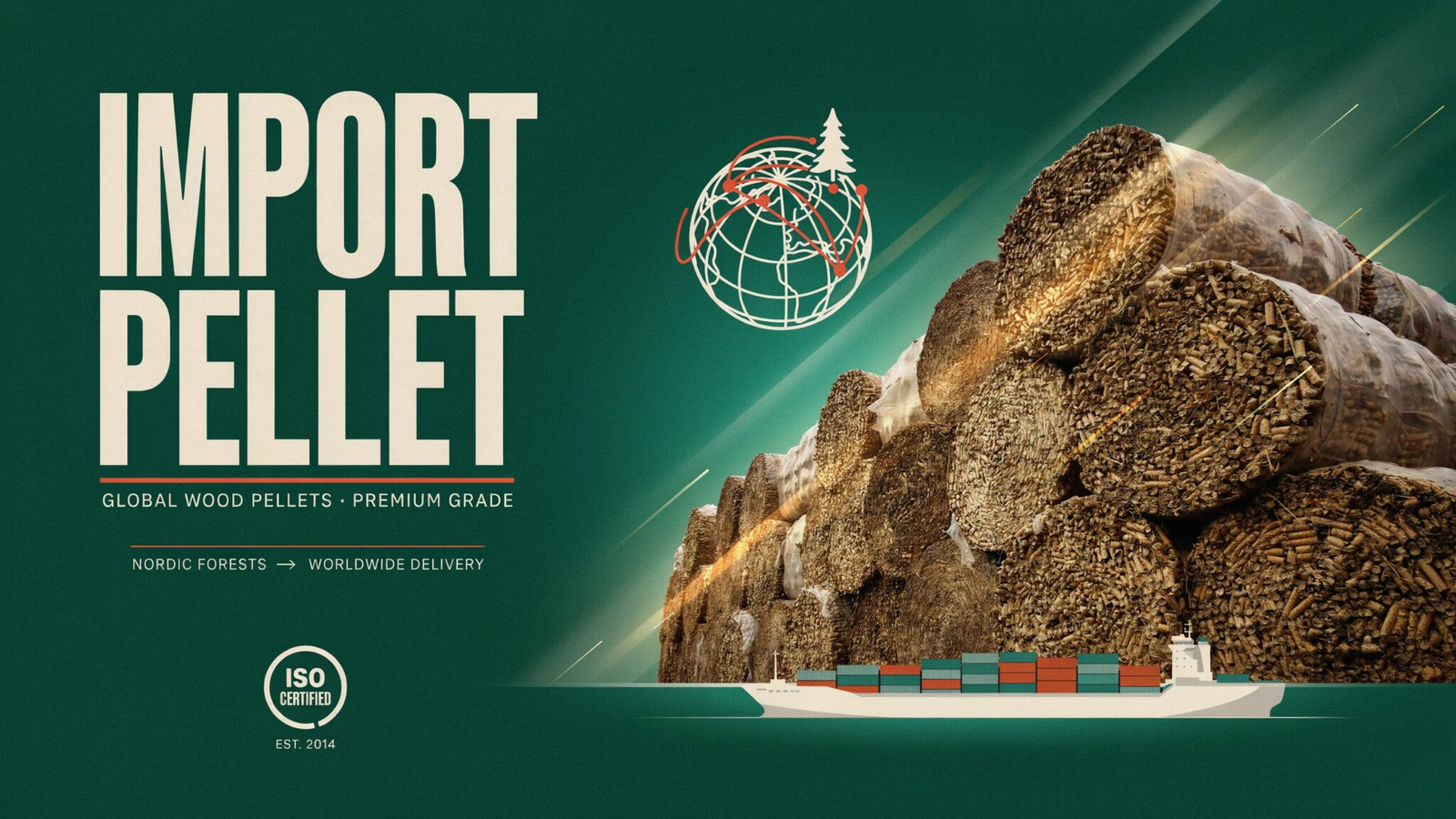
If you searched for importpellet, you may have expected a single company with a simple price list. What you actually find is more complicated, and more useful, once it is untangled. The name importpellet is used in at least two different places, and neither use should be confused with a guarantee that a particular supplier is certified, cheap, or safe.
This article does three things. First, it separates the two uses of the name so you do not merge them. Second, it gives a practical guide to importing wood pellets from Brazil, with the quality checks that matter most. Third, it lists the red flags and scam checks that protect a buyer when a deal looks too easy. No prices are promised here, because pellet prices move with wood supply, energy costs, shipping, exchange rates, and order size, and any article that prints a fixed price without a date and a supplier quote is already out of date.
What Is ImportPellet? Two Uses, Not One Company
The first step is to stop treating importpellet as one settled company. On the evidence available, the name appears in two separate contexts. They share a name pattern, but they are not shown to be the same operation, and this article does not merge them.
| Use of importpellet | What it refers to | What it does not prove |
|---|---|---|
| ImportPellet in the wood pellet guide context | The name used by Mello Commodity for its guidance on importing wood pellets from Brazil, as discussed in an Uplift Place article dated 21 October 2026 | It does not by itself prove that a named seller is ENplus certified or that a shipment will meet a given specification |
| importpellet.it.com | A guest posting platform described on Medium in October 2026 | It is not shown to be the same as the wood pellet guidance, and it is not a pellet supplier on the evidence discussed here |
That separation matters for a buyer. If you contact a guest posting platform expecting wood pellets, you will waste time. If you read a pellet import guide and assume every seller named near it is certified, you may skip the checks that actually protect you. Keep the two uses apart, and check each claim on its own evidence.
- ImportPellet as a guide name is about information on importing pellets from Brazil.
- importpellet.it.com as a platform name is about guest posting, a different activity altogether.
- Neither use, on its own, is proof of certification, stock, price, or delivery ability.
- Every supplier still needs its own certificate check, lab report check, and contract check.
ImportPellet and Mello Commodity: The Brazil Wood Pellet Guide
The wood pellet use is the one most import buyers care about. In that context, ImportPellet is the name used by Mello Commodity for its guidance on importing wood pellets from Brazil. That guidance was discussed in an Uplift Place article dated 21 October 2026. The date matters because pellet markets, shipping routes, and supplier lists change, and a guide from a given month should be read as a snapshot, not as a permanent supplier directory.
Brazil is a natural country to look at for wood pellets. It has large forestry and wood processing sectors, and wood residues that might otherwise be waste can be pressed into pellets for heating and power. That does not mean every Brazilian pellet is the same. Wood species, drying, pressing, storage, and transport all affect quality, and a buyer in Europe, Asia, or elsewhere needs a specification, not just a country of origin.
Why Brazil Attracts Pellet Buyers
Buyers look to Brazil for a mix of reasons. Supply can be large, production can use residues from timber and furniture work, and export experience through Brazilian ports is well established for other bulk goods. Those are real advantages, but they are general advantages of the market, not a promise about any one supplier.
A buyer should also keep the downsides in view. Distance means longer shipping times and higher freight exposure. Moisture control during a long sea voyage matters more than it does for a short truck delivery. Sustainability claims need checking, because a pellet made from residues is different from a pellet made from whole trees, and a buyer who cares about sustainability, or whose customers care about it, needs documents, not slogans.
What a Good Import Guide Should Give You
A useful guide does not just say that pellets are available. It explains what to ask for, what good numbers look like, how to verify a certificate, how to compare a trader with a manufacturer, and how to structure a first order so that risk stays manageable. The sections below are written to that standard. They collect, in one place, the checks that competitors often scatter across several pages or leave out entirely.
If a guide you read elsewhere skips certificate verification, lab reports, or inspection, treat that as a gap, not as a sign that those checks are unimportant. In pellet importing, the paperwork is part of the product. A pellet that cannot be documented is hard to sell onward, hard to insure properly, and hard to defend if a customer complains.
ImportPellet.it.com: A Separate Guest Posting Platform
The second use is entirely different. The name importpellet.it.com was described on Medium in October 2026 as a guest posting platform. Guest posting, in plain terms, means publishing articles written by outside contributors on a platform, often for exposure, links, or content volume. It has nothing to do with pressing wood, drying sawdust, or loading a bulk vessel.
Why does this matter in a pellet article? Because search results mix the two. A buyer who searches importpellet and clicks the first result without reading the description could land on a content platform and wonder where the pellets are. A content marketer who searches the same term could land on a pellet guide and wonder why it talks about ENplus and moisture content.
The fix is simple: read the domain and the description before you click, and read the first paragraph after you click. If the page talks about article submission, author accounts, or publishing guidelines, you have found the guest posting platform. If it talks about Brazilian wood pellets, certificates, and shipping, you have found the import guidance. Do not assume one site covers both, and do not carry a reputation from one use over to the other.
Wood Pellet Quality: The ENplus A1 Numbers That Matter
For most buyers importing pellets for heating, ENplus A1 is the quality benchmark they meet first. ENplus is a certification scheme for wood pellets, and A1 is its top residential grade. The Mello guide gives a set of A1 parameters, and this section presents them clearly, with one honest note about a small difference between sources.
| Parameter | ENplus A1 figure per the Mello guide | What it means in plain terms |
|---|---|---|
| Diameter | 6 or 8 mm | The pellet width; your stove or boiler is designed for one size |
| Moisture content | 10 percent or less | Wetter pellets burn less well and can cause handling problems |
| Ash content | 0.7 percent or less | Less ash means less cleaning and less residue |
| Calorific value | 16.5 megajoules per kilogram or more | How much heat you get from each kilogram |
| Mechanical durability | 98.0 percent or more | How well pellets hold together without breaking into dust |
Those five numbers are a good shortlist test. If a supplier cannot state them, or states numbers far outside them while still claiming A1, ask questions before you go further. A genuine A1 pellet should meet all of them, not just one or two.
The Durability Note: 98.0 Percent or 97.5 Percent?
Here is the honest complication. The Mello guide gives durability as 98.0 percent or more. Other sources cite 97.5 percent or more for the same grade. Both figures appear in discussions of ENplus A1, and a buyer who sees 97.5 percent should not automatically call the supplier dishonest.
The safe way to handle this is to present the range honestly and to put the contract first. Ask the supplier which version of the standard it is certifying to, ask for the certificate and the lab report, and write the agreed figure into the contract. A range in an article is fine for learning. A range in a contract is a dispute waiting to happen. Pin the number down before money moves.
The same rule applies to the other parameters. Learn the guide figures, then confirm the exact agreed figures in writing for your order. Moisture, ash, and calorific value should be testable on delivery, not just promised in a brochure.
Beyond the Five Numbers
Five numbers do not tell the whole story. A pellet can meet diameter, moisture, ash, heat, and durability on paper and still cause trouble if it is contaminated, if it contains bark or soil in a way the ash test does not fully capture, or if it has been stored wet and then dried again. That is why lab reports, inspection, and storage matter as much as the headline specification.
- Ask what wood the pellets are made from, and whether bark content is controlled.
- Ask about additives, if any, and whether they are allowed under the claimed grade.
- Ask how pellets are stored before loading, and whether they are protected from rain and ground moisture.
- Ask how fines, the dust and broken pieces, are handled at loading.
- Ask what happens if a delivery test fails: rejection, price adjustment, replacement, or another agreed remedy.
How to Verify a Supplier Before You Pay
Verification is where careful buyers separate themselves from hopeful buyers. It takes time, but it is far cheaper than a rejected container, a customer complaint, or a lost prepayment. Work through the steps below for every new supplier, even if the supplier came recommended.
Check the Certificate Number in the ENplus Database
If a supplier claims ENplus certification, ask for the certificate number, the certified company name, and the scope of certification. Then check that number in the ENplus database yourself, or ask a trusted third party to check it. Do not accept a logo on a brochure, a screenshot of a certificate, or a certificate with a different company name as proof.
Check four things on the certificate record: that the number is real, that the company name matches the seller, that the scope covers the pellets you are buying, and that the certificate is still valid on the date of your order. A certificate that expired, that covers a different plant, or that belongs to a different company does not certify your shipment.
Ask for Recent Lab Reports, and Read Them
Ask for recent lab reports for the actual production you will receive, not just a generic example from last year. A useful report names the lab, the sample date, the test methods, and the results for moisture, ash, calorific value, durability, and diameter. If the report is undated, unnamed, or only shows one parameter, ask for a fuller report.
Lab reports also need context. A report for one batch does not guarantee the next batch, especially if wood supply or drying changes. For a first order, agree in the contract that an independent test on arrival, or a pre shipment test by an agreed lab, will decide acceptance. That clause protects both sides, because it replaces argument with a test both sides accepted in advance.
Use Independent Inspection for Larger Orders
For larger or first time orders, independent inspection is standard practice in bulk trade. Firms such as SGS, Intertek, and Bureau Veritas are examples of inspection companies that buyers use for this kind of work. They are named here as examples of the type of firm, not as a recommendation of one firm over another, and not as a claim that any of them endorses a particular supplier.
An inspector can check loading, sampling, moisture, and quantity, and can issue a report that both buyer and seller can rely on. Agree in advance who pays, what will be inspected, where sampling happens, and what happens if the inspection fails. Inspection is not free, but for a container or bulk load it is a small share of total cost compared with the cost of a bad shipment.
Manufacturer or Trader? Why the Distinction Matters
Some sellers make pellets. Others buy pellets and resell them. Both can be legitimate, but the risks and questions differ. A manufacturer can usually answer detailed questions about wood source, drying, pressing, and plant capacity. A trader may offer more flexibility on volume and ports, but may have less control over production, and may be selling pellets made by someone else.
Ask directly: are you the manufacturer, or a trader? If a trader, who is the manufacturer, and can the certificate and lab report be traced to that plant? If the seller will not name the plant, or if the certificate name does not match the plant, slow down. Traceability is not a luxury in pellet trade. It is how you know what you are actually buying.
Sustainability: SBP, FSC, and PEFC Where Relevant
Sustainability claims need the same document discipline as quality claims. SBP, FSC, and PEFC are schemes that buyers meet in wood and biomass trade, and each has its own chain of custody rules. A claim that pellets are sustainable should name the scheme, the certificate number, and the scope, and should be checkable in the same way as an ENplus claim.
Do not accept a general statement such as eco friendly pellets or green energy pellets as a substitute for a scheme certificate. Those phrases are marketing, not certification. If your customers, your boiler scheme, or your local rules require a particular sustainability proof, confirm that requirement before you order, and write it into the contract. A pellet that is fine for heating but lacks the required sustainability paper may still be unsellable in your market.
Read also: What Are the Main Household Electricity Consumers?
Packaging, Minimums, and Shipping Choices
Once quality is clear, the next decisions are practical: how pellets arrive, how much you must order, and how they will be stored after arrival. These choices affect price, handling, and risk, and they vary by supplier, so treat any general statement as a starting point, not as a supplier promise.
Packaging Options
Wood pellets are commonly supplied in bulk, in big bags, or in small bags of 15 kilograms or 20 kilograms. Bulk suits large heating plants and power users with proper silos and handling equipment. Big bags suit medium users who need easier handling without a full silo system. Small bags suit retail, household, and small business users who sell onward in bag form or who lack bulk storage.
Each option has trade offs. Bulk usually has the lowest packaging cost per tonne, but it needs dry, clean storage and proper unloading. Small bags cost more to pack and handle, but they protect pellets from moisture during storage and are easier to sell in retail. Big bags sit in between, with handling that still needs a forklift or similar equipment. Choose the packaging that fits your storage and your customers, not just the cheapest headline price per tonne.
Minimum Order Quantities Vary by Supplier
Minimums vary by supplier, and this article deliberately does not state a single minimum as if it applied to everyone. A manufacturer may require a full container or a larger bulk load to make production and shipping economic. A trader may accept a smaller first order, but may charge more per tonne for it. A retail focused seller may offer pallet quantities that a bulk exporter would not consider.
For a first order, a smaller test quantity is often wiser than a maximum order, even if the unit price is higher. A test order lets you check quality on arrival, check handling and storage, and check how the supplier deals with questions and documents. If the test order goes well, larger orders become a lower risk decision. If it goes badly, the loss is contained.
Shipping and Storage Checklist
Shipping pellets from Brazil to a distant market involves several steps, and each step can add moisture, breakage, or delay. Use the checklist below when you discuss logistics with a supplier or a freight forwarder.
- Confirm the loading port, the destination port, and who arranges each leg of transport.
- Confirm who pays freight, insurance, port charges, and customs duties, using clear trade terms in the contract.
- Confirm how pellets are protected from rain during loading, transit, and unloading.
- Confirm the expected transit time, and allow extra time for port congestion and customs checks.
- Confirm how pellets will be stored on arrival, with dry, ventilated, covered storage and no ground contact.
- Confirm who is responsible if pellets arrive wet, broken, or short in quantity.
- Confirm the documents that travel with the shipment, including invoice, packing list, certificate copies, and lab reports where agreed.
Step by Step: Shortlist, Quote, Contract, Delivery
A clear process prevents most beginner mistakes. The steps below are deliberately simple. They are not legal advice, and for a large order you should still take advice on contract terms in your own country, but they give a workable order of operations for a first import.
Step 1: Shortlist on Documents, Not on Websites
Start with a shortlist of suppliers who can provide a certificate number, recent lab reports, plant details, and clear packaging and minimum information. Remove any supplier who cannot provide those basics, however attractive the website looks. A good website is cheap to build. A good pellet plant is not.
Step 2: Request Quotes on the Same Specification
Send every shortlisted supplier the same request for quotation. State the grade, diameter, moisture, ash, calorific value, durability, packaging, quantity, destination port, and delivery terms you want. Ask for the price basis, validity period, and what is included and excluded. Quotes on different specifications cannot be compared fairly, and a cheap quote on a weak specification is not a bargain.
Step 3: Compare Total Cost, Not Just Pellet Price
Compare the total landed cost: pellet price, freight, insurance, port and handling charges, duties and taxes, inland transport, and inspection and testing costs. A supplier with a higher pellet price but a better port or better packaging may still be cheaper overall. A supplier with a low pellet price but vague freight terms may become expensive once hidden charges appear.
Step 4: Put Quality, Testing, and Remedies in the Contract
Put the agreed specification, the certificate details, the testing method, the inspection arrangement, the delivery terms, the payment terms, and the remedy for failed tests into the written contract. Avoid relying on chat messages, verbal promises, or brochure claims. If a term matters to you, it belongs in the contract, in plain language both sides understand.
Step 5: Inspect, Test on Arrival, and Store Correctly
On arrival, check quantity, packaging condition, and moisture protection before unloading is finished. Take samples as agreed, test them, and keep the results. Store pellets dry, covered, and off the ground, and rotate stock so older bags are used first. Good storage protects the quality you paid for, and good records protect you if a customer later raises a quality question.
Red Flags and Scam Checks
Pellet importing, like any bulk import trade, attracts both genuine sellers and opportunists. The red flags below do not prove fraud on their own, but a cluster of them should make you pause, verify more deeply, or walk away.
- No certificate number, or a certificate number that cannot be found in the ENplus database.
- A certificate in a different company name from the seller, with no clear explanation or chain of custody.
- Lab reports that are undated, unnamed, or copied from another supplier.
- Refusal to name the manufacturing plant, or refusal to allow independent inspection.
- Pressure to pay in full in advance by an irreversible method, with no contract and no inspection option.
- A price far below every other quote for the same specification, with no credible explanation.
- Vague answers on wood source, sustainability scheme, packaging, or delivery terms.
- A website or listing that mixes pellet sales with unrelated activities, or that uses a name similar to a known guide or platform without a clear connection.
Scam checks are simple, but they need to be done before payment, not after. Verify the company through independent business records where possible. Check the domain age and contact details, and be cautious if contact details keep changing. Speak to the seller by phone or video where possible, and confirm bank details through a second channel, not just through an email that could be spoofed. Keep every quote, contract, payment proof, and test result in one file for the order.
If a deal fails several checks at once, the safest move is often to stop, even if you have already spent time on it. Time spent on a shortlist is cheap. Money lost on a bad shipment is not. A genuine supplier will usually welcome verification, because verification protects the supplier too, by proving that its pellets met the agreed standard.
Frequently Asked Questions About ImportPellet
These questions answer the points buyers ask first, and they keep the same honesty rule used through the article: separate the two name uses, give the guide figures, and do not promise prices or certification for any single seller.
Is ImportPellet itself a certified pellet supplier?
No such claim is made here. ImportPellet, in the wood pellet context, is the name used by Mello Commodity for its guidance on importing wood pellets from Brazil. That does not make ImportPellet itself a certified supplier, and any seller you consider still needs its own ENplus certificate check, lab reports, and inspection where appropriate.
What is the difference between importpellet and importpellet.it.com?
On the evidence discussed here, they are different uses. The wood pellet guidance is about Brazil pellet imports. importpellet.it.com was described on Medium in October 2026 as a guest posting platform. Do not merge them, and check the domain and page description before assuming which use you have found.
What are the ENplus A1 figures I should ask for?
Per the Mello guide, ask for 6 or 8 mm diameter, moisture at 10 percent or less, ash at 0.7 percent or less, calorific value at 16.5 megajoules per kilogram or more, and durability at 98.0 percent or more. Note that other sources cite 97.5 percent for durability, so confirm the exact agreed figure in your contract and test against it.
How do I verify an ENplus certificate?
Ask for the certificate number, the certified company name, and the scope, then check the number in the ENplus database. Confirm that the name matches the seller, that the scope covers your pellets, and that the certificate is valid on your order date. A logo or a screenshot alone is not verification.
Should I use a manufacturer or a trader?
Both can work. A manufacturer usually gives clearer answers on wood source and production. A trader may offer more flexibility on volume and ports. Whichever you choose, trace the pellets back to the plant, check the certificate name, and agree testing and inspection in the contract.
What packaging should I choose?
Bulk suits large users with silos. Big bags suit medium users with forklift handling. Small bags of 15 or 20 kilograms suit retail and household users. Choose the packaging that fits your storage and your customers, and compare total landed cost, not just the pellet price per tonne.
What is the minimum order for Brazil pellets?
Minimums vary by supplier, so there is no single answer that fits everyone. Ask each shortlisted supplier for its minimum for your chosen packaging and port, and consider a smaller test order first. A test order costs more per tonne in some cases, but it limits risk while you check quality, documents, and service.
What should I do if a delivery fails a quality test?
Follow the remedy written in your contract. That is why the contract should state the test method, the agreed figures, who tests, and what happens on failure, whether that is rejection, replacement, or a price adjustment. Keep samples, lab results, and correspondence together, and raise the issue promptly, with the test evidence attached.
Conclusion
Importpellet is a name that needs untangling before it can be useful. In one use, it points to Mello Commodity guidance on importing wood pellets from Brazil. In another use, importpellet.it.com points to a guest posting platform described on Medium in October 2026. Those are different activities, and treating them as one operation would lead to confusion for both buyers and content marketers.
For a pellet buyer, the useful work starts after that separation. Learn the ENplus A1 figures, including the honest durability range between 98.0 percent in the Mello guide and 97.5 percent cited elsewhere, and pin the agreed figure into the contract. Verify the certificate number in the ENplus database, check scope and validity, read recent lab reports, and use independent inspection for larger or first orders. Distinguish a manufacturer from a trader, check sustainability claims by scheme and certificate where relevant, and choose packaging and order size to fit your storage and your market.
Do all of that, and Brazil can be a sensible source of wood pellets. Skip it, and even a good market can produce a bad order. The guide name ImportPellet can point you to the right questions. Only documents, tests, and a clear contract can answer them for your specific shipment.
Read also: Dresit: Meaning, Origins, and How to Tell Which One You Mean

One thought on “ImportPellet: Brazil Wood Pellet Import Guide and Name Explained”