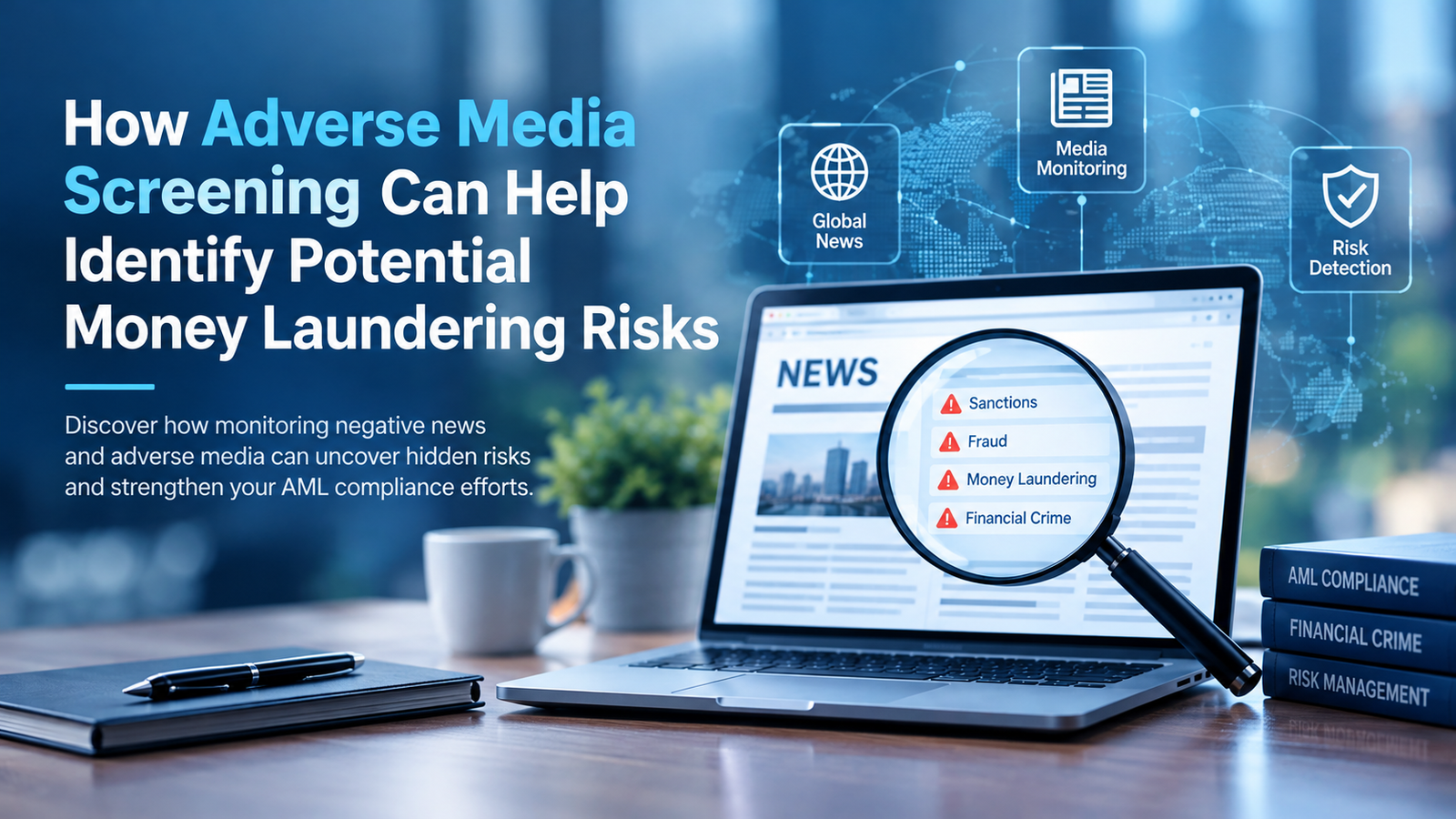
Money laundering remains a major challenge for banks, fintech companies, and other financial institutions. Criminals often use complex business structures, shell companies, and fraudulent transactions to conceal the origins of illegal funds. Traditional monitoring systems may identify unusual transaction patterns, but they cannot always reveal the broader activities or reputational concerns associated with a customer.
Adverse Media Screening helps financial institutions identify potential financial crime risks by analyzing news reports, public records, and other relevant sources. When combined with customer due diligence and transaction analysis, it can provide valuable information for assessing customer risk and supporting informed compliance decisions.
What Is Adverse Media Screening in AML Compliance?
Adverse media screening is the process of reviewing publicly available information to identify negative news or allegations associated with individuals, businesses, and other entities. Relevant reports may involve corruption, fraud, bribery, organized crime, tax evasion, or other activities connected to financial crime.
Unlike transaction monitoring, which focuses on identifying unusual financial behavior, media screening provides additional context about the people and organizations involved. For example, a business may conduct transactions that appear normal but have ownership links to individuals mentioned in credible reports of financial misconduct.
Through effective adverse media checks, compliance teams can identify these warning signs and determine whether further investigation is necessary. However, a negative news mention does not automatically establish criminal activity. Analysts must assess the credibility, relevance, and accuracy of each finding.
How Negative News Screening Helps Detect Money Laundering Risks
1. Identifying Hidden Financial Crime Connections
Criminals may use intermediaries, shell companies, or complex ownership structures to conceal the source of funds. News reports can reveal relationships between customers and individuals or businesses previously associated with financial misconduct.
Negative news screening allows compliance teams to examine these connections before establishing or continuing a business relationship. If credible reports identify suspicious business dealings or links to financial crime, analysts can investigate the customer’s ownership structure and assess whether additional due diligence is appropriate.
2. Strengthening Customer Due Diligence
Customer due diligence requires financial institutions to understand who their customers are, where their funds originate, and whether their activities present potential risks. Basic identity verification alone may not reveal relevant information about a customer’s business history or associations.
By incorporating media screening into onboarding and ongoing reviews, institutions can identify information that requires further examination. For instance, reports linking a prospective corporate customer to procurement fraud may justify reviewing its beneficial owners, source of wealth, and expected transaction activity.
This additional context helps institutions make more informed, risk-based decisions instead of relying exclusively on the information supplied during onboarding.
3. Supporting Ongoing Risk Monitoring
Customer risk can change after an account has been opened. An individual or company with a previously acceptable risk profile may later become associated with investigations, regulatory actions, or credible allegations of financial misconduct.
Negative news monitoring helps institutions identify emerging information that could affect existing customer assessments. Regular reviews allow compliance teams to determine whether a customer’s risk rating needs updating or whether enhanced due diligence is necessary.
Continuous monitoring is particularly valuable for higher-risk customers, complex corporate structures, and businesses operating across multiple jurisdictions.
Common Warning Signs Compliance Teams Should Investigate
Media reports can highlight potential risks that require closer examination. Compliance professionals should consider the broader circumstances rather than treating every negative mention as evidence of wrongdoing.
Important warning signs include:
- Credible reports linking a customer or beneficial owner to money laundering investigations.
- Allegations of fraud, corruption, bribery, or embezzlement involving a customer’s business activities.
- Reports identifying undisclosed relationships with individuals or entities associated with financial crime.
- Regulatory enforcement actions that raise concerns about a company’s financial practices.
- Repeated negative reports suggesting patterns of misconduct across multiple businesses or jurisdictions.
These indicators should trigger appropriate review, not automatic rejection. Analysts must distinguish verified facts from unproven allegations and consider the relevance of the information to the customer’s current risk profile.
The Role of Adverse Media Screening Tools
Manually reviewing news sources can become difficult when financial institutions manage thousands of customers across different regions and languages. Relevant information may appear in local publications, regulatory announcements, and international news outlets.
Modern adverse media screening tools can help automate searches, identify relevant mentions, and connect information to customer records. Depending on their capabilities, these solutions may use artificial intelligence and natural language processing to distinguish relevant reports from unrelated content.
Automation can reduce repetitive research, but human review remains important. Compliance teams should verify source credibility, resolve potential false positives, and document the reasoning behind decisions. Combining automated screening with established investigation procedures helps maintain consistency and accountability.
How AML Watcher Supports Risk-Based Compliance
AML Watcher provides AML screening solutions that can help financial institutions identify potential financial crime risks and strengthen their compliance processes. Incorporating screening into a broader risk management framework allows institutions to evaluate relevant information alongside customer profiles and other available risk indicators.
Organizations should assess screening solutions based on data coverage, matching accuracy, monitoring capabilities, and the quality of information available for investigation. These factors help compliance teams develop more consistent review procedures while ensuring that significant findings receive appropriate attention.
Conclusion
Adverse media screening provides financial institutions with valuable context for identifying potential money laundering risks that may not be apparent from transaction data alone. By examining credible reports, uncovering relevant connections, and monitoring changes in customer risk, compliance teams can strengthen due diligence and support more informed investigations.
Combining automated screening with reliable sources, human verification, and documented risk assessments helps institutions respond to emerging concerns without treating unverified allegations as established facts. With an effective approach, financial institutions can improve their ability to identify suspicious relationships and maintain stronger AML controls.
Read also: