To select the most suitable robot vacuum for cleaning up pet hair, one cannot simply compare peak suction power. Pet hair can accumulate on hard floors, become embedded in carpet fibers, gather along baseboards, or hide beneath furniture — and each scenario presents different cleaning challenges. This guide uses several practical checks, covering floor mix, shedding level, brush and edge design, navigation and clearance, mopping, and maintenance. Follow them in order to find a robot that fits your home and avoid features you do not need.
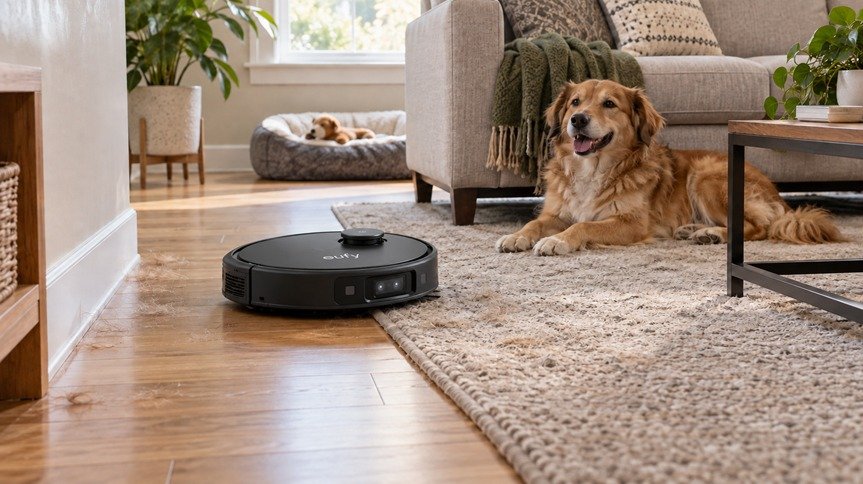
Alt: eufy Robot Vacuum Omni E35 cleaning pet hair on hardwood flooring and a low-pile rug beside a dog
Match the Robot to Your Floors and Pet Hair
Start with two questions about your home: where does the pet hair land, and what kind of hair is it? The answers decide which features are worth paying for — and which ones you can safely skip.
Hard Floors, Rugs, and Carpet
Use the surface that is hardest to clean as your first filter. A robot that performs well on open hard floors may still struggle with carpet, rugs, or raised transitions.
| Home condition | Prioritize | Decision rule |
| Mostly hard floors | Edge pickup, obstacle handling, and mopping | Do not pay for carpet-focused performance you will rarely use. |
| Low-pile carpet | Carpet pickup, brush contact, and repeat passes | Look for evidence on rugs and carpet, not only open-floor results. |
| Medium-pile carpet | Airflow, carpet movement, and clearance | Unverified carpet behavior should count as a risk. |
| Mixed floors | The weakest surface performance and floor transitions | Judge the robot by the surface it struggles with most, not by its best hard-floor result. |
Pay attention to rug corners, raised edges, and room transitions. A curled rug edge or high threshold can interrupt a route even when the robot has enough suction. If your home combines sealed hard floors with low- or medium-pile carpet, the robot needs to collect visible hair on hard surfaces and continue working when it reaches carpet.
Short Hair, Long Hair, and Heavy Shedding
Your pet’s hair type and shedding level determine how much you should prioritize brush design, repeat passes, dust handling, and manual cleaning.
| Pet-hair situation | What to prioritize | What to verify |
| Long hair | Hair detangling and brush access | Whether tangled hair can be removed without cutting it by hand. |
| Heavy shedding | Dust handling, filtration, and repeat cleaning | Dustbin or bag capacity and how often the system needs attention. |
| Short hair or light shedding | Consistent pickup and edge coverage | Whether the extra cost of maximum suction adds value in your home. |
| Hair embedded in carpet | Brush contact and carpet pickup | Independent results on the carpet or rug type in your home. |
Peak suction is only one input. A high number does not tell you how well a robot collects hair from a particular carpet, whether it scatters loose fur on hard floors, or how much hair remains wrapped around the brush after a week of cleaning.
Once you know your floor mix and hair type, the buying focus narrows to four things: edge cleaning where fur gathers, carpet pickup if you have rugs, a tangle-resistant brush for long or heavy-shedding hair, and enough dust capacity for frequent runs. Keep those priorities in mind as you check the design details below.
Check Brush and Edge Design That Reduces Hair Wrap and Manual Cleaning
Now that you know which priorities matter for your home, the next step is verifying that a model’s design actually delivers on them. Long strands can wind around a roller, while short fur can collect around the brush housing, side brush, wheels, and intake. The right design is the one that keeps those problems from landing on you.
Run four quick checks before you buy:
- Is the main brush easy to remove? When hair does wrap, you should be able to clear it in seconds without tools — not fight with clips and screws.
- Is the anti-tangle claim backed by evidence? Does the design reduce hair wrapping, and is that supported by an independent test or a clear product explanation, rather than just a feature name?
- Can you reach the parts where hair collects? The side brush, wheels, filter, and intake should be accessible for quick cleanup when fur builds up there.
- Does it clean close to walls and furniture? Check whether the robot reaches baseboards and cabinet edges closely enough that it does not leave a permanent strip of fur.
When reading an independent review, look for separate tests of hair wrap, edge cleaning, and brush maintenance. A feature name can show what the manufacturer built into the product, but it does not by itself prove how much manual cleaning the owner will avoid.
Make Sure the Robot Can Move Through Your Home
Measure furniture clearance and thresholds before comparing navigation features. A robot cannot clean under furniture or cross a doorway simply because its mapping system is advanced.
| Check | How to check it | How to make the decision |
| Furniture clearance | Measure the lowest gap under sofas, cabinets, and beds. | The measured clearance should be greater than the robot’s listed height. |
| Thresholds | Measure the highest transition between rooms. | Compare it with the product’s published crossing height. |
| Everyday obstacles | List bowls, toys, cords, and other objects that remain on your floors. | Compare that list with the model’s documented obstacle handling. |
| Route reliability | Check whether the robot can return to the station and resume a job. | A robot that repeatedly needs rescue is a poor fit, regardless of its suction rating. |
If the product does not publish its height or threshold-crossing limit, treat that part of the fit as unverified rather than assuming it will work. Under-furniture access is especially important in pet homes because hair and dry debris often collect in the places that are hardest to reach by hand.
Decide Whether Mopping Adds Value in Your Home
Mopping is worth paying for when your home has sealed hard floors and frequent paw prints, tracked dirt, food residue, or small spills. It is less important when most of your home is carpeted.
Use this order of priority:
- If hard floors and pet messes are common, evaluate the mop system and its cleaning routine.
- If carpet covers most rooms, prioritize carpet pickup and brush maintenance first.
- If you have wood, stone, or other specialty flooring, confirm compatibility with the flooring manufacturer before using a wet-cleaning mode. The National Wood Flooring Association advises against wet or steam mops for wood floors.
- If you dislike washing and drying mop parts, do not buy an all-in-one system based only on the promise of convenience.
For mixed floors, let the vacuum function handle fur and dry debris across rooms, then use the mop on sealed hard floors where paw prints and tracked dirt show up quickly. Treat mopping as a secondary filter after pet-hair pickup, carpet performance, and navigation.
Check the Maintenance Routine Before You Buy
The best station is the one that removes the maintenance tasks you actually dislike. Automation can reduce routine work, but it does not eliminate brush, filter, tank, or consumable care.
| Maintenance task | What to verify |
| Pet hair | Brush access, detangling, and how often the roller needs inspection. |
| Dust | Auto-empty function, bag or dustbin capacity, and replacement cost. |
| Mopping | Mop washing, drying, odor control, and the care routine after wet cleaning. |
| Filters and brushes | Cleaning frequency, replacement schedule, and access to the parts. |
| Water tanks | How often they need filling, emptying, and cleaning. |
If a station empties the dustbin but you still have to wash and dry a roller after every mopping cycle, that difference may matter more than a small gap in suction. Compare the full routine, not only the automation headline.
How the eufy Robot Vacuum Omni E35 Fits
The easiest way to use the checklist is to test it against the messes you see most often. Picture this home environment: loose hair piling up on the hardwood floor near the food bowl, working its way into the living room carpet fibers, and mingling with dirt tracked in at the entryway. To handle these everyday challenges, a robot vacuum needs to do more than just transition between floor types, clean along edges, and avoid common obstacles; it must also manage occasional wet messes—all without adding to the user’s daily maintenance burden.
The eufy Robot Vacuum Omni E35 is a compelling option that addresses these specific needs. When evaluating it, look beyond the raw specifications as isolated selling points; instead, consider how each feature aligns with your actual cleaning requirements.
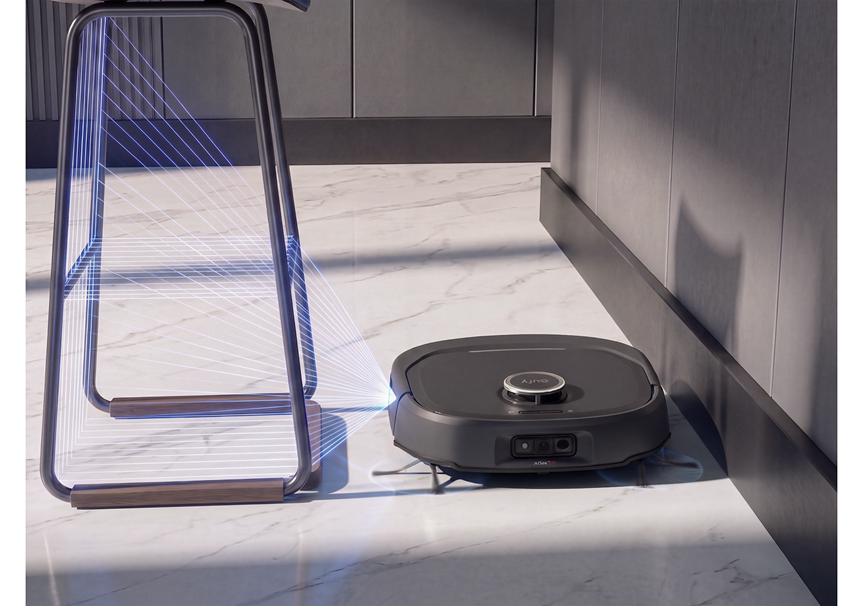
| Pet-home job to solve | E35 feature to evaluate | What it means in daily use |
| Fur on hard floors and carpet | 35,000 Pa peak suction and DuoSpiral™ Detangle Brushes | Helps pull dry debris toward the intake while reducing how much hair wraps around the brush |
| Dust and debris after frequent runs | AeroTurbo™ 2.0 Multi-Cyclone Filtration | Supports dust handling as the robot collects fur, crumbs, and dry debris |
| Paw prints and tracked dirt | HydroJet™ 2.0 Self-Cleaning Roller Mop | Adds routine wet cleaning for sealed hard floors near doors, kitchens, and food stations |
| Hair along walls and around clutter | CornerRover™ True Corner Coverage and AI See™ 3.0 Obstacle Avoidance | Helps the robot work closer to edges and navigate around bowls, toys, and everyday objects |
| Post-run upkeep | ThermoFresh™ Hot Wash-and-Dry Station | Supports mop care after cleaning, while filters, brushes, tanks, and consumables still need periodic attention |
This setup makes the most sense when pets shed regularly, rooms combine sealed hard floors with low- or medium-pile carpet, and you want one system to handle both dry pickup and routine mopping. If your home is almost entirely carpeted, or if you mainly need stairs, upholstery, or deep spot treatment, a simpler vacuum-focused model or a handheld tool may fit better. The right choice is the one that takes over the messes you see every week without adding a maintenance routine you will not keep.
Conclusion
Choosing the best robot vacuum for pet hair starts with the floor plan and the mess, not the headline specification. Look for brush and edge design that suits shedding, carpet performance for your floor type, navigation that fits your layout, and a station that matches the maintenance you want to do.
If your home combines pets, hard floors, and carpet, a vacuum-and-mop system can make daily cleaning more consistent. The eufy Robot Vacuum Omni E35 is worth reviewing when you want strong dry pickup, detangling brushes, roller-based mopping, corner coverage, obstacle avoidance, and automated station care.
Read also: What Is a Sunrise Alarm Clock and Does It Actually Work?




One comment on “How to Choose the Best Robot Vacuum for Pet Hair”