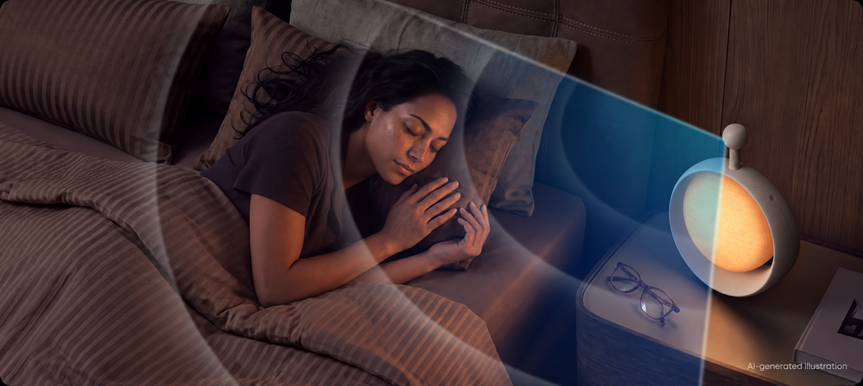
A phone alarm interrupts sleep with no warning at all: silence, then a sound loud enough to end whatever stage of sleep a person was in. A sunrise alarm clock changes that order. The light in the room starts shifting well before the alarm time, and waking up happens gradually rather than at one exact second. Most people looking into this for the first time want to know what the device is actually doing, at what point the light alone stops being enough, and whether their own bedroom, with blackout curtains or a window that already lets in daylight, would notice much difference at all.
Note: This content is for informational purposes only and is not intended as medical advice. Individual results may vary. If you experience chronic sleep issues, consult a healthcare professional.
The Clock Is Really a Timed Lamp
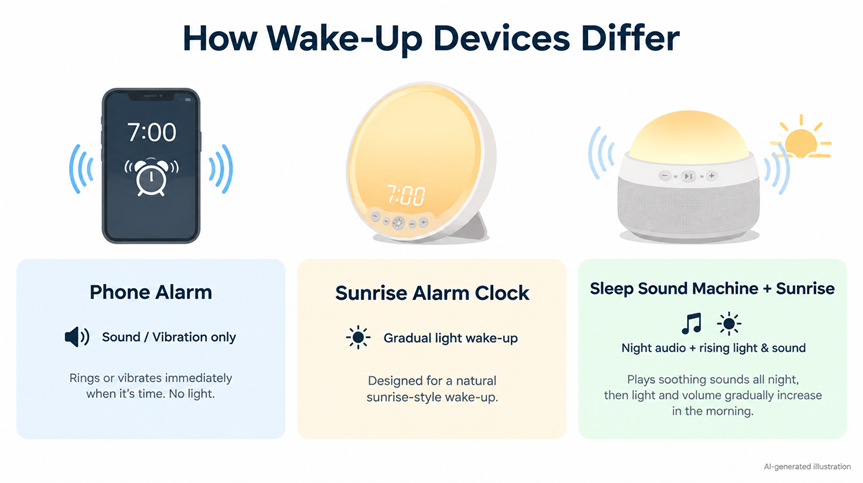
Take the branding off the box and there is not much left to explain: a bulb, a clock chip, and a preset ramp time. Set the alarm, and the light starts climbing toward it a set number of minutes early, filling the room gradually instead of switching on all at once. Sound only shows up afterward, and only once the light on its own has not gotten the job done by the time the alarm was due.
Confusing this with other devices is where a lot of disappointed reviews online come from. A phone alarm skips the light stage entirely and just triggers sound or vibration the moment the clock hits the set time. A standalone sunrise alarm clock exists only for this one job, usually a single lamp face with a handful of buttons. Bedside sleep sound machines that add a sunrise mode are a separate case. Unlike a basic white noise machine, which just plays audio all night with no light involved, this kind of device pairs that audio with its own gradual light and rising sound.
Light Can Cue a Wake-Up. It Cannot Promise One.
A sunrise alarm clock’s gradual brightening works on the body because light is a cue the internal clock uses to stay in sync with the outside world. A room that brightens slowly before the alarm time reads to the body much like sunlight coming through an open curtain. [Source: UW Medicine, rightasrain.uwmedicine.org, Do Wake-Up Lights Actually Work?] How well that works still depends on the person, and it can miss in two opposite directions.
It Can Wake You Earlier Than Planned
The room has to visibly change before any sound plays, so the ramp starts well ahead of the actual wake time. For someone whose sleep reacts strongly to light, that glow by itself is often enough to end the night early, cutting into sleep that was otherwise still scheduled. Ramp lengths are often tuned with a heavier sleeper in mind. That same pace, applied to someone more sensitive to light, can end the night well before the alarm was due.
It May Not Wake You Enough
The opposite problem shows up in people whose sleep does not respond as strongly to light. A slow, dim ramp asks less of the senses than a phone alarm going off next to the pillow, so a deep sleeper, or anyone worn out from a short night, can sleep through the entire ramp without stirring. If the device layers in a louder sound afterward, that stage is usually what finally wakes them. Without it, light on its own may not wake them at all. Light was never built to guarantee a wake-up: it works well for sleepers who respond to it, and barely registers for those who do not.
Your Room Decides Before the Clock Does
The same sunrise alarm clock can produce opposite results from one bedroom to the next, too much light in one room and too little in another, because the room supplies half of what makes its gradual light work. Four common setups show how much that context matters before the alarm time even arrives.
| Room condition | What tends to go wrong | Why it happens |
| Blackout curtains or a dark winter room | You wake too early | With no daylight competing, the clock’s light is the only cue in the room, so a long ramp-up wakes you before the alarm |
| An already-bright east window | The light stage adds little | Daylight is already brighter than the clock’s light, so the wake-up still depends on sound |
| A sleep mask or a face turned away | The light stage does nothing | The light never reaches your eyes, so placement is off or this device is the wrong fit |
| A heavy sleeper | You sleep through the whole sunrise ramp | The gradual cue may be too gentle on its own, so rising sound still matters |
This is a room map for the first few mornings. It is not a ranking.
Borrow the Idea for a Few Mornings First
None of the four room types above require buying dedicated hardware to find out. A few mornings of low-cost experimentation usually settle whether gradual light before the alarm is worth pursuing further.
Test the Timing With Light You Already Have
Leave a gap in the curtains, shift a pillow closer to a window that gets early light, or move a lamp with a plug-in timer near the bed and set it to switch on about 30 minutes before the alarm, shortening the test to 15 or 20 minutes if the light wakes you too early or leaves you groggy. Run that setup for three or four mornings and pay attention to whether waking feels different by the set alarm time, not just whether the room looks brighter. For anyone who decides gradual light is worth pairing with dedicated sleep sounds rather than a single borrowed lamp, a sound machine guide covers that next step.
Keep a Backup Alarm During the Test
Nothing about this trial period should remove the existing phone alarm or clock. Keep it running at the same wake-up time while the light-only test happens, so a slow response on any given morning does not turn into a missed one. Once three or four mornings in a row show that the light helps you wake by the set time, the backup can move from a requirement to a safety net for high-stakes mornings.
When Sound, Light, and That Same Sequence Share One Device
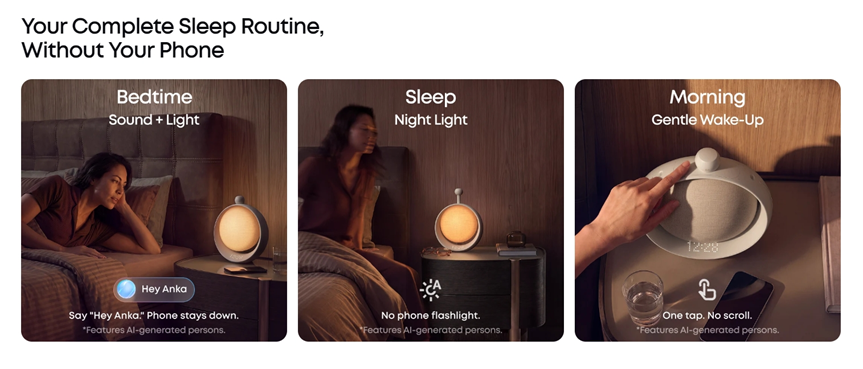
Anker soundcore SleepLab shows what that combination looks like in a single sleep sound machine. It pairs built-in sleep sounds and ambient light with a gradual sunrise and rising sound, all unlocked without a subscription. It also supports phone-free controls, automatic time sync, and battery backup to help keep the alarm on schedule. Contactless sleep sensing belongs to the higher-tier model in the same lineup. For someone who already tested the timing with a curtain gap or a spare lamp and wants the light, the sound, and the same wake-up combined into one device, SleepLab is a straightforward next step.
Conclusion
A sunrise alarm clock is a lamp on a timer: it starts brightening before the alarm and adds sound only once the light has done what it can. That mechanism is simple. What actually decides whether it works is the bedroom it sits in, since a dark room, a bright window, a sleep mask, and a heavy sleeper can each turn the same gradual light into a good cue or a poor one, and the best timing may need to move earlier or later within the usual sunrise window.
Borrowing a curtain gap or a spare lamp for a few mornings answers that question for free. Anker soundcore SleepLab is a straightforward example of that same setup already built into one device, for anyone who finishes the trial and decides the timing is worth buying rather than borrowing.
Frequently Asked Questions (FAQ)
Does a Sunrise Alarm Clock Replace a Regular Alarm?
Not right away, and not for everyone. Give a new sunrise clock a week or two: keep an audible alarm running alongside it, and check whether the light and any built-in sound reliably get you up at the set time on their own. Once that pattern holds, ease the backup back to just the mornings that cannot go wrong, such as a flight or an early meeting.
Can a Sunrise Alarm Clock Help With Waking Up When You Have Insomnia or Seasonal Depression?
No. A sunrise alarm clock changes how waking up feels. It is not a medical device and does not diagnose sleep or mood disorders. Seasonal affective disorder and chronic insomnia are conditions a clinician evaluates and manages, sometimes with a dedicated light therapy box used at prescribed times and distances, a different device doing a different job than a bedside alarm. Ongoing trouble waking up or sleeping is worth raising with a doctor rather than solving with a wake-up light.
How Long Before the Alarm Should the Light Start?
Many sunrise ramps start about 30 minutes to 1 hour before the set wake-up time, though the exact window depends on the device and its settings. A longer ramp gives the body more time to respond, but it also eats into sleep that would otherwise still be happening, so waking up groggy or too early is a sign to shorten the ramp rather than assume something is broken.
How Is a Sunrise Alarm Clock Different From a SAD Lightbox?
A sunrise alarm clock is a low-light, timed device made to ease one wake-up at a set time each day from the nightstand. A SAD lightbox does a different job: much brighter, used during the day while already awake and seated near it for a set session length, typically to help manage seasonal affective disorder under a clinician’s guidance. Neither substitutes for the other, since a lightbox was never meant to run overnight by the pillow, and a bedside alarm is not bright enough to work as daytime light therapy.
Read also: Frehf: Meaning, Uses, Benefits, and Everything You Need to Know




One comment on “What Is a Sunrise Alarm Clock and Does It Actually Work?”