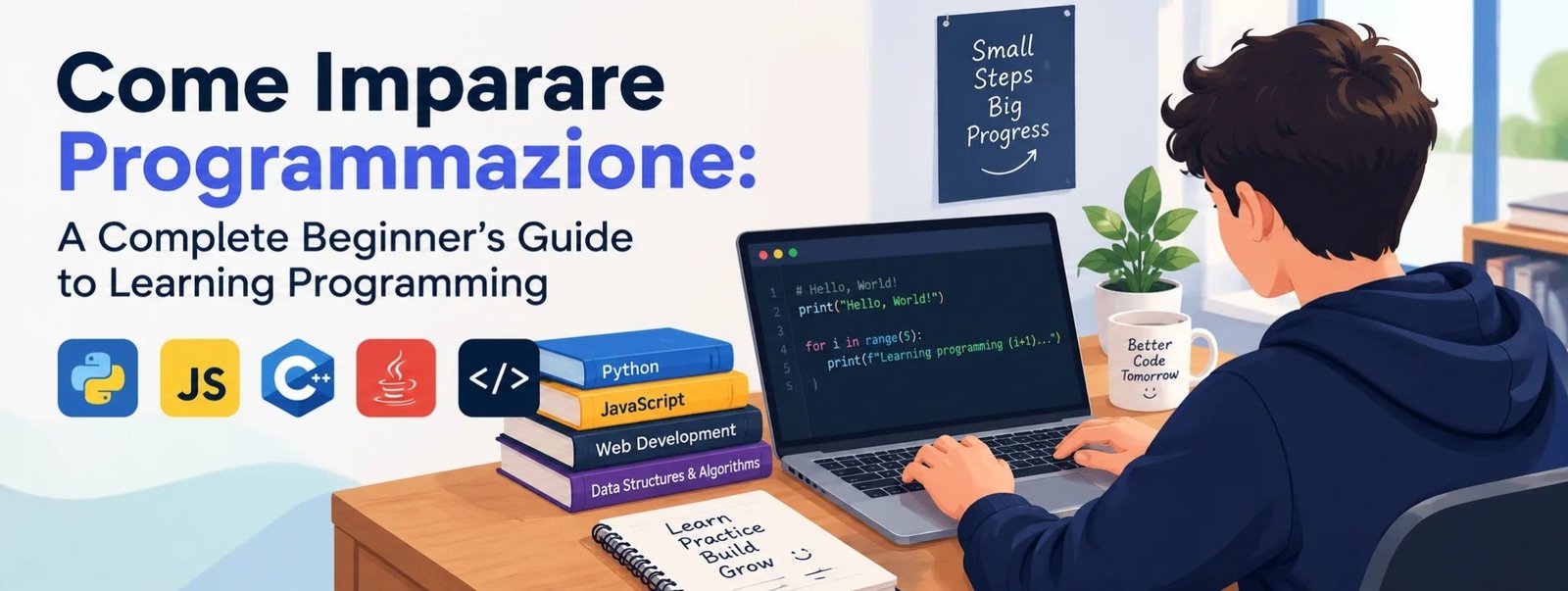
Learning programming can open the door to website development, mobile applications, artificial intelligence, automation, data analysis, and many other technology careers. However, if you are starting from zero, you may have several questions. Which programming language should you learn first? Do you need advanced mathematics? Can you learn coding without a computer science degree? How long does it take to become a programmer?
The good news is that you do not need to know everything before you begin. You can learn programming step by step with a clear plan, regular practice, and small projects that help you understand how code works.
This guide explains come imparare programmazione, which means how to learn programming in Italian. It covers the essential concepts, the best programming languages for beginners, practical exercises, free learning options, common mistakes, and a realistic roadmap for developing your coding skills.
Whether you are a student, a working professional, a complete beginner, or someone planning a career change, this guide will help you choose the right starting point and build a useful programming foundation.
What Does Come Imparare Programmazione Mean?
The Italian phrase “come imparare programmazione” translates into English as “how to learn programming.” It describes the process of learning how to write instructions that a computer can execute to perform specific tasks.
Programming is more than typing lines of code. It involves understanding a problem, dividing it into smaller steps, choosing an appropriate solution, writing instructions, testing the result, and correcting mistakes.
For example, imagine that you want to create a simple calculator. You need to decide how the user will enter numbers, which mathematical operation they want to perform, and how the result will appear. Programming allows you to turn those requirements into working software.
The same principles apply to websites, mobile applications, online stores, video games, business tools, and artificial intelligence systems.
Learning programming becomes easier when you focus on three important areas:
- Logical thinking: Understanding a problem and deciding how to solve it.
- Programming fundamentals: Learning variables, conditions, loops, functions, and data structures.
- Practical development: Using those concepts to build projects that perform real tasks.
You do not have to master every concept at once. Start with the basics and gradually move toward more advanced topics.
Can You Learn Programming Without Previous Experience?
Yes. Anyone with access to suitable learning resources, a willingness to practise, and enough patience can begin learning programming without previous experience.
You do not need to be an expert in computers. You also do not need an expensive laptop, advanced mathematics, or a university degree to write your first program.
However, learning to program does require effort. Some concepts will seem confusing initially, and your first attempts may contain errors. These experiences are a normal part of learning rather than evidence that programming is not for you.
A beginner should concentrate on understanding simple ideas before attempting complicated applications.
For example, instead of trying to build an online shopping platform during your first week, begin with a program that asks for a name and displays a personalized greeting. Later, you can learn how to accept user input, perform calculations, store information, and create interactive features.
The most effective approach is to learn one concept, practise it, and then use it in a small project.
This method helps you build confidence while developing skills that remain useful when you move to another programming language.
How to Start Learning Programming Step by Step
The easiest way to begin is to follow a structured learning process instead of jumping between random tutorials.
Step 1: Decide What You Want to Create
Before choosing a programming language, identify your main goal. Different goals require different tools, so understanding your interests can save time.
Consider these common programming paths:
- Website development: Learn how websites are structured, designed, and made interactive.
- Mobile app development: Learn to create applications for smartphones and tablets.
- Artificial intelligence: Explore algorithms, data, machine learning, and intelligent applications.
- Data analysis: Learn to process information, calculate results, and create useful reports.
- Game development: Understand game logic, graphics, physics, and player interaction.
- Automation: Write programs that complete repetitive tasks automatically.
- Software development: Build desktop applications, business systems, and other software products.
You do not need to select a permanent career immediately. Choose one area that interests you enough to begin practising.
For example, if you want to create websites, start with HTML and CSS before learning JavaScript. If you want to automate everyday computer tasks or explore data analysis, Python is a practical starting point.
Step 2: Choose One Beginner-Friendly Language
Your first programming language should match your goal and be manageable for a beginner.
Python is a popular option because its syntax is relatively readable. JavaScript is useful for interactive websites, while HTML and CSS help beginners understand how web pages are structured and styled.
Avoid learning several languages simultaneously at the beginning. Although comparing languages can be interesting, switching constantly may prevent you from developing a strong understanding of basic programming concepts.
Choose one primary path and continue until you can create a small working project without copying every instruction from a tutorial.
Step 3: Prepare Your Learning Environment
You can begin programming with a computer, a text editor, and the appropriate language tools. You do not need to purchase expensive software.
A beginner working with Python can install Python and use a code editor to create and run programs. Someone learning web development can write HTML, CSS, and JavaScript files and open the resulting pages in a browser.
If you do not have a suitable computer immediately, browser-based coding environments can help you practise simple exercises without installing everything locally.
Create a dedicated folder for your projects. Give files clear names and save working versions regularly. Keeping your work organized makes it easier to find errors and see your progress.
Step 4: Learn the Fundamental Concepts
Every beginner should understand a few essential programming concepts before moving to advanced frameworks or tools.
These include:
- Variables and data types
- Input and output
- Operators and expressions
- Conditional statements
- Loops
- Functions
- Lists and other data structures
- Basic error handling
You do not need to memorize every rule. Focus on understanding what each concept does and when it is useful.
For example, a variable stores information, a condition allows a program to make a decision, and a loop repeats instructions. Functions organize reusable pieces of code.
Once these ideas become familiar, more complex programs will be easier to understand.
Step 5: Practise With Small Exercises
Reading explanations is useful, but programming is a practical skill. You need to write code yourself to discover whether you truly understand a concept.
Start with short exercises such as:
- Displaying a greeting on the screen
- Adding two numbers
- Converting temperatures
- Checking whether a number is even or odd
- Calculating the average of several scores
- Printing a multiplication table
- Counting words in a sentence
Try solving each exercise independently before looking at a complete solution.
If your first attempt fails, examine the error and identify what needs to change. Even a small exercise can teach you how to think through a problem systematically.
Step 6: Build Your First Project
After learning the basics, combine them in a simple application.
A calculator, quiz, number guessing game, or to-do list can help you practise several concepts at once.
Your first project does not need a complicated design. It should have a clear purpose and work as expected.
For instance, a number guessing game can generate a random number, accept a player’s guess, compare the guess with the answer, and display a helpful message. You can then improve it by limiting the number of attempts or keeping track of the score.
Projects help you move from understanding individual commands to solving complete problems.
Step 7: Review and Improve Your Code
Writing code that works is an important achievement, but it is not the end of the learning process.
Review your project and ask yourself whether the code is easy to understand, whether repeated instructions can be simplified, and whether unusual inputs cause problems.
Test your program with different values. Add comments where they clarify a complicated decision, and divide large sections into smaller functions when appropriate.
Learning to improve existing code is just as important as learning to write new code.
Which Programming Language Is Best for Beginners?
There is no single best programming language for every learner. The right choice depends on what you want to build, the type of problems you enjoy solving, and your longer-term goals.
| Programming language or technology | Best suited for | Beginner advantage |
| Python | Automation, data analysis, AI, general programming | Readable syntax |
| JavaScript | Interactive websites and web applications | Runs in web browsers |
| HTML and CSS | Website structure and visual design | Immediate visual results |
| Java | Backend systems, enterprise software, Android development | Structured programming concepts |
| C++ | Game development, performance-focused software, algorithms | Helps develop a deeper understanding of programming |
| C# | Applications and game development | Useful ecosystem for software and games |
| PHP | Server-side websites and content management systems | Practical for dynamic websites |
| Kotlin | Android application development | Designed for modern Android development |
| Swift | Apple platform applications | Focused on Apple’s software ecosystem |
Remember that HTML is a markup language and CSS is a styling language, not a general-purpose programming language. Both are nevertheless essential starting technologies for many web developers.
Python: A Practical First Language
Python is an excellent choice if you want to learn general programming, automate tasks, analyse data, or explore artificial intelligence.
Its syntax often makes programs easier to read than equivalent code in more complex languages. Beginners can concentrate on understanding programming logic instead of dealing with excessive syntax.
Python can be used for scripts, web applications, data processing, testing, and machine learning projects.
A simple Python program looks like this:
name = input(“What is your name? “)
print(“Welcome to programming, ” + name + “!”)
The program asks the user for a name and then displays a greeting. Although the example is simple, it introduces input, variables, and output.
JavaScript: Best for Interactive Websites
JavaScript is a strong choice for people interested in website development.
It allows developers to create interactive buttons, validate forms, update page content, and build applications that respond to user actions. With suitable tools, JavaScript can also be used for server-side development.
Beginners who want to become frontend developers should first understand HTML and CSS, then learn JavaScript fundamentals.
A small JavaScript exercise is to display a message when a user clicks a button. This creates a visible connection between code and the behaviour of a website.
HTML and CSS: Best for Seeing Results Quickly
HTML defines the structure of a web page, while CSS controls its presentation, including colours, spacing, typography, and layout.
These technologies are useful for beginners who want to create something visible as early as possible.
You can begin with a personal profile page, add headings and paragraphs, style the page with CSS, and gradually introduce forms and responsive layouts.
Once you understand the basics, JavaScript can make the page interactive.
Java and C++: Useful for Structured Learning
Java and C++ are valuable languages for learners interested in computer science, algorithms, software engineering, and certain specialized development roles.
They introduce concepts such as data types, program structure, and object-oriented programming. C++ is also useful for performance-sensitive applications and many game development environments.
Both can be learned by beginners, but they may require more attention to syntax and language-specific concepts than a simple introductory Python course.
Choose them when they fit your educational goals or the software you want to create, rather than assuming that a more difficult language automatically makes you a better programmer.
The Most Important Programming Concepts to Learn
A strong foundation is more valuable than memorizing hundreds of commands. The following concepts appear in many programming languages and help you understand how software works.
Variables and Data Types
Variables allow programs to store and use information. A variable might contain a person’s name, a product price, a score, or the result of a calculation.
Data types describe the kinds of values a program handles. Common examples include integers, decimal numbers, strings, and Boolean values.
For example, a shopping application may store a product name as text and its price as a number.
Understanding variables helps you write programs that work with changing information instead of fixed values.
Conditions and Decision-Making
Conditional statements allow a program to choose between different actions.
A program might check whether a customer has entered a valid discount code, whether a student has passed an examination, or whether a number is greater than zero.
Conditions are useful whenever a program needs to respond differently depending on the information it receives.
Loops and Repetition
Loops repeat a block of code while a particular condition remains true or for each item in a collection.
For example, a program can use a loop to display numbers, process a list of products, or calculate the total of several expenses.
Learning loops reduces unnecessary repetition and makes programs more efficient to maintain.
Functions and Reusable Code
Functions group instructions into reusable units. Instead of writing the same calculation several times, you can create a function and call it whenever necessary.
Functions also make large programs easier to understand because each function can handle a specific responsibility.
A well-organized program often contains multiple functions that work together to complete a larger task.
Data Structures
Data structures help programs organize information.
Lists and arrays store collections of values, while dictionaries and maps associate keys with values. Sets are useful when you need collections of unique items.
For example, a student management application might use a collection to store student names and a dictionary to associate each student with a score.
Learn the basic structures in your chosen language before studying more advanced data organization techniques.
Debugging and Error Handling
Debugging means finding and correcting problems in code.
Some errors prevent a program from running. Others allow it to run but produce the wrong result. Learning to distinguish these situations helps you diagnose problems more effectively.
Read error messages carefully, check the relevant line, and test your assumptions. When possible, reproduce the problem with a small example.
Error handling is also important because real programs must respond sensibly to unexpected input, missing files, or unavailable services.
How to Practise Programming Every Day
Consistency is one of the most important parts of learning to code. You do not need to study for several hours every day to make progress, but you should practise regularly.
A focused session of 30 to 60 minutes can be useful when you spend most of that time actively solving problems.
You can organize a session into three parts:
- Learn: Spend a short period understanding one new concept.
- Practise: Write several small programs using that concept.
- Review: Identify mistakes, record what you learned, and decide what to practise next.
For example, if you are learning conditions, spend the session writing programs that compare numbers, validate ages, or calculate grades.
Do not measure progress only by the number of lessons completed. Measure it by what you can create or explain without following instructions.
Keeping a simple learning journal can help. Record the concept you studied, the exercise you completed, the problem you encountered, and how you solved it.
Over time, this record becomes evidence of your progress and a useful reference when you forget something.
A 30-Day Programming Roadmap for Beginners
A 30-day plan gives you a practical way to begin. The schedule below assumes approximately 30 to 60 minutes of practice on most days. You may need more time for difficult topics, and that is completely normal.
Week 1: Understand the Basics
Choose Python for general programming or HTML and CSS for a website-focused path.
During the first week, learn how your chosen technology works and prepare a simple coding environment.
For Python, practise displaying messages, receiving input, creating variables, using data types, and performing basic calculations.
For web development, create a simple page with headings, paragraphs, links, and basic styling.
Weekly goal: Create a small program or web page without copying every line from a tutorial.
Week 2: Learn Logic and Control Flow
Focus on conditions, loops, and problem-solving.
Write programs that compare numbers, check whether a value meets a requirement, display multiplication tables, or repeat a task for several items.
Try to solve each problem in your own way before checking a sample answer.
If you are learning web development, begin JavaScript fundamentals after gaining a basic understanding of HTML and CSS.
Weekly goal: Solve several small problems using decisions and repetition.
Week 3: Learn Functions and Organize Information
Move on to functions and basic data structures.
Practise creating reusable functions, passing information into them, returning results, and storing multiple values in lists or arrays.
Build a small program that combines these concepts. A quiz application, expense calculator, or student score tracker is a suitable option.
Test your work with different inputs and correct any errors you discover.
Weekly goal: Complete a small project that uses multiple programming concepts.
Week 4: Build and Improve a Complete Project
Choose one project and finish a usable first version.
Avoid adding too many features. Concentrate on making the essential functionality work properly.
For a Python project, you might create a calculator, a number guessing game, or a simple expense tracker. For web development, you could create a responsive personal page with an interactive feature.
Document what the project does, what you learned, and what you would improve next.
Weekly goal: Finish a project that you can demonstrate and explain.
What Should You Do After 30 Days?
At the end of the month, review your progress honestly.
Can you write simple code independently? Can you explain variables, conditions, loops, and functions? Can you read an error message and attempt to fix it? Can you complete a small project without following a tutorial from beginning to end?
If the answer to some questions is no, continue practising those areas before moving forward.
Your next step should be to learn more advanced concepts within your chosen path, complete larger projects, and begin exploring the tools used by developers in that field.
The objective of the first month is not to become an expert. It is to establish a foundation and develop a consistent learning habit.
Best Free Ways to Learn Programming
You can learn many programming fundamentals without paying for a course. Free educational materials, interactive exercises, documentation, and personal projects can provide a solid starting point.
Follow a Structured Course
A structured course provides lessons in a logical order. This can be especially helpful when you do not know which concepts to study first.
Look for beginner courses that explain fundamental ideas, include exercises, and encourage you to write code independently.
Choose one main course rather than collecting dozens of unfinished courses. Complete its introductory material and use additional resources only when you need another explanation.
Use Interactive Coding Exercises
Interactive exercises allow you to write code and see the result immediately.
They are useful for practising syntax, solving small problems, and identifying misunderstandings. Start with simple exercises and increase the difficulty gradually.
However, do not rely entirely on exercises with predefined answers. You should also create your own programs to learn how separate concepts work together.
Read Documentation
Official language documentation explains how programming features and tools behave.
At first, documentation may seem difficult because it often assumes some familiarity with technical terms. Start with beginner tutorials and gradually learn how to use reference material when you need to understand a function or feature.
Being able to find and interpret reliable technical information is an important long-term programming skill.
Learn From Example Projects
Reading example code helps you see how programmers organize files, name variables, define functions, and solve common problems.
Start with small projects that you can understand. Change a feature, experiment with different inputs, and observe how the program responds.
Simply copying a project does not guarantee that you understand it. Your goal should be to explain what the important sections do and make meaningful modifications yourself.
Use Books and Video Lessons Carefully
Books and videos can provide helpful explanations, particularly when you are struggling with a new topic.
Pause videos regularly and write the code yourself. After finishing a lesson, close the tutorial and try to recreate the main example from memory.
If you cannot do that yet, revisit the relevant concept and practise with a smaller exercise.
The best learning resource is one that helps you become increasingly independent, not one that encourages you to watch more lessons without writing code.
Read more: Family Life Elevated: What Makes Lentor Signature’s Launch a Game-Changer for Parents
How to Learn Programming Without a Computer Science Degree
A computer science degree can provide valuable theoretical knowledge, structured instruction, and opportunities to collaborate with other learners. However, it is not the only way to develop programming skills.
Self-directed learners can build a foundation through courses, practice exercises, technical documentation, and independent projects.
If you are learning without a degree, pay particular attention to the following areas:
- Programming fundamentals and problem-solving
- Data structures and algorithms
- Testing and debugging
- Basic computer science concepts
- Version control and project organization
- Clear technical communication
- Practical projects that demonstrate your abilities
The depth of knowledge you need depends on your goals. Someone creating small websites may follow a different learning path from someone preparing for a software engineering interview.
For employment, some companies require degrees or specific qualifications, while others place considerable emphasis on relevant experience and demonstrated skills. Requirements vary by employer, location, and role.
A portfolio can help you show what you have learned, but it does not guarantee employment. Combine practical work with an understanding of the technical concepts relevant to the positions you want.
How to Learn Programming for a Career
Programming can lead to several career paths, but each requires a different combination of skills.
Frontend Development
Frontend developers create the parts of websites and web applications that users see and interact with.
A typical learning path includes HTML, CSS, JavaScript, responsive design, accessibility, and eventually a relevant framework or library.
Build projects such as personal websites, interactive forms, dashboards, and small web applications to practise these skills.
Backend Development
Backend developers work on the server-side systems that support applications.
Their responsibilities may include handling requests, processing information, managing databases, implementing authentication, and maintaining application logic.
Depending on your chosen ecosystem, you might learn Python, JavaScript with a server-side runtime, Java, PHP, or another suitable language.
After learning the fundamentals, explore databases, APIs, security basics, and testing.
Mobile App Development
Mobile developers create applications for smartphones and tablets.
For Android development, Kotlin is a relevant option. For Apple platforms, Swift is commonly used. Cross-platform frameworks can also allow developers to build applications for multiple platforms with shared code.
Start by learning the language and development tools appropriate to your chosen platform, then create a small app with a clear purpose.
Data Analysis and Artificial Intelligence
Python is a practical starting point for people interested in data analysis and many AI-related fields.
Begin with Python fundamentals, then study data handling, statistics, and the tools required for your chosen specialization.
Artificial intelligence involves more than writing code. Depending on the role, you may need mathematics, probability, linear algebra, model evaluation, data preparation, and an understanding of how machine learning systems behave.
Build projects that demonstrate how you collect, process, analyze, and interpret data.
Automation and Freelancing
Programming can also help freelancers and professionals automate repetitive tasks or develop small tools for clients.
Examples include processing spreadsheet data, organizing files, generating reports, creating website features, and integrating software systems.
Choose a specific problem, learn the tools needed to solve it, and create a reliable solution. If you plan to work with clients, also learn how to understand requirements, estimate the scope of a task, test your work, and communicate clearly.
Common Programming Mistakes Beginners Should Avoid
Many learners struggle because they use ineffective study habits rather than because programming is inherently beyond their abilities.
Trying to Learn Too Many Languages
Learning Python, JavaScript, Java, and C++ at the same time can create unnecessary confusion.
Start with one language that supports your immediate goal. Learn its fundamentals and complete a few projects before deciding whether you need another language.
Watching Tutorials Without Practising
Watching someone else write code can make a topic feel easy, but understanding an explanation is different from solving a problem independently.
Type the examples, change them, and recreate them without assistance. Regular practice reveals gaps in your understanding.
Copying Code Without Understanding It
Copying code may help you explore an unfamiliar project, but it should not replace learning.
After using an example, explain the purpose of its important sections. Change an input, remove a feature, or add a small improvement to see whether you understand how it works.
Giving Up When Errors Appear
Errors are part of normal programming work. Even experienced developers encounter unexpected behavior.
Read the error message, check the relevant code, and reproduce the issue with a smaller example if possible. Change one thing at a time so you can identify what actually fixes the problem.
Starting With Projects That Are Too Difficult
Building a large social network, complex game, or complete online store may be overwhelming for a beginner.
Divide ambitious ideas into smaller features. First create a basic working version, then add improvements gradually.
Ignoring Fundamentals Because of AI Tools
AI coding assistants can explain concepts, suggest examples, and help investigate errors. However, depending on generated code without understanding it can leave you unable to maintain or troubleshoot a project.
Use AI to ask questions, compare approaches, and receive hints. Test suggestions yourself, verify important details, and make sure you understand the resulting code.
How AI Can Help You Learn Programming Faster
Artificial intelligence tools can support programming education when used as learning assistants rather than replacements for your own reasoning.
You can ask an AI assistant to explain a concept in simpler language, generate practice questions, review a short program, or describe why a particular error might occur.
For example, you could ask for five beginner exercises about Python loops without requesting their solutions immediately. After attempting the exercises, you can compare your approach with a suggested solution and examine any differences.
AI can also help you understand unfamiliar terminology and explore alternative ways to solve a problem.
Nevertheless, generated explanations and code can contain mistakes. Test code in your own environment and verify important technical details.
Never share passwords, private keys, confidential client information, or sensitive personal data when using coding assistants. If you work with private code, follow the relevant privacy and security requirements.
The best approach is to attempt a problem yourself first, use AI when you need help, and then solve a similar problem independently. This allows you to benefit from AI while continuing to develop your own programming ability.
Frequently Asked Questions About Come Imparare Programmazione
How Can I Learn Programming From Zero?
Start by choosing a goal and one suitable language. Learn variables, data types, conditions, loops, and functions. Practise with small exercises and then build a simple project. Study regularly, review your mistakes, and gradually increase the complexity of your work.
Which Programming Language Is Easiest for Beginners?
Python is often a good choice for general programming because its syntax is relatively readable. HTML and CSS are accessible starting technologies for people interested in websites, while JavaScript is important for interactive web development. The easiest option depends on your goal and learning preferences.
Can I Learn Programming in 30 Days?
You can learn basic concepts and potentially complete a small project in 30 days if you practise consistently. However, becoming proficient enough to handle complex applications or qualify for a particular job generally takes longer. Your progress depends on your background, study time, project difficulty, and learning approach.
How Many Hours Should I Study Programming Every Day?
Beginners can start with 30 to 60 minutes of focused practice on most days. Longer sessions can be helpful when you have sufficient time and energy, but consistency and active problem-solving are more important than simply spending many hours watching lessons.
Do I Need Mathematics to Become a Programmer?
Basic arithmetic and logical reasoning are sufficient for many introductory programming tasks. Advanced mathematics becomes more important in specialized fields such as machine learning, scientific computing, computer graphics, and certain engineering applications. The mathematics you need depends on the type of software you want to develop.
Can I Learn Programming on My Own?
Yes. Many people begin programming through self-study using courses, documentation, practice exercises, and personal projects. Self-study requires discipline because you must organize your learning and identify gaps in your understanding. A structured curriculum and feedback on your projects can make the process easier.
Can I Learn Programming on a Mobile Phone?
You can practise basic coding concepts using mobile-friendly coding environments and applications. However, a computer is generally more convenient for developing larger projects, managing files, using professional development tools, and testing complex applications. A phone can help you begin, but a computer is preferable for sustained development work.
Is Programming Still Worth Learning?
Programming remains useful for building software, automating tasks, working with data, developing websites, and understanding technology. The value of learning it depends on your goals and the skills you develop. Combining programming fundamentals with communication, problem-solving, testing, and domain knowledge can make your abilities more useful across different roles.
Should I Learn Python or JavaScript First?
Choose Python if you are interested in general programming, automation, data analysis, or AI-related projects. Choose JavaScript if your main goal is interactive websites and web applications. Both can teach important programming concepts, so select the one that best supports your first meaningful project.
Can I Get a Programming Job Without a Degree?
Some employers accept candidates without a computer science degree, while others require formal qualifications. Practical projects, technical knowledge, problem-solving ability, and interview performance can help demonstrate your skills. Research the requirements for your target role and location before deciding which qualifications to pursue.
What Should I Build as My First Programming Project?
Good beginner projects include a calculator, number guessing game, quiz application, to-do list, personal website, and expense tracker. Choose something small enough to finish, then improve it by adding features, validating input, and handling errors.
Is It Better to Learn Coding Through Videos or Books?
Both can be useful. Videos provide demonstrations, while books and written tutorials allow you to study at your own pace. The most effective resource is one that includes clear explanations and practical exercises. Whichever format you choose, write and test code rather than consuming lessons passively.
Final Thoughts
Understanding come imparare programmazione begins with a simple principle: start small, practise consistently, and build your knowledge one step at a time.
You do not need to learn every programming language or understand every advanced concept before creating something useful. Choose a clear goal, select an appropriate first language, and focus on the fundamentals. Then apply what you learn through exercises and practical projects.
If you want to create websites, begin with HTML and CSS before progressing to JavaScript. If you are interested in automation, general programming, or data analysis, consider Python. Other languages may be more appropriate when your goals involve particular platforms or specialized software.
Expect to encounter mistakes, revisit difficult concepts, and improve your code over time. Use learning resources and AI tools thoughtfully, but make sure you can explain and test the programs you create.
Your first program may be small, but completing it gives you a foundation for the next one. With patience, consistent effort, and a practical learning plan, you can progress from a complete beginner to someone who can design, build, and improve useful software.



One thought on “Come Imparare Programmazione: A Complete Beginner’s Guide to Learning Programming from Scratch”