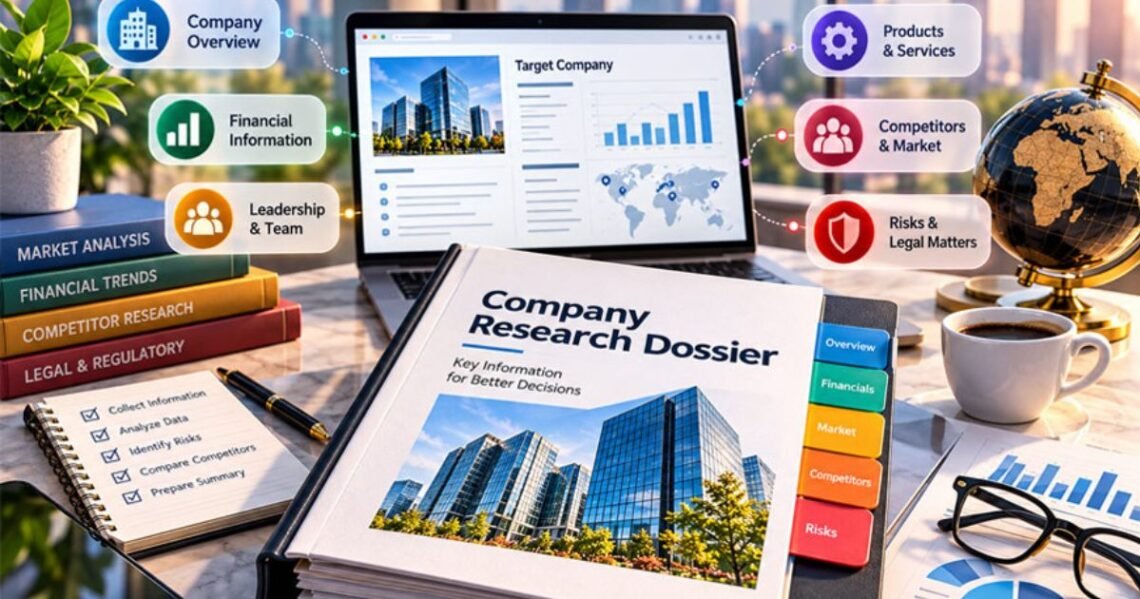
A research dossier for target company analysis is a structured document that helps you understand a business before making an important decision. It brings essential information about a company’s background, ownership, products, customers, financial performance, competitors, market position, and potential risks into one organized report.
Whether you are researching a potential business partner, evaluating a supplier, preparing for a sales meeting, studying a competitor, or considering an investment, a well-prepared company research dossier can save time and improve your understanding. Instead of relying on scattered information, you can use verified facts and meaningful analysis to build a clearer picture of the business.
This guide explains what a research dossier for a target company is, why it matters, which information to collect, how to verify company details, and how to create a professional dossier using a practical template. It also covers financial analysis, competitive intelligence, risk assessment, and common research mistakes to avoid.
What Is a Research Dossier for a Target Company?
A research dossier for a target company is a detailed report that organizes relevant information about a specific business for a particular research purpose. It combines company facts, supporting evidence, market information, observations, and analysis to help someone understand the organization more effectively.
The term target company simply refers to the business being investigated. It does not necessarily mean a particular retailer or a company with the word Target in its name.
Depending on the research objective, a dossier may contain:
- Company name, background, and legal identity
- Founders, owners, executives, and management structure
- Products, services, and business model
- Customer groups and geographic markets
- Revenue, expenses, profitability, and available financial data
- Competitors and industry trends
- Marketing strategies and market positioning
- Employees, suppliers, and business partners
- Technology, operations, and intellectual property
- Reputation, legal matters, and regulatory concerns
- Growth opportunities, business risks, and research gaps
A strong dossier does more than describe what a company does. It explains what the available information means and how reliable that information is.
For example, discovering that a company has expanded into another country is a useful fact. A deeper analysis considers why the company expanded, which customers it wants to reach, what resources the expansion requires, and whether the move creates new opportunities or risks.
The purpose is to turn information into a practical understanding of the business.
Why Is a Target Company Research Dossier Important?
Business decisions often involve uncertainty. A company may appear successful because it has a professional website, an active social media presence, or an attractive product range. However, these details alone cannot establish its financial stability, operational strength, customer satisfaction, or long-term potential.
A research dossier helps bring different pieces of information together so that important decisions are based on evidence rather than assumptions.
- Better business decisions
A structured report makes it easier to compare available facts, identify concerns, and determine whether a company meets your requirements.
- Improved sales preparation
Sales professionals can learn about a potential customer before making contact. Understanding the customer’s products, industry, business priorities, and likely needs helps make conversations more relevant.
- More informed investment research
Investors can use a company dossier to examine financial performance, management, competition, business risks, and potential growth drivers before deciding whether further investigation is necessary.
- Safer supplier selection
Businesses can evaluate a supplier’s capabilities, delivery arrangements, available certifications, financial information, and documented performance before entering a commercial relationship.
- Stronger competitor analysis
A dossier helps identify competing products, pricing approaches, customer segments, market positioning, and potential gaps that a business could address.
- Easier future updates
Once information is organized, researchers can update the same document when new financial results, leadership appointments, product launches, or major business developments occur.
The main benefit is clarity. A good research dossier shows what is known, what remains uncertain, and what should be investigated next.
Research Dossier vs. Company Profile vs. Due Diligence
These terms are related, but they serve different purposes.
Company profile: A company profile provides a relatively short overview of a business. It usually covers its background, industry, products, services, location, and leadership.
Research dossier: A research dossier goes deeper by organizing information from multiple sources, evaluating the evidence, identifying risks, comparing competitors, and explaining the findings in relation to a specific objective.
Due diligence: Due diligence is a more formal investigation commonly conducted before an acquisition, investment, major contract, or other significant transaction. It may require access to private financial records, contracts, tax documents, legal records, operational data, and professional advisers.
A public-information research dossier can support the early stages of due diligence, but it cannot replace a complete legal, financial, or technical investigation when one is required.
The appropriate level of research depends on the decision you need to make.
Define Your Research Objective Before Starting
The first step in creating a research dossier for a target company is to establish why you are researching the business.
Without a clear objective, it is easy to collect large amounts of information that do not help answer the important questions.
Start by writing one sentence that describes the purpose of the research.
For example:
- Sales research: Determine whether the company is a suitable potential customer for a particular service.
- Investment research: Evaluate the company’s business model, financial performance, growth prospects, and major risks.
- Supplier research: Assess whether the company can provide reliable products or services.
- Competitor research: Understand how the business competes and where opportunities may exist.
- Acquisition research: Identify the company’s ownership, financial condition, operations, liabilities, and strategic value.
- Partnership research: Determine whether the business has the capabilities, reputation, and goals needed for a successful collaboration.
Next, prepare three to five questions that the dossier must answer.
A supplier assessment, for example, might ask whether the supplier has the necessary capacity, serves the required locations, provides suitable quality controls, and has a reliable delivery process.
Also record the research date, geographic scope, intended audience, and any limitations. These details help readers understand what the investigation covers.
Step-by-Step Process for Creating a Company Research Dossier
A consistent research process makes the final report easier to prepare, review, and update.
Step 1: Confirm the company’s identity
Identify the exact legal entity being researched. Record its legal name, trading names, official website, headquarters, registration details when available, industry, and ownership type.
This is particularly important when several businesses use similar names or when a brand operates through different subsidiaries.
Step 2: Collect basic company information
Review available company descriptions, official announcements, public records, product information, and relevant business documents. Record the source and date of important details.
Step 3: Investigate the business model
Determine what the company sells, who buys it, how customers access its products or services, and how the business generates revenue.
Step 4: Examine leadership and ownership
Identify relevant executives, founders, owners, parent companies, and subsidiaries when this information can be verified.
Step 5: Review financial information
Collect available financial statements, revenue figures, expenses, debt information, cash flow, funding announcements, and other relevant indicators. Clearly distinguish official figures from outside estimates.
Step 6: Analyze the market and competition
Identify direct competitors, alternative solutions, customer expectations, industry developments, and the company’s position within its market.
Step 7: Investigate operations and risks
Review publicly available information about suppliers, production, technology, cybersecurity, legal exposure, regulatory requirements, and operational dependencies.
Step 8: Verify important findings
Check significant claims against reliable evidence. Resolve differences between sources where possible, and record any remaining uncertainty.
Step 9: Summarize the implications
Explain the company’s major strengths, weaknesses, opportunities, risks, and unresolved questions in relation to your original objective.
Step 10: Prepare and review the final report
Write a concise executive summary, organize the detailed findings, check dates and calculations, and make sure every important conclusion is supported by evidence.
Essential Sections of a Research Dossier for a Target Company
A useful company research dossier should contain enough information to answer its main research questions without becoming an unorganized collection of facts.
The following sections provide a comprehensive framework.
1. Executive Summary
The executive summary presents the most important findings at the beginning of the dossier.
It should briefly explain what the company does, why it was researched, what the investigation discovered, and which issues deserve attention.
Include the company’s basic identity, principal business activities, relevant strengths, major risks, and the most important conclusions.
Keep the summary focused. A reader should be able to understand the main findings without reading every page.
Although it appears first, the executive summary is usually best written after the rest of the research has been completed.
2. Company Background and Identity
This section establishes the identity of the target company.
Record the following information where available:
- Full legal name and commonly used brand name
- Founding year and founders
- Headquarters and operating locations
- Industry and principal business activities
- Public or private ownership status
- Parent company and subsidiaries
- Main products and services
- Geographic markets served
- Official registration information
- Company website and relevant contact information
Do not assume that every field will be publicly available. If a detail cannot be confirmed, label it as unavailable or unverified instead of inventing an answer.
The company’s background should explain how it developed into its current form, particularly when major changes have affected its operations or market position.
3. Company History and Major Milestones
A company timeline can reveal how a business has evolved over time.
Look for important events such as its founding, product launches, acquisitions, partnerships, funding rounds, international expansion, restructuring, and changes in leadership.
For each milestone, record the date, event, available evidence, and potential significance.
For example, an acquisition may expand a company’s product range, provide access to new customers, or introduce integration challenges. A product launch may indicate a new strategic direction, but it does not automatically prove that the product has been commercially successful.
Focus on events that explain the company’s present situation. Minor historical details that do not affect your research objective can usually be excluded.
4. Products, Services, and Customer Segments
Understanding the company’s products and services is essential for evaluating its commercial position.
Describe its main offerings in simple language. Explain the problem each product solves, the customers it serves, and the main features that distinguish it from alternatives.
Investigate the following areas:
- Core products and services
- Pricing and subscription arrangements
- Product availability and distribution
- Main customer groups
- Business-to-business or consumer focus
- Publicly documented customer relationships
- Customer support and service arrangements
- Product development and innovation
- Dependence on particular products or customer groups
For example, a software business may serve individual users through subscriptions while offering customized enterprise packages to larger organizations.
A manufacturer may sell through distributors, retailers, or direct commercial contracts.
The dossier should explain how these arrangements affect the company’s reach, costs, customer relationships, and competitive position.
5. Business Model and Revenue Sources
The business model explains how a company creates value and earns money.
Common revenue sources include product sales, subscriptions, licensing, advertising, commissions, consulting fees, memberships, marketplace charges, and long-term contracts.
Some businesses use several revenue models at once.
When examining a business model, identify its main revenue sources, customer acquisition methods, pricing structure, sales channels, major costs, and important commercial relationships.
Also consider whether revenue depends on repeat purchases, ongoing subscriptions, seasonal demand, or a small number of large customers.
A diversified revenue model may reduce dependence on a single source, but diversification alone does not guarantee profitability.
For private companies, detailed revenue breakdowns may not be publicly available. Do not estimate exact figures without a defensible method and clear labeling.
6. Leadership, Ownership, and Governance
Leadership research helps establish who directs the business and how important decisions are made.
Identify the founder, chief executive, finance leader, technology leader, board members, major owners, and parent organizations when relevant information is available.
Record each person’s current role, relevant professional background, appointment date, and responsibilities.
For larger organizations, consider the board’s structure, ownership concentration, succession planning, and documented governance arrangements.
For smaller businesses, founder involvement may be particularly important if the company’s operations depend heavily on one individual.
However, leadership experience should be evaluated using documented information rather than assumptions about a person’s ability or intentions.
Always check that the roles are current. An older profile may identify someone as an executive even though that person has since left the company.
7. Financial Performance and Stability
Financial research helps explain whether a company is growing, generating cash, managing costs, and meeting its obligations.
Useful indicators include:
- Revenue and revenue growth
- Gross profit and gross margin
- Operating profit or loss
- Net income
- Operating cash flow
- Cash and available liquidity
- Debt and financial obligations
- Assets and liabilities
- Capital expenditure
- Funding and financing arrangements
Review multiple reporting periods whenever possible. A single year’s figures may not show whether a business is experiencing sustainable growth or a temporary change.
Revenue should not be examined in isolation. A company can increase sales while experiencing falling margins, rising debt, or negative cash flow.
The source, currency, reporting period, and accounting basis should be recorded for every important financial figure.
Public companies may disclose detailed financial statements, while private businesses may reveal much less information. If reliable figures are unavailable, explain this limitation clearly.
A lack of public financial data does not automatically mean that a company is financially weak.
8. Market Research and Industry Position
Company performance is influenced by the market in which the business operates.
Research the industry’s size, growth patterns, customer demand, pricing pressures, regulatory environment, technology changes, and major economic influences.
Identify the company’s principal customer segments and the geographic markets that matter most to its operations.
For a technology business, relevant factors might include automation, artificial intelligence, cybersecurity, cloud infrastructure, and changing customer expectations.
For a manufacturing business, important factors might include material costs, transportation, production capacity, labor availability, and supply chain stability.
Use market statistics carefully. Figures from different reports may cover different regions, customer groups, or product categories.
The dossier should define the market being discussed rather than presenting unrelated industry estimates as if they describe the same market.
9. Competitor Analysis and Market Positioning
Competitor analysis helps explain the target company’s position relative to other businesses offering similar products or solutions.
Begin by identifying direct competitors that serve similar customers with comparable offerings. Then identify indirect competitors that solve the same problem in a different way.
Compare the businesses across relevant factors, including pricing, product features, quality, customer service, distribution, geographic reach, technology, and brand positioning.
A simple comparison table can make the findings easier to interpret.
| Comparison factor | What to investigate |
| Products and services | Main offerings and important differences |
| Pricing | Public prices, plans, and commercial terms |
| Target customers | Customer groups and industries served |
| Geographic reach | Markets and locations covered |
| Distribution | Direct sales, partners, stores, or online channels |
| Customer experience | Repeated feedback patterns and service strengths |
| Innovation | Documented product development and new capabilities |
| Competitive risks | Areas where alternatives may be more attractive |
Avoid describing a company as the market leader unless credible evidence supports that claim. A business may be strong in one region or niche without dominating the wider industry.
The purpose of competitor research is to identify meaningful differences and their possible implications, not simply to create a list of competing names.
10. Operations, Technology, and Supply Chain
This section explains how the company delivers its products or services.
For manufacturers, investigate production facilities, suppliers, inventory, transportation, quality controls, and distribution arrangements.
For digital businesses, relevant areas may include software infrastructure, hosting, payment processing, customer support systems, third-party integrations, and service availability.
For service providers, examine staffing, delivery processes, customer onboarding, training, and quality assurance.
Identify operational dependencies that could disrupt the business if a supplier, platform, facility, or essential system became unavailable.
Technology research may also include publicly documented patents, trademarks, software products, and other intellectual property.
Do not claim to know private technical systems or security arrangements based on limited public information.
11. Reputation and Customer Feedback
A company’s reputation can influence purchasing decisions, partnerships, employee recruitment, and long-term customer relationships.
Review available customer feedback, documented complaints, public responses, employee reviews, industry coverage, and relevant case studies.
Look for recurring patterns rather than relying on individual comments.
For example, repeated reports about delivery delays may justify further investigation. One negative review does not prove that a business consistently provides poor service.
Similarly, positive testimonials may highlight useful customer experiences, but they do not establish that every customer receives the same results.
Record the date and context of significant feedback. Explain whether the evidence represents a broad pattern or a limited number of observations.
12. Legal, Regulatory, and Compliance Risks
Legal research can be particularly important when evaluating suppliers, investment opportunities, acquisitions, or businesses operating in regulated industries.
Depending on the company, relevant areas may include registration status, licenses, regulatory filings, intellectual property disputes, public enforcement actions, court proceedings, contractual obligations, and compliance requirements.
Use precise language when describing legal matters.
An allegation is not proof of wrongdoing. An investigation is not the same as a final judgment. A settlement does not necessarily mean that every allegation was established.
Record the status and date of each relevant matter, and distinguish confirmed records from interpretations.
Legal requirements differ across countries and industries. For important transactions, qualified legal professionals may be needed to examine records and explain their implications.
13. Growth Opportunities and Strategic Priorities
After studying the company, consider where future opportunities may exist.
Potential opportunities include entering new markets, improving existing products, serving new customer groups, developing partnerships, reducing operating costs, adopting useful technology, or strengthening distribution.
Connect each opportunity to evidence.
For example, documented customer demand in an underserved segment may support investigating a new product offering. It does not guarantee that the expansion will succeed.
Also consider the resources required, potential competition, implementation challenges, and possible financial impact.
A useful dossier separates current strengths from future opportunities and makes clear which conclusions are evidence-based observations rather than confirmed company plans.
14. Key Risks, Weaknesses, and Research Gaps
A reliable company dossier should identify what could go wrong and which important questions remain unanswered.
Possible risk categories include financial pressure, customer concentration, supplier dependence, intense competition, regulatory changes, cybersecurity incidents, management transitions, and operational disruption.
For every material risk, record its supporting evidence, potential business impact, likelihood where it can reasonably be assessed, and possible mitigation measures.
A simple risk rating can help prioritize attention:
- High: The issue could significantly affect the decision or business outcome.
- Medium: The issue deserves monitoring or additional investigation.
- Low: The issue appears less significant based on the available evidence.
These ratings are judgment tools, not precise measurements. Explain the reasoning behind important ratings.
Also maintain a list of unresolved questions. Missing information should not automatically be treated as evidence of misconduct or poor performance.
How to Verify Company Information and Avoid Research Errors
The quality of a research dossier depends on the quality of its evidence.
Use primary sources first. Official company filings, government registration records, financial statements, regulatory documents, and dated company announcements can provide strong evidence for specific claims.
Cross-check important facts. Where practical, confirm significant details using another credible source. This is particularly useful for ownership, financial performance, executive roles, and major legal developments.
Check dates and reporting periods. A previously accurate fact may no longer describe the company today. Keep the original publication date separate from the date you accessed the information.
Distinguish facts from estimates. Clearly label company-reported figures, independently verified information, outside estimates, and your own analysis.
Resolve conflicting information. Check whether sources refer to different years, currencies, subsidiaries, or reporting methods. If the difference cannot be explained, record the discrepancy rather than choosing an unsupported figure.
Avoid unsupported conclusions. Do not assume that a company’s size, reputation, profitability, or future plans can be established from its website or social media activity alone.
Protect confidential information. Use private business documents only when you have appropriate authorization. A public research dossier should respect privacy, contractual restrictions, and applicable laws.
These practices make the report more transparent and easier for another researcher to review.
Where to Find Reliable Information for a Target Company
Different research sources serve different purposes. No single source is sufficient for every question.
Official company materials: Useful for understanding products, services, leadership, locations, pricing, company history, and publicly announced plans.
Government business records: Helpful for confirming legal identity, registration details, and certain ownership or officer information, depending on the jurisdiction.
Financial reports and regulatory filings: Important for reviewing public company revenue, expenses, assets, liabilities, risk disclosures, and management commentary.
Industry reports: Useful for market size, customer behavior, competitive trends, and changes affecting the sector.
Credible business reporting: Can provide independent context about acquisitions, product launches, leadership changes, market developments, and significant disputes.
Customer and employee feedback: Helpful for identifying possible patterns in customer experience, workplace conditions, and service quality.
Professional and industry profiles: May provide additional context about leadership experience, employment history, partnerships, and technical expertise.
Match each source to the question being investigated. For example, a company’s official product page may establish what it advertises, but independent testing or documented customer evidence may be more useful when evaluating real-world performance.
Research Dossier Template for a Target Company
The following reusable template can help you start a new company investigation. Copy it into a document or spreadsheet and complete the fields that apply to your research objective.
Research details
- Target company: [Company name]
- Legal entity: [Verified legal name]
- Official website: [Company domain]
- Industry: [Industry or sector]
- Headquarters: [City and country]
- Research date: [Date]
- Researcher: [Name or team]
- Research purpose: [Decision the dossier supports]
- Geographic scope: [Relevant markets]
- Research cutoff date: [Last date covered by the research]
Executive summary
- Company overview: [Short description]
- Main findings: [Most important discoveries]
- Key strengths: [Evidence-based strengths]
- Major risks: [Significant concerns]
- Opportunities: [Potential areas for growth]
- Overall assessment: [Conclusion and recommended next step]
Company profile
- Founding year: [Year or unavailable]
- Founder or founders: [Verified names]
- Ownership structure: [Public, private, subsidiary, or other]
- Parent company: [If applicable]
- Main products and services: [List]
- Customer segments: [Relevant groups]
- Operating markets: [Countries or regions]
Business and financial analysis
- Revenue sources: [Verified information]
- Available financial results: [Figures and reporting periods]
- Profitability: [Confirmed results or unavailable]
- Cash flow and debt: [Available evidence]
- Pricing model: [Documented approach]
- Main business costs: [Known information]
- Financial uncertainties: [Unresolved questions]
Competition and market
- Direct competitors: [Relevant businesses]
- Indirect competitors: [Alternative solutions]
- Market position: [Evidence-based assessment]
- Industry trends: [Important developments]
- Competitive strengths: [Supported observations]
- Competitive weaknesses: [Supported observations]
Risk and verification register
- Risk or research question: [Description]
- Supporting evidence: [Relevant information]
- Source date: [Publication or reporting date]
- Verification status: [Confirmed, estimated, conflicting, or unverified]
- Potential impact: [Why it matters]
- Follow-up action: [Additional research required]
Final assessment
- Main conclusion: [Summary]
- Important unanswered questions: [List]
- Recommended next steps: [Actions]
- Next review date: [Date]
This template is flexible. A sales dossier may need only a few pages, while an acquisition assessment may require extensive financial, legal, operational, and technical documentation.
How to Build an Evidence Register
An evidence register records the information supporting the dossier’s most important conclusions.
It helps prevent errors, makes updates easier, and allows other readers to trace findings back to their original evidence.
A useful register can include the following fields:
| Field | Purpose |
| Claim | The fact or observation being assessed |
| Source | The document or record containing the evidence |
| Publication date | When the information was originally published |
| Access date | When the researcher reviewed it |
| Reporting period | The period covered by financial or operational data |
| Verification status | Confirmed, estimated, conflicting, or unverified |
| Notes | Context, limitations, or discrepancies |
| Business relevance | Why the information matters |
For example, a dossier may contain a statement that a company opened a new regional office. The register should record the supporting announcement, its date, and whether the opening was completed or merely planned.
For financial information, the register should also record the currency, reporting period, and whether the figure is audited, company-reported, or estimated.
The objective is not to create paperwork for every minor detail. Focus on evidence that supports important conclusions or could materially influence the final decision.
How to Turn Research Findings Into Actionable Insights
A dossier becomes more valuable when it explains the implications of the information it contains.
Instead of merely recording that a company sells products in several countries, investigate whether its geographic reach creates a meaningful advantage for the research objective.
Instead of listing revenue growth, consider whether margins, cash flow, and costs support the same conclusion.
Instead of identifying several competitors, compare their offerings and explain which differences may affect customer decisions.
A practical way to do this is to connect each important finding to three questions:
What does the evidence show? State the confirmed fact or clearly labeled observation.
Why does it matter? Explain its relevance to the company’s position, performance, or risk.
What should happen next? Recommend additional research, monitoring, a meeting, a comparison, or another appropriate action.
For example, suppose a potential supplier has documented production capacity but limited information about delivery performance. The reasonable conclusion is that production capability appears promising while delivery reliability remains unverified. The next step may be to request references, service records, or agreed delivery commitments.
This approach prevents assumptions from becoming conclusions and helps decision-makers focus on the issues that matter most.
Read More: How to Create a Seamlessly Blended Gradient Eye Look
Common Mistakes to Avoid When Preparing a Company Research Dossier
Even a detailed report can be unreliable if its research methods are weak.
Collecting information without a clear objective: Irrelevant facts make the dossier longer without making it more useful. Focus on questions that support the intended decision.
Relying on a single source: One source may be outdated, incomplete, or based on a company’s own claims. Verify important information where possible.
Using old information as current evidence: Always check publication dates and whether the situation has changed.
Confusing similar companies: Confirm the legal entity, brand, location, and ownership before combining information.
Treating estimates as confirmed figures: Label estimates clearly and explain their limitations.
Ignoring negative or contradictory evidence: A balanced dossier includes relevant concerns as well as strengths.
Making unsupported financial claims: Do not infer exact revenue or profit from employee counts, website traffic, funding announcements, or social media followers.
Overstating legal findings: Describe the actual status of a documented matter instead of implying that an allegation proves wrongdoing.
Failing to record research gaps: Missing information can affect a decision. Make unresolved questions visible.
Writing an excessively long executive summary: Keep the opening focused on the most important findings and recommended next steps.
Avoiding these mistakes improves both the credibility and practical value of the final document.
When Should You Update a Research Dossier?
Company information changes as businesses grow, restructure, introduce products, enter new markets, and respond to changing conditions.
Review the dossier before using it for an important decision. An update may be especially necessary after:
- New financial results or significant funding
- An acquisition, merger, or ownership change
- The appointment or departure of a senior executive
- A major product launch or product withdrawal
- Entry into a new geographic market
- A significant customer or supplier change
- A material legal or regulatory development
- A major cybersecurity or operational incident
- A change in market conditions or competitive position
The review frequency should match the company’s industry and the purpose of the dossier. A fast-changing technology business may require more frequent updates than a stable local supplier.
Always record the latest research cutoff date. This makes it easier to identify which details need verification before the report is reused.
How AI Can Help With Company Research
Artificial intelligence can make some research tasks faster, but it should support rather than replace verification.
AI tools can help organize notes, summarize long documents, identify missing sections, compare information, draft an executive summary, and turn unstructured research into a consistent template.
They can also help generate questions that a researcher should investigate, such as whether a company depends heavily on a particular product or whether a reported financial change requires further explanation.
However, AI-generated content can contain outdated details, incorrect figures, unsupported conclusions, or references that do not substantiate the associated claim.
For reliable results, use original documents to verify important information. Do not treat a generated answer as proof simply because it sounds confident.
Protect confidential company information when using AI tools, and do not upload restricted documents to services unless their use is authorized.
The best approach combines the speed of automated organization with human judgment, source checking, and an understanding of the business decision involved.
Benefits of Using a Structured Company Research Framework
A consistent research framework provides several advantages.
Better organization: Every category has a clear place, making information easier to find and review.
More reliable conclusions: Evidence labels and source records help distinguish established facts from assumptions.
Faster comparisons: Applying the same categories to several businesses makes differences easier to identify.
Improved collaboration: Team members can review the same findings, identify gaps, and update the document without repeating the entire investigation.
More efficient decision-making: An executive summary and prioritized risk register direct attention toward the most important issues.
Easier maintenance: A dated dossier can be updated when relevant information changes.
Greater transparency: Readers can understand where the information came from and which questions remain unresolved.
These benefits apply to small businesses, large corporations, startups, potential customers, suppliers, and acquisition targets. The framework can be adjusted to match the complexity of the research.
Frequently Asked Questions
What is a research dossier for a target company?
A research dossier for a target company is an organized report containing relevant business information, supporting evidence, and analysis. It may cover company identity, ownership, products, customers, finances, competitors, operations, reputation, risks, and growth opportunities.
What should a target company research dossier include?
A comprehensive dossier typically includes a research objective, executive summary, company background, ownership, leadership, products, business model, financial information, market analysis, competitors, operational risks, legal considerations, supporting evidence, and unanswered questions.
How do you create a company research dossier?
Start by defining your research objective. Confirm the company’s identity, collect relevant information, investigate its business model and finances, analyze its market and competitors, verify important claims, and summarize the findings. Use a reusable template and record the research cutoff date.
What is the difference between a company profile and a research dossier?
A company profile provides a basic overview of a business. A research dossier goes further by evaluating evidence, examining financial and competitive factors, identifying risks, and answering questions related to a specific business decision.
Is a research dossier the same as due diligence?
No. A research dossier can support preliminary research using available information. Due diligence is generally a more formal and detailed investigation that may require private documents, financial analysis, legal review, and professional advice.
What are the best sources for researching a company?
Useful sources include official company materials, government business records, regulatory filings, financial statements, industry reports, credible business reporting, and relevant customer feedback. The best source depends on the fact being investigated.
How long should a company research dossier be?
The appropriate length depends on the research objective. A short sales prospect report may need only a few pages, while a complex investment or acquisition investigation may require a much larger document. Completeness and evidence quality matter more than page count.
Can you prepare a research dossier for a private company?
Yes. Publicly available company records, official announcements, product information, hiring activity, customer feedback, and industry research can provide useful insights. However, private companies may not disclose detailed financial or ownership information, so unavailable details should be identified clearly.
How often should a company research dossier be updated?
Update it before an important decision and whenever material company information changes. Financial results, leadership appointments, acquisitions, regulatory developments, and major product launches are common reasons to review the document.
How can I check whether information in a company dossier is accurate?
Confirm important claims against reliable original records, check publication and reporting dates, compare credible sources where possible, and distinguish confirmed facts from estimates and analysis. Record unresolved discrepancies instead of hiding them.
Can AI create a company research dossier?
AI can help organize research, summarize documents, identify gaps, and draft sections. However, every important claim should be checked against reliable evidence before the dossier is used for business decisions.
Does a target company always mean Target Corporation?
No. In business research, a target company is simply the organization being investigated. It may be a potential customer, supplier, competitor, investment opportunity, acquisition target, or business partner.
Final Thoughts
A research dossier for target company analysis is most useful when it combines accurate information with clear reasoning. It should explain what the company does, how it operates, who its customers are, how it competes, what its financial information reveals, and which opportunities or risks deserve attention.
The most effective process begins with a clear objective and follows a consistent structure. Confirm the company’s identity, examine its business model, research leadership and finances, analyze the market, verify important facts, and record unresolved questions.
Use the template in this guide as a starting point, then adapt it to your specific needs. Keep information dated, separate evidence from interpretation, and update the dossier when important developments occur.
Ultimately, the goal is not to collect the largest possible amount of company information. It is to create a reliable, organized, and actionable understanding of the business so that your next decision is better informed.



One comment on “Research Dossier for Target Company: Complete Guide, Template, and Research Strategies”