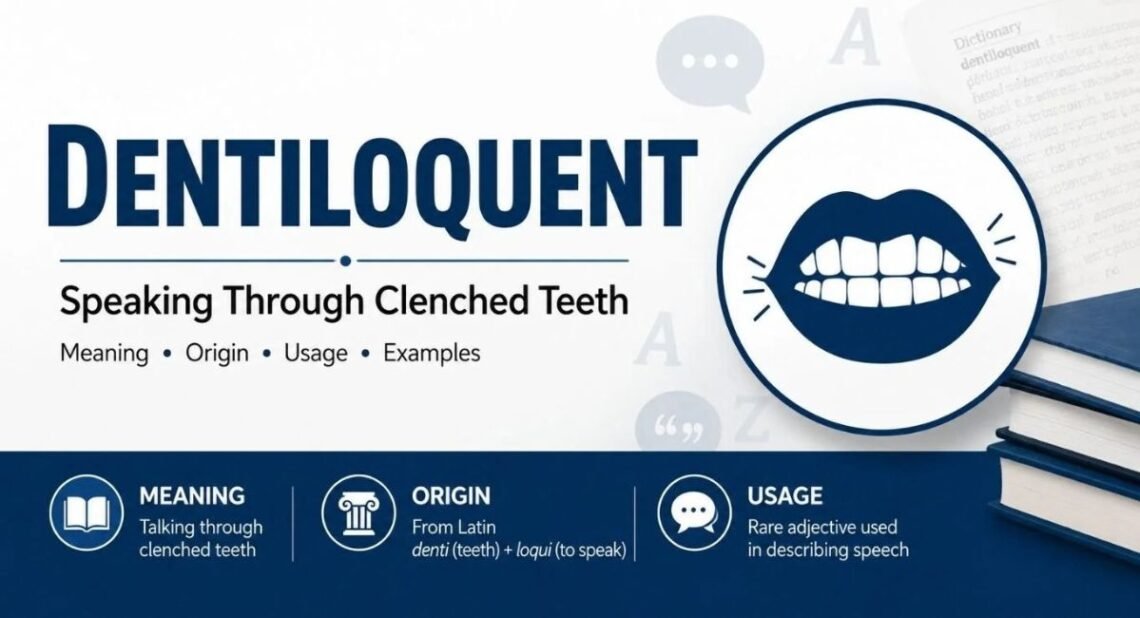
Dentiloquent is a rare and unusual English word that describes a particular way of speaking through the teeth. Because the word is not commonly used in everyday conversation, many people who encounter it for the first time wonder what dentiloquent means, whether it is a real word, how it is pronounced, where it came from, and how it should be used in a sentence.
In simple English, dentiloquent means speaking through the teeth or speaking while the teeth are held closely together. The word mainly describes the physical manner in which speech is produced. Depending on the situation, dentiloquent speech may sound tight, restrained, compressed, muffled, tense, or controlled.
The word is especially interesting because it combines ideas associated with teeth and speech. It can be useful in descriptive writing when a writer wants to explain how a character speaks without using a longer phrase such as “speaking through clenched teeth.”
Although dentiloquent is a documented term, it is extremely uncommon in modern everyday English. Most people would naturally say “speaking through clenched teeth” or “talking through the teeth” instead.
This complete guide explains the dentiloquent meaning, definition, origin, pronunciation, examples, related words, differences from similar speech terms, and the correct ways to use it.
What Does Dentiloquent Mean?
Dentiloquent means speaking through the teeth. More specifically, it describes speech produced while the teeth are held relatively close together or the mouth and jaw are more restricted than they normally are during relaxed speech.
Imagine someone saying a sentence without opening their mouth fully. Their words may still be understandable, but the sound can feel different because the jaw is not moving freely. That physical manner of speaking can be described as dentiloquent.
The central meaning is about how someone speaks, not necessarily about what they are saying or why they are saying it.
For example, a person might speak through their teeth because they are:
- Trying to control their emotions
- Speaking while physically uncomfortable
- Keeping their jaw tight
- Trying not to raise their voice
- Acting in a dramatic scene
- Deliberately using a restrained speaking style
- Speaking while their teeth remain closed or nearly closed
However, the word itself does not automatically mean anger, frustration, aggression, or hostility. Those meanings may come from the context.
A dentiloquent response in a tense argument may suggest suppressed anger, while the same type of speech in a theatrical performance may simply be an intentional acting technique.
Dentiloquent in Simple English
If you want the easiest definition, remember this:
Dentiloquent = speaking through the teeth.
Another simple explanation is:
Dentiloquent describes speech made while the teeth are held together or close together.
This makes the word much easier to understand than its unusual spelling might suggest.
Dentiloquent Definition
A concise dentiloquent definition is:
Dentiloquent is an adjective describing speech produced through or between closely held teeth.
The word focuses on the physical manner of speaking. It does not necessarily describe the speaker’s personality, emotional condition, intelligence, confidence, or communication ability.
For example, if someone says, “He gave a dentiloquent reply,” the adjective suggests something about the way the reply was delivered. The speaker may have kept the jaw tight or spoken through the teeth.
The definition becomes clearer when compared with the ordinary phrase “speaking through clenched teeth.” That familiar phrase communicates essentially the same basic idea in language that most readers immediately understand.
Dentiloquent is simply a much rarer and more compact vocabulary choice.
What Is Dentiloquent in Everyday Language?
In everyday language, dentiloquent can be understood as talking through the teeth.
Most people do not use this word during ordinary conversations. Instead, they might say:
- “She spoke through clenched teeth.”
- “He talked without opening his mouth much.”
- “She answered through her teeth.”
- “He spoke with his jaw tightly closed.”
These expressions are more familiar and easier for a general audience.
Dentiloquent becomes useful when discussing unusual vocabulary, literary descriptions, historical language, character dialogue, or situations where a precise single-word adjective is desirable.
For example:
His dentiloquent reply made the tension in the room obvious.
The sentence suggests that his reply was delivered through a restricted mouth or jaw position.
Where Does the Word Dentiloquent Come From?
Dentiloquent has a classical word structure associated with Latin roots relating to teeth and speaking.
The beginning of the word is connected with the Latin dens, whose forms relate to the idea of a tooth. This same linguistic family appears in familiar English words such as:
- Dental
- Dentist
- Dentition
- Denture
- Dentin
- Dentifrice
The second part is connected with the Latin verb loqui, meaning “to speak.”
The same speech-related root can be recognized in several English words, including:
- Eloquent
- Loquacious
- Colloquy
- Soliloquy
- Grandiloquent
- Magniloquent
- Locution
When these ideas are combined, the structure of dentiloquent points toward teeth plus speaking.
That construction helps explain why the word has its particular meaning.
The Latin Roots Behind Dentiloquent
Understanding the roots is one of the easiest ways to remember dentiloquent.
Denti and Teeth
The “dent” or “denti” element relates to teeth. You already see the same root in common words such as dental and dentist.
When you see “dent” in a word, thinking about teeth can provide an immediate clue.
Loquent and Speaking
The second part relates to the Latin loqui, meaning to speak.
Words such as eloquent and loquacious demonstrate how this old speech-related root continues to appear in English.
Therefore, dentiloquent can be remembered as a word built around the idea of teeth and speech.
This does not mean that every word containing a similar sequence has exactly the same meaning. It simply provides a useful linguistic clue for understanding an unfamiliar word.
Is Dentiloquent a Real Word?
Yes, dentiloquent is a documented English lexical form, but it is extremely rare.
This distinction is important.
Calling dentiloquent a completely invented internet word would be misleading. At the same time, describing it as a common modern English word would also be inaccurate.
The term has historical documentation associated with older English vocabulary. It also appears in modern dictionary-related records with the meaning of talking through one’s teeth.
Its rarity means that many English speakers will never encounter it during ordinary conversation.
This is why people searching for dentiloquent may initially wonder whether they have discovered a typo, an obscure technical term, or a newly created internet expression.
It is better described as rare, unusual, and historically documented vocabulary.
Why Is Dentiloquent So Rare?
The main reason for the rarity of dentiloquent is practical.
English speakers already have simple phrases that communicate the same idea. “Speaking through clenched teeth” is immediately understandable, while dentiloquent requires many readers to look up its meaning.
Languages often contain words for highly specific actions that never become common vocabulary. A word can exist and have a recognizable definition without becoming part of normal daily speech.
Dentiloquent is a good example.
Most people do not need a special adjective every day to describe someone speaking through their teeth. As a result, the simpler phrase usually wins in ordinary communication.
Rare words can still survive because they may be useful to writers, language enthusiasts, editors, researchers, readers of older texts, and people interested in unusual vocabulary.
What Does Dentiloquent Speech Sound Like?
Dentiloquent speech does not have one single sound that every speaker produces.
The exact sound can vary depending on how tightly the teeth are held, how much the jaw moves, the position of the tongue, the movement of the lips, airflow, voice level, and the speaker’s natural speech pattern.
When someone talks through tightly held teeth, their speech may sound:
- Tight
- Restricted
- Compressed
- Slightly muffled
- Controlled
- Clipped
- Tense
- Quieter than normal
- Less open than relaxed speech
Not every dentiloquent utterance will have all of these characteristics.
The important point is that the mouth and jaw position can influence the way speech sounds.
Does Dentiloquent Always Mean Angry?
No.
This is one of the most important distinctions to understand.
Speaking through clenched teeth is often associated with anger in movies, novels, and everyday descriptions. A character may smile while secretly feeling angry and then speak through tightly held teeth.
However, dentiloquent itself does not automatically mean angry.
The word primarily describes a physical manner of speaking.
For example:
The actor delivered the line in a dentiloquent voice.
The character could be angry, frightened, determined, nervous, or simply performing a particular style. The surrounding context determines the emotional interpretation.
A writer should therefore avoid treating dentiloquent as a direct synonym for anger.
Can Dentiloquent Suggest Tension or Frustration?
Yes, depending on context.
If someone keeps their jaw tight while speaking, listeners may interpret the behavior as a sign of tension or emotional restraint.
This is particularly common in descriptive writing.
For example:
She answered in a dentiloquent tone, carefully controlling every word.
Here, the word works together with the surrounding description to create an impression of restraint.
Another example:
His dentiloquent warning sounded controlled but unmistakably tense.
The word describes the physical manner of speaking, while “tense” communicates the emotional atmosphere.
This distinction makes the writing more accurate.
Dentiloquent vs Speaking Through Clenched Teeth
These expressions are closely related, but they are not equally common.
Speaking through clenched teeth is an ordinary English phrase that almost everyone can understand.
Dentiloquent is a rare adjective that expresses the same central concept more compactly.
Compare:
She answered while speaking through clenched teeth.
and:
She gave a dentiloquent answer.
The first sentence is clearer for a general audience. The second uses a rare vocabulary term and may be more suitable for literary or language-focused writing.
When writing for broad audiences, clarity should usually come before unusual vocabulary.
Dentiloquent vs Mumbling
Dentiloquent and mumbling are not the same thing.
Mumbling generally means speaking in a quiet, unclear, indistinct, or poorly articulated way.
A person can mumble without clenching their teeth.
Dentiloquent, on the other hand, focuses on speech produced through the teeth or with the teeth held relatively closed.
For example:
He mumbled an answer because he was tired.
This does not necessarily involve speaking through the teeth.
By contrast:
He answered dentiloquently, keeping his jaw tightly closed.
The second sentence emphasizes the physical manner of speech.
The difference can be summarized simply:
Mumbling concerns unclear or indistinct speech. Dentiloquent concerns speaking through the teeth.
Dentiloquent vs Muttering
Muttering is another related but different word.
To mutter usually means to speak quietly, often in a low voice that may be difficult to understand. A person may mutter to themselves or speak in a dissatisfied way.
Dentiloquent does not primarily describe volume or whether the person is talking to themselves.
It describes the physical manner of producing speech.
Someone could therefore mutter without being dentiloquent, or speak dentiloquently without muttering.
Dentiloquent vs Eloquent
Dentiloquent is sometimes confused with eloquent because the two words look similar.
Their meanings are completely different.
Eloquent describes speech or writing that expresses ideas effectively, clearly, or persuasively.
Dentiloquent describes a physical manner of speaking through the teeth.
For example:
She gave an eloquent presentation.
This means her presentation was effective and expressive.
She gave a dentiloquent reply.
This suggests something about how she physically delivered the reply.
A person could theoretically be eloquent and dentiloquent at the same time, because one word describes the quality of expression while the other describes the manner of speaking.
Dentiloquent vs Loquacious
Loquacious means very talkative or inclined to talk a lot.
Dentiloquent has nothing to do with how much someone talks.
A person could be:
- Loquacious but not dentiloquent
- Dentiloquent but not loquacious
- Both
- Neither
The similarity between the words comes from their historical connection with speech-related language roots, not from having the same meaning.
Is Dentiloquent a Medical Term?
Dentiloquent should not be treated as the name of a medical condition simply because it sounds technical.
The word is primarily descriptive vocabulary.
It does not by itself diagnose a dental condition, jaw disorder, speech disorder, neurological condition, or psychological problem.
Someone may speak through their teeth temporarily because of emotion, discomfort, habit, performance, or a particular situation. That does not automatically indicate a health problem.
If a person experiences persistent changes in speech, jaw pain, difficulty moving the mouth, or other concerning symptoms, those issues should be evaluated using appropriate medical or dental terminology rather than assuming that the word dentiloquent explains the cause.
Is Dentiloquent a Speech Disorder?
No. Dentiloquent is best understood as a descriptive adjective rather than the standard name of a speech disorder.
Speech and language professionals use specific terminology to describe problems involving articulation, fluency, voice, resonance, language, or motor control.
Simply speaking through the teeth does not establish that someone has a disorder.
This distinction is especially important because rare vocabulary words can sometimes sound more technical than they really are.
How Is Dentiloquent Used in Writing?
Dentiloquent can be useful in writing when the physical manner of speech matters.
It can describe:
- A voice
- A reply
- A warning
- A statement
- A delivery
- A tone
- A character
- A line of dialogue
- A speaking style
For example:
The detective gave a dentiloquent response and refused to explain further.
Or:
Her dentiloquent warning was quiet but firm.
Or:
The actor adopted a dentiloquent delivery to portray the character’s restraint.
The surrounding sentence should provide enough context for readers who have never encountered the word before.
Dentiloquent Example Sentences
Here are several natural examples showing how the word can be used.
Example 1
He delivered a dentiloquent reply while keeping his jaw tightly closed.
This makes the physical meaning obvious.
Example 2
Her dentiloquent tone suggested that she was trying to remain calm.
The context provides the emotional interpretation.
Example 3
The actor used a dentiloquent delivery during the most tense scene.
Here, the word describes a performance choice.
Example 4
His dentiloquent warning sounded controlled rather than loud.
This demonstrates that the speech does not have to be shouted.
Example 5
She answered in a dentiloquent voice, barely opening her mouth.
This is another clear example of the physical meaning.
Example 6
The character’s dentiloquent speech added tension to the conversation.
The word works well in literary and character descriptions.
Example 7
He gave a short dentiloquent response and walked away.
This sentence shows how the word can modify “response.”
Example 8
The director asked the actor to make the final line more restrained and dentiloquent.
This demonstrates a possible use in performance or creative writing.
Dentiloquent as an Adjective
Dentiloquent is an adjective.
That means it is generally used to describe a noun.
For example:
- Dentiloquent speech
- Dentiloquent voice
- Dentiloquent tone
- Dentiloquent reply
- Dentiloquent warning
- Dentiloquent delivery
- Dentiloquent expression
- Dentiloquent character
Using the word as an adjective helps readers understand exactly what aspect of communication is being described.
For example, “dentiloquent speech” is more immediately understandable than using the word without context.
What Is the Related Word Dentiloquy?
A closely related word is dentiloquy.
Dentiloquy is a noun referring to the act or practice of speaking through the teeth or with the teeth closed.
This gives us a useful distinction:
Dentiloquent describes something associated with speaking through the teeth.
Dentiloquy refers to the act or practice itself.
This relationship is similar to other adjective and noun pairs in English, although the words are extremely uncommon.
Understanding dentiloquy can make the meaning of dentiloquent easier to remember.
What Is a Dentiloquist?
The related form dentiloquist can refer to a person who speaks through the teeth.
This form is also rare and is unlikely to appear in ordinary modern conversation.
The word family can therefore be understood conceptually as:
- Dentiloquent: describing speech through the teeth
- Dentiloquy: the act or practice of speaking through the teeth
- Dentiloquist: a person associated with speaking through the teeth
These terms are interesting examples of how English can create different grammatical forms from a shared linguistic idea.
Why Is Dentiloquent Interesting for Vocabulary Lovers?
Dentiloquent is interesting because it gives a single word to an action that most people normally describe with a phrase.
Instead of saying “speaking while keeping the teeth tightly closed,” a writer can use a compact adjective.
Rare words like this also demonstrate the enormous size and historical depth of the English vocabulary.
English contains thousands of words that are technically documented but rarely used in everyday communication. Some survive in literature, historical dictionaries, specialist writing, or vocabulary collections.
Dentiloquent belongs to this fascinating category of uncommon language.
Dentiloquent and Creative Writing
Creative writers can use dentiloquent to make dialogue more visually descriptive.
Consider a basic sentence:
“Leave me alone,” he said.
Now consider:
“Leave me alone,” he replied in a dentiloquent voice, his jaw barely moving.
The second sentence gives the reader a stronger physical image.
The word can help writers communicate tension without directly saying that a character is angry.
For example:
She smiled politely and answered in a dentiloquent whisper.
The combination of the physical speech description and the surrounding context allows readers to infer that something is being held back.
This is one reason unusual descriptive vocabulary can be valuable in fiction when used carefully.
Read more: Xavier Alexander Wahlberg: Life, Family, Music Career, and Everything You Should Know
When Should You Avoid Using Dentiloquent?
Because the word is rare, it should not be inserted simply to make writing sound sophisticated.
If your audience may not know the word, an ordinary phrase may communicate the idea more effectively.
For example, a news article or general information page might be clearer with:
He spoke through clenched teeth.
Instead of:
He was dentiloquent.
The second sentence may force readers to stop and search for the definition.
Rare vocabulary is most useful when it adds genuine precision or when the topic itself concerns language.
Is Dentiloquent Positive or Negative?
Dentiloquent does not have a fixed positive or negative meaning.
The emotional impression depends on context.
In a dramatic argument, dentiloquent speech might suggest:
- Anger
- Restraint
- Frustration
- Pressure
- Threat
- Determination
In a performance, it could simply describe a deliberate vocal technique.
In a neutral linguistic discussion, it may have no emotional implication at all.
Therefore, it is more accurate to call dentiloquent a descriptive term rather than a positive or negative word.
Why Does Context Matter So Much With Dentiloquent?
The physical act of speaking through the teeth can occur for many reasons.
A character might be angry and trying not to shout.
Another person might have a tense jaw.
An actor might deliberately create a restricted voice.
A person might simply be speaking with limited mouth movement.
The word itself does not tell the reader which explanation is correct.
Good writing should therefore combine dentiloquent with enough context to make the intended meaning clear.
For example:
He spoke in a dentiloquent tone, clearly trying to keep his anger under control.
Here, the word describes the speech while the second part explains the emotional context.
What Does Dentiloquent Tell Us About Speech?
Speech is produced through the coordinated movement of several parts of the vocal system, including the tongue, lips, jaw, teeth, and other structures involved in shaping sound.
Changing the position or movement of these structures can affect how speech sounds.
When the mouth is held in a restricted position, speech may feel different from relaxed speech. Words may sound more compressed or controlled, and certain sounds may become more noticeable.
Dentiloquent is therefore an interesting descriptive term because it connects a physical feature of speech with the way that speech is perceived.
It does not, however, provide a scientific measurement or diagnosis.
Dentiloquent and Normal Dental Sounds
The fact that teeth are involved in ordinary speech does not make every speaker dentiloquent.
Many normal speech sounds involve the teeth, tongue, lips, or areas near the teeth.
For example, English contains sounds that require specific positioning of the tongue or lips relative to the teeth.
That normal articulation should not automatically be called dentiloquent.
The important distinction is that dentiloquent describes a broader manner of speaking through or with closely held teeth, rather than simply naming one sound produced near the teeth.
Why People Search for Dentiloquent
People may search for dentiloquent for several reasons.
They may have encountered the word in:
- A vocabulary list
- A book
- A historical text
- A writing exercise
- A word puzzle
- A social media post
- An online article
- A dictionary-related search
- Creative writing
- A language discussion
Because the term is so unusual, searchers often want more than a one-line definition.
They may also want to know whether dentiloquent is real, its pronunciation, origin, synonyms, example sentences, and how it differs from similar words.
That is why understanding the full word family and usage context is useful.
A Quick Way to Remember Dentiloquent
The easiest memory trick is:
Denti = teeth
Loquent = speaking
Put the ideas together:
Dentiloquent = speaking through the teeth.
You can also connect the beginning to familiar words such as dental and dentist.
For the second part, think about eloquent and loquacious, which are also associated with speech or speaking.
This simple association makes the unusual spelling much easier to remember.
Frequently Asked Questions About Dentiloquent
What is the meaning of dentiloquent?
Dentiloquent means speaking through the teeth or speaking while the teeth are held relatively close together. It is a rare adjective that describes the physical manner of speech.
What is dentiloquent in simple words?
In simple words, dentiloquent means talking through your teeth.
Is dentiloquent a real English word?
Yes. Dentiloquent is a documented but very rare English word. It should not be treated as a common everyday expression.
Is dentiloquent the same as speaking through clenched teeth?
They express closely related ideas. “Speaking through clenched teeth” is the familiar phrase, while dentiloquent is the rare single-word adjective.
Does dentiloquent mean angry?
Not necessarily. Dentiloquent describes a physical manner of speaking. Anger, frustration, or tension may be suggested by the context but are not required by the basic definition.
Is dentiloquent a medical condition?
No. Dentiloquent is a descriptive vocabulary term, not a standard medical diagnosis.
Is dentiloquent the same as mumbling?
No. Mumbling generally refers to quiet or unclear speech. Dentiloquent focuses on speaking through the teeth or with the teeth held closely together.
Is dentiloquent the opposite of eloquent?
No. Eloquent and dentiloquent describe different things. Eloquent refers to effective or persuasive expression, while dentiloquent refers to the physical manner of speaking through the teeth.
What is dentiloquy?
Dentiloquy is the noun related to dentiloquent. It refers to the act or practice of speaking through the teeth or with the teeth closed.
What is a dentiloquist?
Dentiloquist is a rare related term for a person who speaks through the teeth.
Can dentiloquent be used in creative writing?
Yes. It can be useful when describing a character’s voice, reply, tone, warning, or delivery, especially when the physical manner of speaking contributes to the scene.
Why is dentiloquent so uncommon?
Most speakers can simply say “speaking through clenched teeth,” so there is little everyday need for the specialized adjective. Its rarity is part of what makes it interesting as vocabulary.
Does dentiloquent describe the content of speech?
No. It primarily describes the manner in which speech is produced. The content of the speech can be anything.
Can a person be dentiloquent without being angry?
Yes. Anger is not required. A person could speak through the teeth because of restraint, habit, discomfort, performance, or another situation.
Is dentiloquent useful in everyday conversation?
Usually, no. Most people will understand the phrase “speaking through clenched teeth” more easily. Dentiloquent is more appropriate for specialized vocabulary discussions, descriptive writing, or situations where rare words are relevant.
Final Thoughts on Dentiloquent
Dentiloquent is a fascinating example of rare English vocabulary. Its meaning is much simpler than its unusual appearance suggests.
At its core, dentiloquent means speaking through the teeth. It describes the physical manner of producing speech when the teeth are held closely together or the jaw and mouth are more restricted than in normal relaxed speech.
The word has a classical structure connected with ideas of teeth and speaking. Its related form, dentiloquy, refers to the act or practice of speaking through the teeth.
Dentiloquent should not automatically be interpreted as meaning angry, aggressive, unhealthy, or medically abnormal. Those meanings may arise from context, especially when a character speaks through clenched teeth during an emotionally tense situation.
The word is also different from terms such as mumbling, muttering, eloquent, and loquacious. Each describes a different aspect of speech or communication.
For everyday communication, “speaking through clenched teeth” remains much clearer. However, dentiloquent can be a useful and memorable word when discussing unusual vocabulary or creating detailed descriptions in literature and creative writing.
The easiest definition to remember is simple:
Dentiloquent means speaking through the teeth.
Once that meaning is understood, the unusual word becomes much easier to recognize, remember, and use correctly.





One comment on “Dentiloquent: Meaning, Definition, Origin, Pronunciation, Examples, and Usage”